Checkout Counters Using an Omnidirectional Barcode Scanner Process More Transactions With Zero Misreads
Installing an omnidirectional barcode scanner at the checkout counter is a decision most retail operators reach after one uncomfortable calculation. Misread events, cashier intervention time, and average queue duration combine into a number that becomes difficult to ignore once someone runs the arithmetic. The conversation that follows usually starts with speed and ends somewhere closer to reliability.
The Checkout Experiment That Changed Three Store Locations
A supermarket chain across Gurgaon’s Sector 14, Sector 29, and Sushant Lok ran a 45-day internal study across three checkout counters, each handling between 400 and 600 transactions daily. The objective: document every instance where a barcode required more than one scan attempt, and calculate total cashier intervention time per shift.
Misread events averaged 23 per shift per counter. Intervention time per misread averaged 8 seconds. Across three counters over a full operating week, the figure translated to 4.5 hours of cashier time consumed entirely by repeated scan attempts on products already in hand.
The variables behind those events were consistent: damaged labels on FMCG products, curved packaging on beverages and cosmetics, low-contrast codes on reflective surfaces, and QR codes from supplier campaigns that the existing linear scanners could not read. The problem was scan engine capability, not cashier technique.
Why the Scan Engine Determines Everything at the Counter
Retail operators replacing checkout scanners typically evaluate speed, size, and price. What rarely enters the initial conversation is the imaging engine, which determines whether a device reads a barcode from a challenging surface on the first pass or requires repositioning, multiple attempts, and manual entry. That gap between first-pass read rate and fallback intervention is where checkout efficiency holds or collapses under volume.
Delhi NCR’s organized retail sector now includes global FMCG brands alongside domestic SKUs, supplier-labelled B2B stock, and promotional items with QR codes across Noida, Faridabad, and Gurgaon corridors. A scan engine designed only for clean, high-contrast linear barcodes handles a diminishing share of what actually arrives at the counter during a typical shift. This is where commercial-grade presentation imaging becomes operationally meaningful rather than a specification on paper.
What the Zebra DS9308 Omnidirectional Barcode Scanner Does Differently
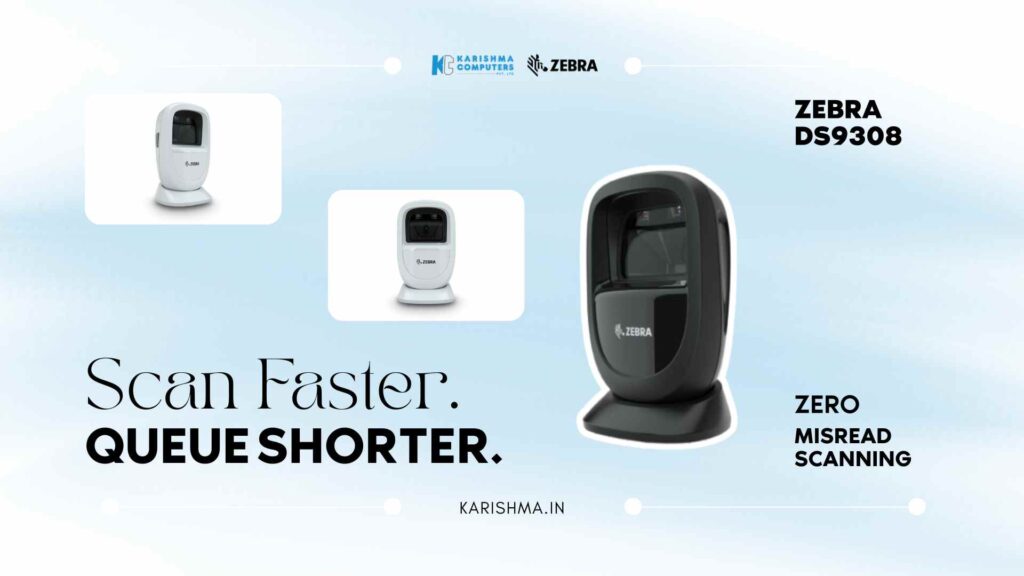
The DS9308 operates on an 800 MHz processor, a 1280×800 megapixel sensor, and PRZM Intelligent Imaging technology developed specifically for high-volume presentation-mode scanning. The combination captures barcodes that flatbed or entry-level imagers routinely misread or reject: poorly printed, faded, crinkled, low-contrast, wrapped in plastic, or displayed on mobile screens.
PRZM reads omnidirectionally. The orientation of the barcode relative to the scanner is irrelevant. Cashiers do not position products. Products move through the field of view and the scanner captures them. The field of view is the largest in the DS9308’s class, eliminating the sweet spot problem where products must be positioned precisely within a narrow reading zone.
Swipe speed runs up to 50% faster than competing scanners in the same category, reaching 120 inches per second. For the Gurgaon chain, the first-pass read rate on the categories driving their misread events improved from the first week. The 45-day intervention count dropped to under 4 events per counter per shift within two weeks of deployment.
PRZM Intelligent Imaging and What It Prevents in Practice
Most scanner specifications list symbologies supported. What they do not quantify is performance degradation under real conditions. A label printed cleanly in a warehouse scans consistently. The same label after three weeks in transit, exposed to moisture and handling, challenges the scan engine differently.
PRZM decode algorithms compensate for real-world label deterioration. Damaged portions that cause misreads on standard imagers are reconstructed before decode is attempted. For pharmacy counters in Noida handling pharmaceutical packaging, where label integrity connects directly to dispensing accuracy, that capability is a compliance requirement, not a convenience feature.
Durability Built for the Retail Floor, Not the Laboratory
The DS9308 is IP52 sealed against spills and dust, practical at any food retail counter where liquids are constant. It withstands 5-foot drops to concrete and 1,000 consecutive tumbles. The ratcheting base adjusts to multiple angles without mechanical wear, and the concealed beeper hole with elevated circuitry prevents liquid ingress internally. Backward compatibility with DS9208 cables and power supplies means Zebra users upgrading from the previous generation avoid infrastructure replacement costs entirely.
The plug-and-play auto-host detect cable identifies the interface and configures the scanner without technical setup. Zebra’s 123Scan tool handles parameter customization without specialized knowledge. Remote management through Scanner Management Service provides centralized visibility and configuration across a full scanner fleet from one dashboard. For retail operators managing scanners across 10 or more Delhi NCR locations, that control eliminates individual device visits for updates and setting changes.
Selecting an omnidirectional barcode scanner requires matching device specifications to the actual barcode mix arriving at the counter, not the ideal mix assumed during procurement. The DS9308 is built for the real mix, which is rarely as clean as the specification sheet suggests.
The Omnidirectional Barcode Scanner Built for Every Retail Format
The DS9308 operates as an omnidirectional barcode scanner in traditional checkout lanes, self-service kiosk configurations, and service counter applications equally well. Driver’s license parsing adds age verification and loyalty program auto-fill. Intelligent Document Capture converts prescriptions, checks, and IDs up to A6 size into corrected digital images without additional equipment. The device reads QR codes, Data Matrix, PDF417, and all major 2D symbologies alongside the complete 1D range, including codes on mobile screens.
For retail environments integrating loyalty app scanning, digital coupon redemption, and mobile payment verification, that multi-symbology capability consolidates what previously required separate devices into a single counter unit.
What the Gurgaon Chain Measured After Sixty Days
Sixty days after deploying the DS9308 across all three locations, the supermarket chain ran the same tracking study. Misread events dropped from 23 per counter per shift to under 4, an 83% reduction. Cashier intervention time fell proportionally. Average queue time during peak hours decreased measurably across all locations. The damaged label and curved packaging categories that had driven the original misread count produced consistent first-pass reads throughout the follow-up period.
The chain extended deployment to their Faridabad location and ordered three additional units for Gurgaon stores opening in the following quarter. The equipment decision had moved from a checkout efficiency upgrade to a store opening standard.
Which Operations Gain the Most From This Technology
High-transaction retail environments represent the most direct use case: supermarkets, hypermarkets, pharmacy chains, and quick-service restaurants where checkout speed and accuracy determine customer experience at peak hours. Hospitality operators at hotel reception and restaurant counters benefit from hands-free configuration and multi-symbology coverage across loyalty cards, booking QR codes, and identification documents. Warehousing operations in Noida’s industrial sectors use the DS9308’s PRZM engine for receiving verification where inbound labels have experienced transit damage.
The common thread is volume under real-world conditions. The omnidirectional barcode scanner earns its value not during smooth, controlled scanning, but during the moments when labels are imperfect, lighting is variable, and transaction pace does not allow repositioning or retry attempts.
Karishma Computers and the Zebra DS9308 Across Delhi NCR
Zebra Technologies has built commercial-grade scanning hardware for enterprise retail and logistics across more than four decades. The DS9308 carries that heritage into a counter-optimized form factor that handles the full barcode complexity of contemporary retail without operational compromise.
Karishma Computers supplies and supports the Zebra DS9308 omnidirectional barcode scanner across Delhi, Gurgaon, Noida, Faridabad, and the broader NCR region. For retail and operations teams evaluating checkout performance and first-pass read reliability, the DS9308 addresses the scan engine gap that standard presentation scanners leave open.
The Gurgaon supermarket chain no longer tracks misread events as a management metric. The number became too low to be meaningful. Sometimes the most consequential change at a checkout counter is the device that sits on it.
FAQs
-
What is PRZM Intelligent Imaging and how does it improve barcode scanning?
PRZM (Presentation Zebra Imaging) uses decode algorithms that reconstruct damaged portions of barcodes before attempting to read them. It captures poorly printed, faded, crinkled, low-contrast, and plastic-wrapped barcodes that standard imagers reject, improving first-pass read rates significantly.
-
Can the Zebra DS9308 scan barcodes from any angle?
Yes. The DS9308 reads omnidirectionally, meaning barcode orientation relative to the scanner is irrelevant. The largest field of view in its class eliminates the “sweet spot” problem where products must be positioned precisely within a narrow reading zone.
-
How durable is the DS9308 for high-volume retail checkout environments?
The DS9308 is IP52 sealed against spills and dust, withstands 5-foot drops to concrete, and survives 1,000 consecutive tumbles. The ratcheting base adjusts angles without mechanical wear, and elevated circuitry with a concealed beeper hole prevents liquid ingress damage.
-
What symbologies can the Zebra DS9308 scan?
The DS9308 reads all major 1D and 2D barcodes including QR codes, Data Matrix, PDF417, and codes displayed on mobile phone screens. It also includes driver’s license parsing for age verification and Intelligent Document Capture for prescriptions, checks, and IDs up to A6 size.