Print shop dependency determines an affordable color printer shifts from optional equipment to financial necessity when freelancers and startups calculate monthly outsourcing costs. Client proposals, marketing materials, presentation decks, and invoice documentation accumulate into recurring expenses that small businesses absorb without measuring the cumulative impact. The pattern surfaces consistently across Delhi NCR’s home office and startup sectors: color printing becomes an invisible overhead that compounds monthly until someone runs the calculation.
When the Print Shop Spreadsheet Changes Equipment Priorities
A graphic designer operating from Sector 62, Noida, maintained detailed expense tracking across six months of freelance operation. Every client presentation, every pitch deck, every marketing sample required color printing. The nearest print shop charged ₹12 per color page for standard quality, ₹18 for premium output. Monthly volume averaged 280 color pages plus 150 black-and-white documents.
The six-month total revealed ₹23,760 spent entirely on printing services, excluding the time cost of shop visits, file transfers via USB drives, and waiting periods during peak hours. Annualized, the figure projected to ₹47,520 purely for print output. The designer faced a decision point: continue absorbing this recurring expense or investigate in-office printing capability.
Equipment research surfaced a difficult constraint. Traditional color laser printers required upfront investments exceeding ₹25,000, with toner replacement cycles adding ₹8,000-12,000 annually. Cartridge-based inkjet models appeared more affordable initially but revealed per-page costs that approached print shop pricing once cartridge replacement frequency factored into calculations. An affordable color printer needed to eliminate these recurring costs entirely without transferring them to consumable purchases.
What the Epson EcoTank L1250 Affordable Color Printer Delivers for Home Offices
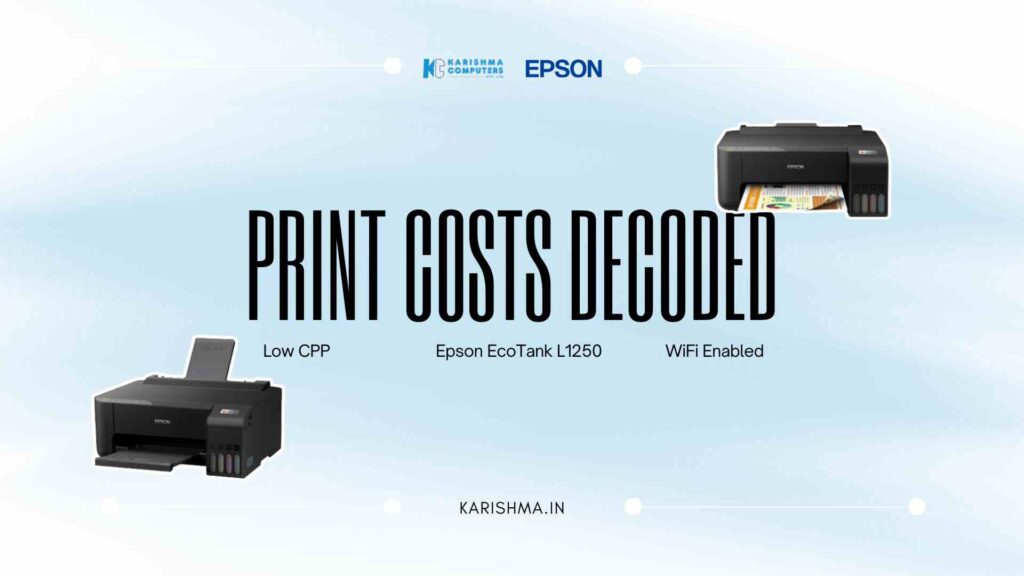
The EcoTank L1250 emerges as an affordable color printer that eliminates cartridges entirely. Integrated ink tanks hold sufficient volume to produce 4,500 black pages and 7,500 color pages from a single refill set. That specification translates differently for home office operations running 200-400 monthly color pages. A freelancer printing 300 color pages monthly exhausts one color refill after approximately 25 months of continuous operation.
Twenty-five months where ink becomes a fixed cost rather than a recurring procurement decision. The initial ink bottles ship with the printer, meaning organizations achieve immediate operational capacity without separate consumable purchases. Subsequent refills cost approximately ₹500 per color bottle, creating a per-page color cost under ₹0.30 compared to ₹12-18 at commercial print shops.
Heat-Free Technology addresses another home office constraint: startup time. The L1250 requires no warm-up period, printing the first page within 10 seconds of job submission. For freelancers managing client calls where immediate document output matters, that elimination of thermal cycling delays removes the planning buffer traditionally required around printing tasks. Print speeds reach 33 pages per minute for black output and 15 ppm for color, handling batch jobs without extended waiting periods.
WiFi connectivity and WiFi Direct support eliminate the physical cable requirement that constrains printer placement in compact home offices. The Epson Smart Panel app enables print job submission directly from mobile devices, converting smartphones and tablets into print control interfaces without desktop computer intermediation. That wireless architecture addresses workspace flexibility for operations where desk configurations change based on project requirements.
The Affordable Color Printer Economics That Change Freelance Budgets
The Noida designer deployed the L1250 and tracked identical metrics across the following six months. Print shop visits dropped to zero for routine client deliverables. Color page production remained consistent at 280 monthly. The six-month printing cost: one initial equipment purchase of ₹10,999 plus negligible electricity consumption. Per-page cost calculated to approximately ₹0.26 for color output when amortizing equipment cost across projected three-year lifespan.
The financial shift eliminated ₹23,760 in semi-annual print shop expenses, recovering the equipment investment within five months of operation. Annualized, the savings projected to ₹1,21,440 over three years when comparing print shop costs against in-office production including equipment depreciation and consumable refills. That calculation excluded time savings from eliminating shop visits, which the designer estimated at 2-3 hours monthly.
The Print Quality Requirement for Client-Facing Work
Home office printing carries different quality thresholds than internal documentation. Client proposals, marketing materials, and portfolio samples represent business credibility. The L1250 addresses this through 5760 x 1440 dpi maximum resolution and Epson’s genuine ink formulation designed for color accuracy on both standard paper and photo media.
Borderless printing capability up to 4R size enables photo output without white margins, supporting creative professionals producing physical portfolio pieces or product photography samples. The 100-sheet paper tray capacity handles batch jobs without constant refilling, while the compact footprint measuring approximately 375mm wide occupies desk space equivalent to a standard keyboard.
A content marketing consultant in Gurgaon’s Sohna Road discovered the quality advantage when submitting printed campaign samples to traditional industry clients who preferred physical review over digital presentations. The ability to produce immediate color proofs during client meetings eliminated the delay between concept discussion and physical sample delivery, shortening approval cycles measurably.
WiFi Setup and Network Infrastructure Requirements
The L1250 requires WiFi network presence for wireless operation. Home offices operating without existing WiFi infrastructure need router deployment before achieving wireless printing capability. WiFi Direct functionality provides an alternative path, allowing direct device-to-printer connection without router intermediation for up to 8 simultaneous devices.
Initial configuration through the Epson Smart Panel app handles network connection and printer registration. The setup process requires smartphone or tablet interaction, as the printer lacks an onboard display panel for manual configuration. Organizations preferring wired connectivity can utilize USB connection as an alternative to wireless operation, though this constrains the printer to fixed desk placement.
Network security considerations matter for home offices handling client data. The printer connects to the existing WiFi network using standard WPA2 encryption, inheriting the security posture of the home network infrastructure. Organizations operating guest WiFi networks separate from primary business networks can assign the printer to either network based on security requirements and user access patterns.
Which Home Office Operations Benefit Most From In-House Color Printing
Freelance designers, consultants, and content creators represent where an affordable color printer shifts economics. Monthly volumes between 150-500 pages create the threshold where print shop costs exceed equipment amortization. Startups in Noida Sector 62, Gurgaon Golf Course Road, and South Delhi’s Hauz Khas benefit from portable wireless printing.
Educational consultants producing student materials, real estate agents printing property brochures, and event planners creating client presentation decks all share similar printing patterns: moderate monthly volume with quality requirements that prevent downgrading to monochrome output. The L1250 addresses this specific intersection of cost sensitivity and quality necessity.
Operations running under 100 monthly color pages might find print shop services more economical when factoring equipment maintenance and space constraints. Conversely, businesses exceeding 800 monthly color pages should evaluate higher-capacity models with faster output speeds and larger paper handling capability. The L1250 optimizes for the middle range where volume justifies equipment investment without demanding enterprise-grade specifications.
Karishma Computers and the Epson EcoTank L1250 Across Delhi NCR
Epson developed ink tank technology over 13 years of iterative refinement, converting the consumable-dependent printer model into a refillable system that eliminates recurring cartridge purchases. The EcoTank L1250 represents this technology deployed in a compact, home-office-optimized form factor designed for operations where desk space and budget both constrain equipment decisions.
Karishma Computers supplies and supports the Epson EcoTank L1250 across Delhi, Gurgaon, Noida, Faridabad, and the broader NCR region. For freelancers and startups evaluating printing costs against monthly operational budgets, the L1250 addresses the recurring expense problem that print shop dependency creates without demanding the upfront investment that laser printers require.
The Noida designer stopped tracking print shop receipts after deploying an affordable color printer at the home office desk. The spreadsheet that triggered the equipment decision now tracks recovered savings rather than accumulated monthly costs. That shift from expense tracking to savings measurement changes more than accounting categories.
FAQs
-
How much does the Epson EcoTank L1250 save compared to print shop costs?
For freelancers printing 280 color pages monthly at ₹12 per page (print shop rate), annual costs reach ₹40,320. The L1250 with ₹0.26 per-page cost reduces this to approximately ₹870 annually plus initial equipment purchase of ₹10,999. Three-year savings project to ₹1,21,440 including equipment depreciation.
-
What is the ink yield of the Epson EcoTank L1250?
The L1250 delivers 4,500 black pages and 7,500 color pages from a single set of ink bottles. For home offices printing 300 color pages monthly, one color refill lasts approximately 25 months. Ink bottles cost approximately ₹500 per color, creating per-page costs under ₹0.30.
-
Does the Epson L1250 require WiFi to operate?
WiFi connectivity is optional. The L1250 supports WiFi for wireless printing, WiFi Direct for router-free connection to up to 8 devices, and USB wired connection as an alternative. WiFi setup requires the Epson Smart Panel app on smartphone or tablet, as the printer lacks an onboard display panel.
-
What print quality does the L1250 deliver for client-facing documents?
The L1250 produces 5760 x 1440 dpi maximum resolution with Epson genuine ink formulation designed for color accuracy. Borderless printing up to 4R size supports photo output without white margins. Heat-Free Technology ensures consistent quality across large batch jobs without thermal degradation.
-
Which businesses benefit most from the Epson EcoTank L1250?
Freelance designers, consultants, content creators, and startups printing 150-500 color pages monthly gain the most direct savings. Educational consultants, real estate agents, and event planners with moderate monthly volumes and quality requirements achieve equipment cost recovery within 5-8 months at typical print shop pricing.