
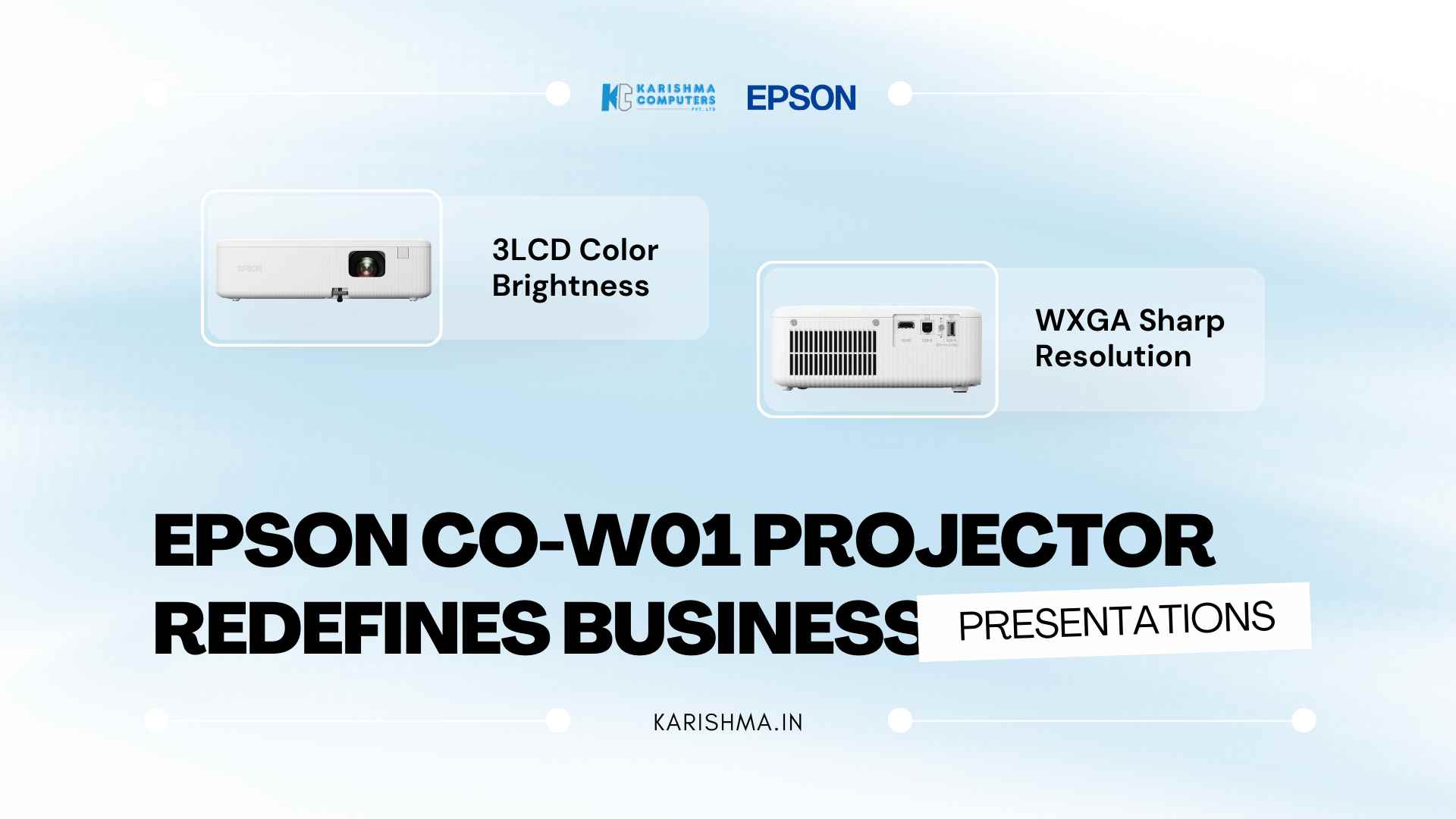
The Epson CO-W01 WXGA Projector and What 3LCD Technology Changes About Business Presentations
The Epson CO-W01 WXGA projector sits in a category that procurement teams often approach as a commodity decision. A projector is a projector. Lumens are lumens. The cheapest unit that throws an acceptable image onto a screen will do. That reasoning holds until a client presentation goes wrong because the colours on screen look nothing like what was prepared. Or until a quarterly business review runs with slides so washed out in the ambient light of a Gurgaon conference room that the numbers are barely legible from the back row. At that point, the projector becomes visible as a business decision rather than a purchasing footnote. The CO-W01’s 3LCD technology is the reason this distinction matters, and understanding it requires stepping back from the lumens number printed on the specification sheet. Why the Specification Sheet Misleads on Projectors Two projectors can share the same white brightness rating and produce significantly different images. The gap comes from colour light output, which single-chip DLP projectors routinely underperform on relative to their white brightness rating. A projector advertising 3,000 lumens may deliver considerably less than that in colour brightness, because the colour wheel technology at the heart of most entry-level projectors allocates white light efficiently but colour light unevenly. 3LCD technology, which Epson has developed and refined across more than 40 years of projection innovation, uses three separate liquid crystal display panels, one each for red, green, and blue light. All three panels work simultaneously. The result is that colour light output equals white light output. What is rated at 3,000 lumens produces 3,000 lumens of colour brightness, not a fraction of it. For business presentations, where charts use colour to carry meaning, where brand colours must appear consistent, and where data visualisations rely on contrast to communicate hierarchy, this technical distinction has a direct practical consequence. The Epson CO-W01 WXGA Projector in Delhi NCR’s Business Environment Conference Rooms with Mixed Lighting Conditions Delhi NCR’s commercial office stock includes a wide range of conference room configurations. Glass-walled meeting rooms in Cyber Hub Gurgaon admit significant daylight. Older commercial buildings in Okhla and Saket have mixed fluorescent and natural light that varies by time of day. Training rooms in IT parks across Noida Sector 62 and Sector 125 operate under consistent artificial lighting but at higher ambient levels than a dedicated auditorium. In these conditions, 3,000 lumens of full colour output is meaningfully different from 3,000 lumens of white brightness with diminished colour performance. Presentations in rooms that cannot be fully darkened depend on colour brightness, not white brightness, to remain legible. The CO-W01’s 3LCD architecture delivers consistent colour output across these variable conditions. WXGA Resolution and Modern Content The CO-W01 outputs at WXGA resolution: 1280 by 800 pixels. The 16:10 aspect ratio matches standard laptop display outputs, which eliminates the letterboxing that appears when a widescreen laptop drives a standard 4:3 projector. Business presentations display as prepared, with no content trimmed at the edges or compromised by aspect ratio conversion. For organisations using Microsoft Office or Google Workspace for presentation content, WXGA is the practical native resolution. Upscaling from WXGA to higher resolutions at the display end adds cost without changing the source material quality. The CO-W01 is specified at the resolution that matches the actual content most business teams produce. Epson’s 40-Year Projection Heritage in the CO-W01 Epson’s position in projection technology is not an inherited legacy that has been coasting. The 3LCD manufacturing capability, the optical engineering, and the lamp technology in the CO-W01 represent the current iteration of a development process spanning four decades of continuous innovation. The practical manifestation is component reliability. The CO-W01’s lamp is rated for up to 12,000 hours in ECO mode. At an eight-hour business day, five days a week, that represents more than six years of operation before lamp replacement becomes necessary. For organisations that have previously managed projector costs through frequent lamp replacements, this operational cost reduction is measurable and significant. The 3LCD panels themselves carry no colour wheel, which eliminates the rainbow effect that some viewers perceive on single-chip DLP projectors during fast-moving presentations. In training environments where presentations involve rapid transitions, this visual quality difference affects how the audience experiences the content. Portability and the Multi-Room Reality The CO-W01 weighs approximately 2.4 kilograms. This matters in the operational reality of many mid-size Delhi NCR businesses where a single projector serves multiple rooms, is transported between sites, or moves between training sessions in different locations. A chartered accountancy firm in Nehru Place running client workshops across three floors uses a single CO-W01 that travels with the session facilitator. A consulting firm in Connaught Place carries the unit to client sites for quarterly presentations. In both cases, the compact form factor and the consistent image quality at the destination location are both operationally relevant. Connectivity covers the standard business requirement: HDMI input for modern laptops, VGA for legacy equipment that remains common in institutional environments across Delhi NCR’s education and government sectors. The transition between input sources handles without specialist IT involvement. Where the CO-W01 Sits in the Procurement Decision The CO-W01 is not positioned as an entry-level commodity projector, and understanding where it fits requires being precise about the use cases it serves well. For large auditorium projection requirements, rooms exceeding 15 metres in throw distance, or installations requiring 5,000 lumens and above for high-ambient-light environments, the CO-W01 is undersized. These scenarios require projectors from higher specification tiers. For conference rooms seating eight to twenty people, training rooms, and portable applications where the image is projected onto a standard screen in controlled ambient conditions, the CO-W01’s 3,000 lumens of full colour output, WXGA resolution, and 3LCD colour consistency deliver above what the price bracket typically produces. The procurement question to examine honestly is whether the meeting rooms where the projector will be installed actually require higher specifications, or whether the specification upgrade is being purchased for situations that rarely arise in practice. The CO-W01 is sized for the application most Delhi