
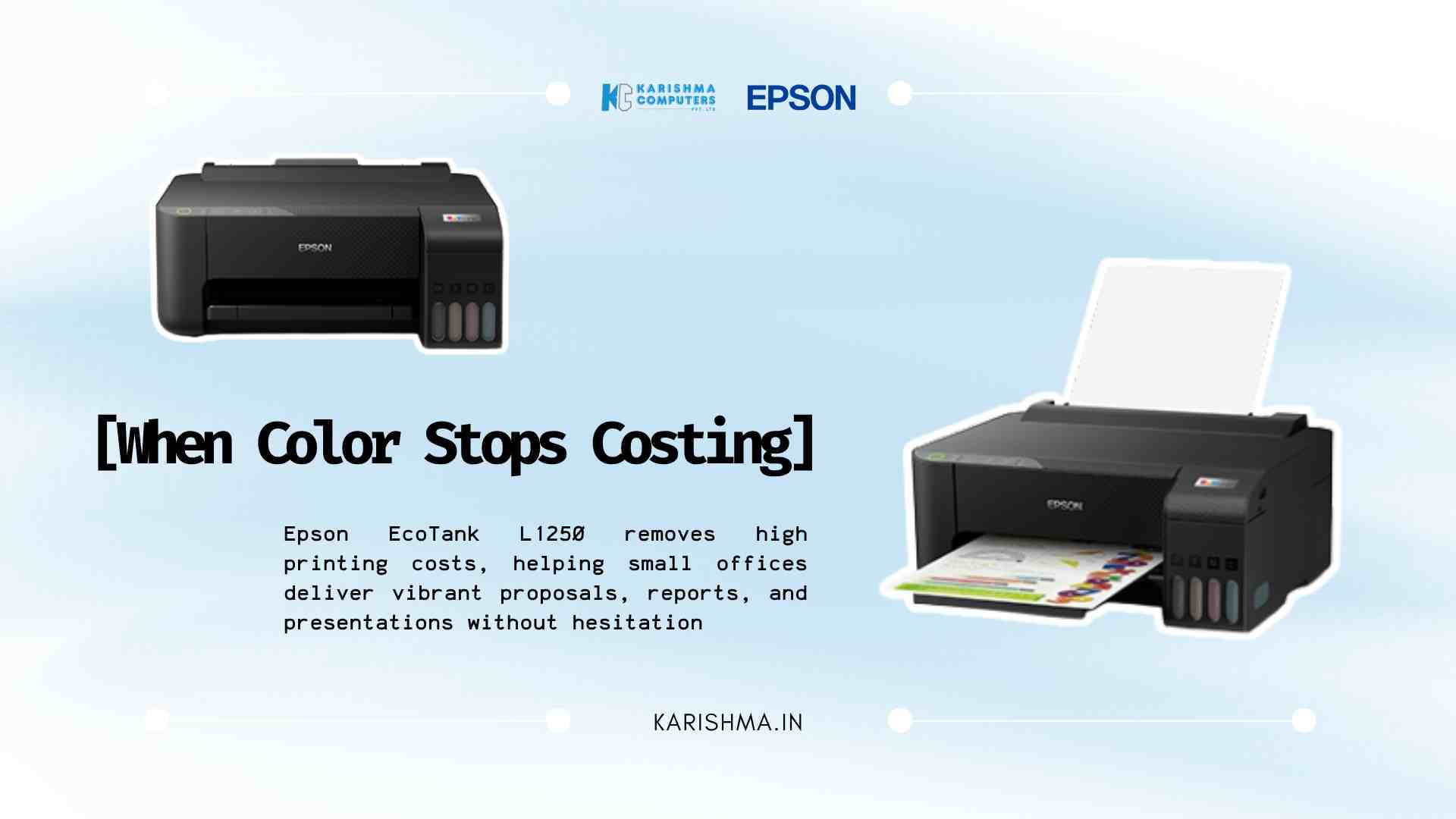
The Color That Stayed in Draft: Epson EcoTank L1250 Removes the Cost Barrier for Small Offices
Businesses rarely frame the Epson EcoTank L1250 as a quality decision. The cost argument is more immediate and easier to calculate. But cost and quality are not separate variables in this case. The printer changes what small offices can afford to send to clients, and that changes how those clients receive the work. The Proposal That Went Out in Black and White A two-person interior design consultancy operating out of Okhla Industrial Area had been preparing client proposals for three years. Their briefs were thorough. The sourcing was detailed. Material selections had been researched carefully and documented with specific product references, supplier contacts, and cost breakdowns. Every proposal went out as a black and white printout. Color printing from their cartridge-based inkjet cost approximately Rs 9 to Rs 12 per color page. A twelve-page proposal featuring mood boards, material swatches, and room layout previews — printed across three or four client revision rounds — added up to a figure that felt disproportionate for a business operating on project-by-project margins. So color stayed in the digital file. The printed version clients received told half the story. This pattern repeats across a wide range of small professional services businesses in Delhi NCR. Design consultancies, boutique marketing agencies, small architectural firms, chartered accountants producing branded client reports, independent financial advisors preparing illustrated portfolio summaries. The businesses that most benefit from color output are frequently the ones who stopped producing it, because cartridge economics made every color page feel like an expenditure that needed justification. The unspoken calculation: keep color for the most critical documents, print everything else in black and white, and accept the quality difference as a permanent feature of operating at this scale. The assumption behind that calculation is that color printing at small business volumes will always carry a premium that larger operations can absorb more easily. What the Epson EcoTank L1250 Changes About That Assumption The Epson EcoTank L1250 replaces cartridge economics with ink bottle economics, and the difference is substantial enough to retire that assumption entirely. A single set of EcoTank ink bottles delivers approximately 7,500 color pages. For a two-person consultancy printing forty to sixty color pages per project across ten monthly projects — roughly 400 to 600 color pages — a single refill set lasts well over a year. The per-page cost drops from the Rs 9-12 range of cartridge-based color output to a fraction of that figure. The immediate behavioral effect is that color stops being rationed. Design proposals go out with color mood boards included. Client reports arrive with branded headings and highlighted data sections. Presentations print in the colors they were designed in, rather than the greyscale version prepared specifically because producing the intended version was too expensive to justify for every client. The interior design consultancy in Okhla noticed the change in client response quickly after switching. The proposals looked different. Two clients mentioned the presentation quality in initial meetings. The conversion rate on pitches improved over the following quarter. Attributing that outcome entirely to a printer change would be too simple. But color output on a professionally prepared proposal is not a negligible variable in how that proposal reads to the person receiving it. There is a broader point here that applies beyond design firms. Small businesses frequently underinvest in the physical presentation of their professional materials — not because they don’t understand the value of quality presentation, but because the economics of producing quality printed materials at small volumes genuinely made it difficult to justify. The EcoTank model addresses the economics. The quality question was never really about the business’s standards. Heat-Free Technology: What the Epson EcoTank L1250 Delivers Consistently Epson’s heat-free printing technology removes thermal elements from the print mechanism entirely. For small office users, the practical outcomes matter more than the technical description. A heat-free printer starts immediately, without warm-up delay, regardless of how long it has been idle. A small business that prints intermittently throughout the day — a few pages in the morning, a document batch before a client meeting in the afternoon — gets consistent immediate performance across every print job without waiting. PrecisionCore technology ensures that color accuracy holds across the full run. A twelve-page proposal where the heading color shifts between pages three and seven communicates something unintended about the quality of the work it contains. PrecisionCore eliminates that variation. The first page and the twelfth page match. That consistency is what makes color output professionally viable rather than a risk that needs to be managed through checking and reprinting. Without heating elements to degrade, the printer’s long-term reliability remains consistent with lower maintenance requirements across its working life. In a small office where printer management is part of nobody’s specific job, a device that simply continues operating reliably is not a minor feature. Wireless Connectivity and the Shared Office Workflow The L1250 connects wirelessly to any device on the network, which removes the cable-sharing friction that small teams with a single printer manage constantly. Three team members each access printing from their own workstation without routing jobs through a designated connected machine or managing USB access between different users and devices. Wi-Fi Direct support allows direct device-to-printer connection without requiring a network router as an intermediary, which becomes useful in compact home office setups or during client visits where printing is needed quickly from a visiting device. Mobile printing support covers smartphones and tablets directly. Client documents, quick reference sheets, and confirmed booking records print from mobile devices without laptop involvement. The compact form factor fits the actual desk configurations that small offices and home offices in Gurgaon’s residential sectors, Noida’s mixed-use business areas, and Delhi’s apartment home offices realistically have. The printer fits into the working environment without requiring a dedicated surface or reorganising the existing layout. The Profile This Printer Serves The Epson EcoTank L1250 is a single-function device. It prints. There is no scanning, copying, or fax capability. For professionals who need a separate, reliable print resource —
