
Fujitsu fi 800r Scanner Hospital Records
In short An illustrative look at how the Fujitsu fi-800R scanner can help a hospital or diagnostic records department with mixed-document digitisation.
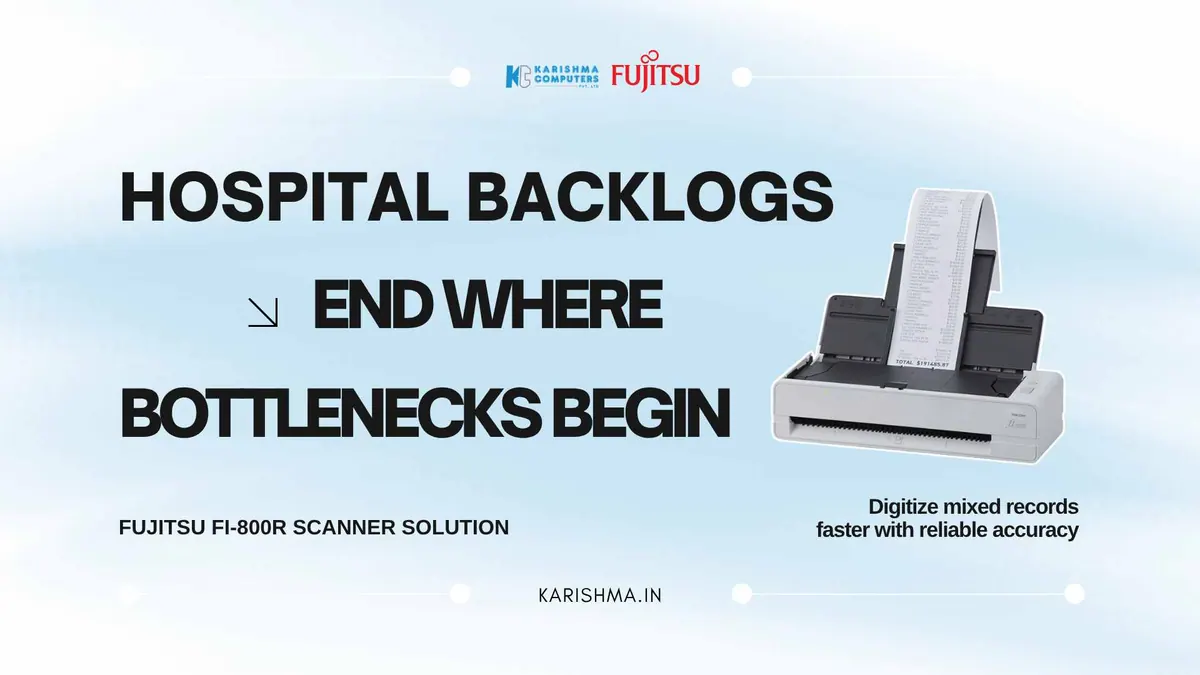
How the Ricoh fi-800R (formerly Fujitsu) Scanner Ends a Bottleneck Hospitals Misdiagnose
The Ricoh fi-800R (formerly Fujitsu) scanner was not in the conversation when a multi-branch diagnostic chain, in this illustrative scenario, spent a long time struggling with a records digitisation backlog that kept growing. The chief operating officer commissioned an external consultant to recommend a fix. The consultant’s recommendation was that the records department needed more staff.
The recommendation was acted on. The new staff joined. The backlog continued to grow.
What Hospitals and Diagnostic Chains Get Wrong About Records Backlogs
A medical records department is a peculiar kind of operation. The documents arriving for digitisation are not uniform. A single patient file might contain referral letters on doctor’s letterhead, prescription printouts, laboratory report sheets in A4 size, ultrasound image printouts, identity card photocopies, insurance authorisation forms in landscape orientation and signed consent documents on legal-size paper. Every patient file is a different combination.
The diagnostic chain was running this digitisation through a refurbished sheet-fed scanner that had been adequate for back-office paperwork in its first life and was hopelessly inadequate for medical documentation. Each file required pre-sorting by paper type, weight and size. The records staff had become unconscious experts in paper management, and the actual job, which was digitising patient files, was happening in the gaps between paper management.
The misdiagnosis is widespread. A backlog gets treated as a throughput problem solved by adding people. The actual problem is often a per-item handling problem that adding people does not solve. New staff joining an inefficient process can simply produce more inefficient operators.
What the Ricoh fi-800R Scanner Offers a Hospital Records Department
The fi-800R has overlap multifeed detection, which helps flag when sheets feed together. Its automatic document feeder (ADF) holds 20 sheets, and it has a separate front feeder for thick items such as IDs and passports (figures are those listed by PFU/Ricoh; specifications can vary by model and region, so please confirm the India variant with us).
How the Ricoh fi-800R Scanner Handles Mixed Documentation
For mixed paper types, check the supported media list in the user guide. The fi-800R’s expected daily volume, as listed by PFU/Ricoh, is up to 4,500 sheets per day. Consistent image quality matters in medical documentation, because a poor scan has to be re-scanned and re-scanning adds to the backlog.
Why a Hospital Records Desk Has Different Requirements
A hospital records department also has a different operational rhythm than an office back-room. The records clerk is rarely working in a quiet environment. The phone rings constantly. Patients and family members arrive at the counter asking for old reports. Insurance verifiers call asking for authorisation documentation. The clerk cannot afford to stand at a slow scanner waiting for it to finish. The fi-800R has a separate front feeder for thick items such as IDs and passports, and an ADF for standard batches, so a clerk can keep both kinds of document moving.
The Recruitment Drive That Did Not Solve the Problem
In this scenario the new records staff arrived, and the backlog continued to grow. The chief operating officer began to wonder whether the consultant had misread the problem. The consultant had read the symptoms correctly. The recommendation had been wrong because the consultant had not examined the actual document handling at sufficient depth. The bottleneck was at the device, not at the desk.
This is the wrong turn that hospital and diagnostic administrators routinely take. People shortages are visible. Equipment inefficiencies are not. The visible answer gets pursued first, and the invisible answer reveals itself only after the visible answer has failed.
Where the Real Cost of the Backlog Was Quietly Sitting
The cost of the records backlog had been hiding in places that did not look like backlog costs. It can hide in an insurance reimbursement cycle that stretches because authorisation documents cannot be located quickly, or in difficulty retrieving past reports for patients seeking second opinions.
In this scenario, the Ricoh (formerly Fujitsu) fi-800R scanner helps the records team handle documents with less pre-sorting effort, so the new staff can work on the actual job of digitising files.
The Same Device in an Insurance Claims Context
The pattern repeats in adjacent industries. A health insurance third-party administrator may struggle with claim processing turnaround and suspect staff inefficiency, when the actual cause is a scanner workflow that turns every claim file into a paper-management exercise.
What Procurement Teams Should Check
A procurement team evaluating scanners often focuses on the speed specification on the datasheet. Also consider the per-page handling time before scanning, how the scanner handles your actual mix of documents, and operator time lost to downtime. Ask us for the PFU/Ricoh datasheet and test with a sample of your own documents. A scanner does not by itself make records compliant with any regulation or audit requirement; that depends on your own processes.
A Standalone Observation
A pattern is visible across compliance-heavy industries in Delhi NCR. The instinct when faced with a backlog is to add headcount. It is often worth auditing the equipment first, because headcount looks like a decision and equipment looks like maintenance.
FAQs
Q1. Is the Ricoh fi-800R scanner suitable for hospital records workflows?
The Ricoh fi-800R is a document scanner with multifeed detection, an ADF and a separate front feeder for thick items. Whether it suits your records workflow depends on your documents; please check the supported media list and test with samples.
Q2. Can the fi-800R scan thermal paper prescriptions?
Please check the supported media list in the user guide for thermal paper and other special media, and test with samples before relying on it.
Q3. How does the fi-800R handle thick items such as IDs?
It has a separate front feeder for thick items such as IDs and passports (as listed by PFU/Ricoh). For other media types, please check the user guide.
Q4. Does the fi-800R work with hospital management software?
The fi-800R supports TWAIN and ISIS drivers. Compatibility with your hospital management or document management software should be confirmed with your software vendor.
Q5. What is the daily volume of the fi-800R?
Expected daily volume: up to 4,500 sheets per day (PFU/Ricoh). Specifications can vary by model and region; please confirm the India variant with us.
Q6. Where can a Delhi NCR healthcare or insurance business buy the Ricoh fi-800R?
Karishma Computers supplies Ricoh fi Series (formerly Fujitsu) scanners in Delhi NCR, including to hospital, diagnostic and insurance back-office environments across Karol Bagh, Bhikaji Cama Place, Saket, Faridabad and the medical corridors of NCR.
This article uses an illustrative scenario. Names, figures and outcomes are examples, not customer results.
Keep reading
Not sure which fits?
Tell us what you need. Our team will help you choose and send a quote.