Fujitsu Scansnap Sv600 Bound Documents
In short How the Fujitsu ScanSnap SV600 solved a digitisation problem that a Daryaganj law publisher had wrongly assumed required cutting the spines of irreplaceable volumes.
Why the Ricoh ScanSnap SV600 (formerly Fujitsu) Suits Bound Documents
The Ricoh ScanSnap SV600 (formerly Fujitsu) was not in the conversation when a law publishing house operating from Daryaganj’s publishing district spent years stalled on a digitisation project that had been promised to its institutional clients. The publisher held a reference collection of pre-Independence case-law volumes, royal commission reports and government gazettes that ran to a very large number of bound volumes. The institutional clients wanted searchable digital access. The publisher wanted to deliver it. The project had not moved because every digitisation vendor approached had returned the same answer. The volumes would need to be unbound. Each page would have to be fed through a sheet-fed scanner. The spines would need to be cut. The originals would need to be rebound afterwards, or replaced with replicas.
The publisher could not accept the unbinding. Several of the volumes were the only surviving copies of certain editions. The university libraries that owned other copies would not permit destructive scanning. The project sat. The institutional clients moved on. The publisher’s reputation took a quiet hit.
What Most Archive Digitisation Approaches Get Wrong
The misattribution in archive digitisation is structural. For bound-document digitisation, the destructive route is a common default. Overhead scanning is designed for bound or fragile originals. For most modern documents this trade-off is acceptable. For archival, irreplaceable or culturally significant volumes, it is not, and those documents often do not get digitised at all.
The publisher’s stall was a category problem, not a procurement problem.
What the Ricoh ScanSnap SV600 Brings to a Reference Archive
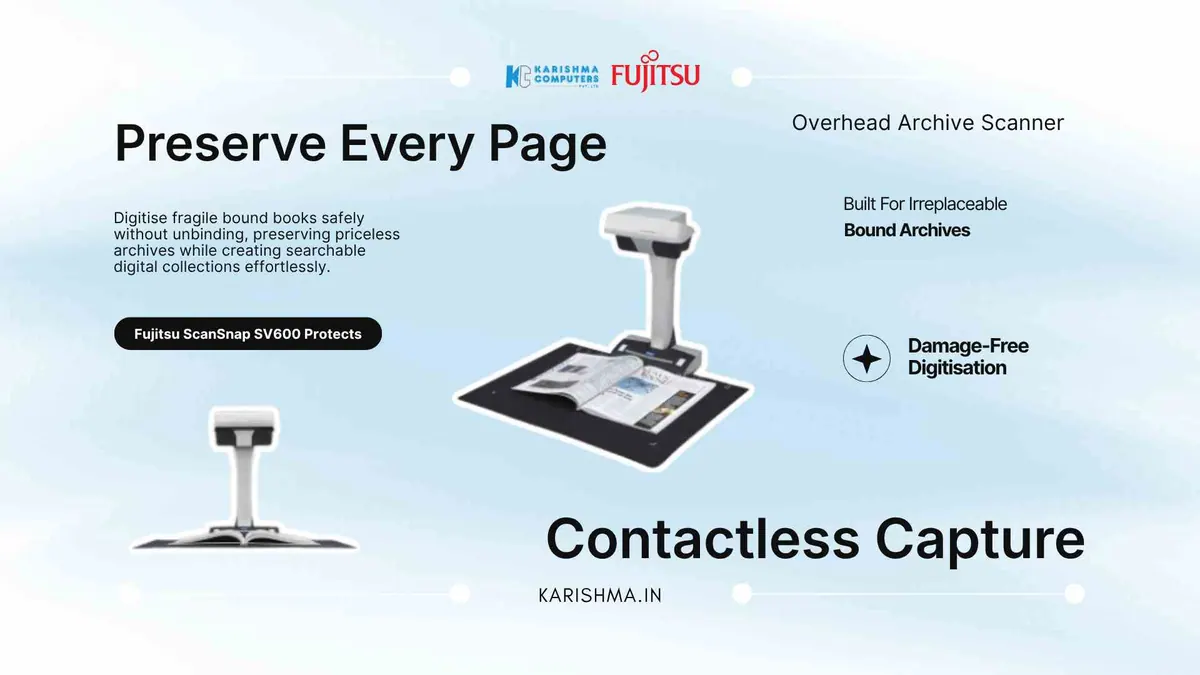
The SV600 is an overhead contactless scanner. The book or document is placed face-up on the scanner’s base and the image is captured from above, so the scanning mechanism does not touch the page. The operator turns the page between scans.
How the Ricoh ScanSnap SV600 Handles a Bound Book Without Damage
The overhead design is the point of the product. The SV600 scans without touching the surface. The Ricoh India page lists scanning of newspapers, magazines, books and documents up to 30 mm thick, described as a Large Format Contactless Scanner. Please confirm your volumes with us. It lists about 3 seconds per page. The operator turns the page and the next scan begins.
The SV600’s image-processing software handles the curvature of an open book automatically. The page that bends towards the spine, which would distort badly in a flat-bed scan, is corrected by advanced image correction, which flattens curve distortions in scanned books and other bound documents.
Why Overhead Contactless Scanning Is a Different Category
Overhead scanning is its own category. This distinction matters for procurement teams who have spent years specifying scanners by speed and feed capacity. For bound, fragile or oversized originals, the relevant specifications are page-curvature correction and finger-image removal, which erases finger images captured during scanning.
The Wrong Compromise That Came First
In this scenario, the publisher had considered an unhappy compromise: photographing each page with a camera on a copy stand, with the volumes held open by hand by an operator. The image quality was inconsistent, the capture rate was slow and the cost per page was high.
This is the wrong turn that archive holders routinely take. The instinct, when the obvious method is unacceptable, is to improvise a custom workflow. The improvisation rarely scales. The actual answer is to use a device that was designed specifically for the use case, which is what the SV600 is meant to be.
Where the Real Cost of the Bound-Document Problem Was Hiding
The cost of the un-digitised archive had not been appearing under any line item called archive cost. It had been appearing in the publisher’s lost institutional contracts, which had moved to digital-first competitors. It had been appearing in senior editor time, which was being consumed by physical retrieval requests. It had been appearing in the publisher’s relationship with research scholars, who had begun to view the holdings as inaccessible rather than valuable.
In this scenario, the Ricoh ScanSnap SV600 gave the publisher a way to move the stalled project forward without unbinding the originals.
The Same Device in a University Library Setting
The principle generalises across institutional libraries, museum archives, religious manuscript collections and personal heritage archives. Picture a private trust in Lutyens Delhi holding a personal library of bound volumes that the trustees want digitised for family access without dispersing or risking the originals. An overhead scanner lets the originals stay bound and shelved.
Where the SV600 Sits in the Ricoh ScanSnap Range
The Ricoh (formerly Fujitsu) scanner range includes the fi Series and the ScanSnap range, with the SV600 in the overhead category (the official product pages now sit on PFU, a Ricoh company). The SV600 is aimed at bound or fragile originals. An organisation with archival holdings may pair it with an fi Series sheet-fed scanner for the unbound paperwork that flows through the same operation.
A Standalone Observation
A pattern is visible across institutional and heritage holdings in Delhi NCR right now. The default assumption in any digitisation conversation is that scanning means sheet-fed scanning. This assumption rules out documents that most need careful handling. The Ricoh ScanSnap SV600 offers an overhead, contactless alternative.
Karishma Computers supplies Ricoh scanners (formerly Fujitsu) in Delhi NCR, including the SV600, and can help law publishers, university libraries, religious trusts, private archives, museum collections and family heritage holdings in Daryaganj, Lutyens Delhi, Old Delhi and Civil Lines choose a suitable scanner. Please confirm current availability with us.
FAQs
Q1. What kind of documents is the Ricoh ScanSnap SV600 designed for?
The Ricoh ScanSnap SV600 is designed for bound books, magazines, newspapers, documents and fragile originals. It is aimed at archival, heritage and reference collections where preserving the original matters.
Q2. How does overhead contactless scanning work?
The document is placed face-up on the scanner’s base. A camera mounted in an arm above the document captures the image from above. The SV600 scans without touching the surface. Ricoh lists about three seconds per page, after which the operator turns the page manually for the next capture.
Q3. Does the SV600 correct for the curvature of an open book?
Yes. Ricoh lists advanced image correction, which flattens curve distortions in scanned books and other bound documents.
Q4. What thickness of document can the SV600 scan?
Ricoh lists documents up to 30 mm thick.
Q5. What software comes with the SV600?
Ricoh lists ScanSnap Home as its all-in-one software. The software bundle can vary by region, so please confirm what is included with the India variant.
Q6. Where can a Delhi NCR institution or practitioner buy the Ricoh ScanSnap SV600?
Karishma Computers supplies Ricoh scanners (formerly Fujitsu) in Delhi NCR. We can help law publishers, advocate chambers, university libraries, religious trusts, private archives and museum collections across Daryaganj, Defence Colony, Lutyens Delhi, Civil Lines and the heritage corridors of NCR choose a suitable scanner.
This article uses an illustrative scenario. Names, figures and outcomes are examples, not customer results.
Keep reading
Not sure which fits?
Tell us what you need. Our team will help you choose and send a quote.