Why Cashiers Kept Getting Blamed Until the Zebra DS9308 Barcode Scanner Told a Different Story
In short Six weeks before the Zebra DS9308 barcode scanner arrived, a mobile accessories retail chain in Pitampura was handing out overtime pay to fix a problem it had misdiagnosed completely. Checkout queues at two of the chain's busiest.
Six weeks before the Zebra DS9308 barcode scanner arrived, a mobile accessories retail chain in Pitampura was handing out overtime pay to fix a problem it had misdiagnosed completely. Checkout queues at two of the chain's busiest outlets had been stretching past closing time most evenings, and the regional manager's explanation was straightforward: cashiers were too slow at the till, especially during the post-dinner rush when customers paid with a mix of loyalty app coupons, UPI QR codes, and physical product barcodes in the same transaction. Staff were told to work faster. Two cashiers at the worst-performing outlet were moved to morning shifts as an informal demotion.
The first fix was a speed drill. A regional trainer ran both outlets through a checkout-speed workshop, timing cashiers against a stopwatch and offering a small bonus to whoever cleared transactions fastest over a trial week. Checkout times barely improved. Cashiers were scanning as fast as the scanner let them, which turned out to be the actual constraint nobody had tested. The existing handheld laser scanners struggled badly with barcodes displayed on customer phone screens, the loyalty app coupons and UPI confirmation codes that had become routine parts of a single transaction, often requiring three or four attempts at awkward angles before a scan registered.
Nobody in the chain had connected slow checkout to the scanner itself. The repeated rescanning wasn't showing up as an equipment complaint, because the scanners still worked eventually and nobody had filed a formal fault report against them. It was showing up as staff overtime, paid out every evening to keep tills open until the queue cleared, a cost the finance team reconciled under labour rather than hardware. Slow checkout wasn't a cashier skill gap. It was a scanner compatibility gap wearing a staffing-shaped costume.
What Changed When the Zebra DS9308 Barcode Scanner Replaced the Handheld Units
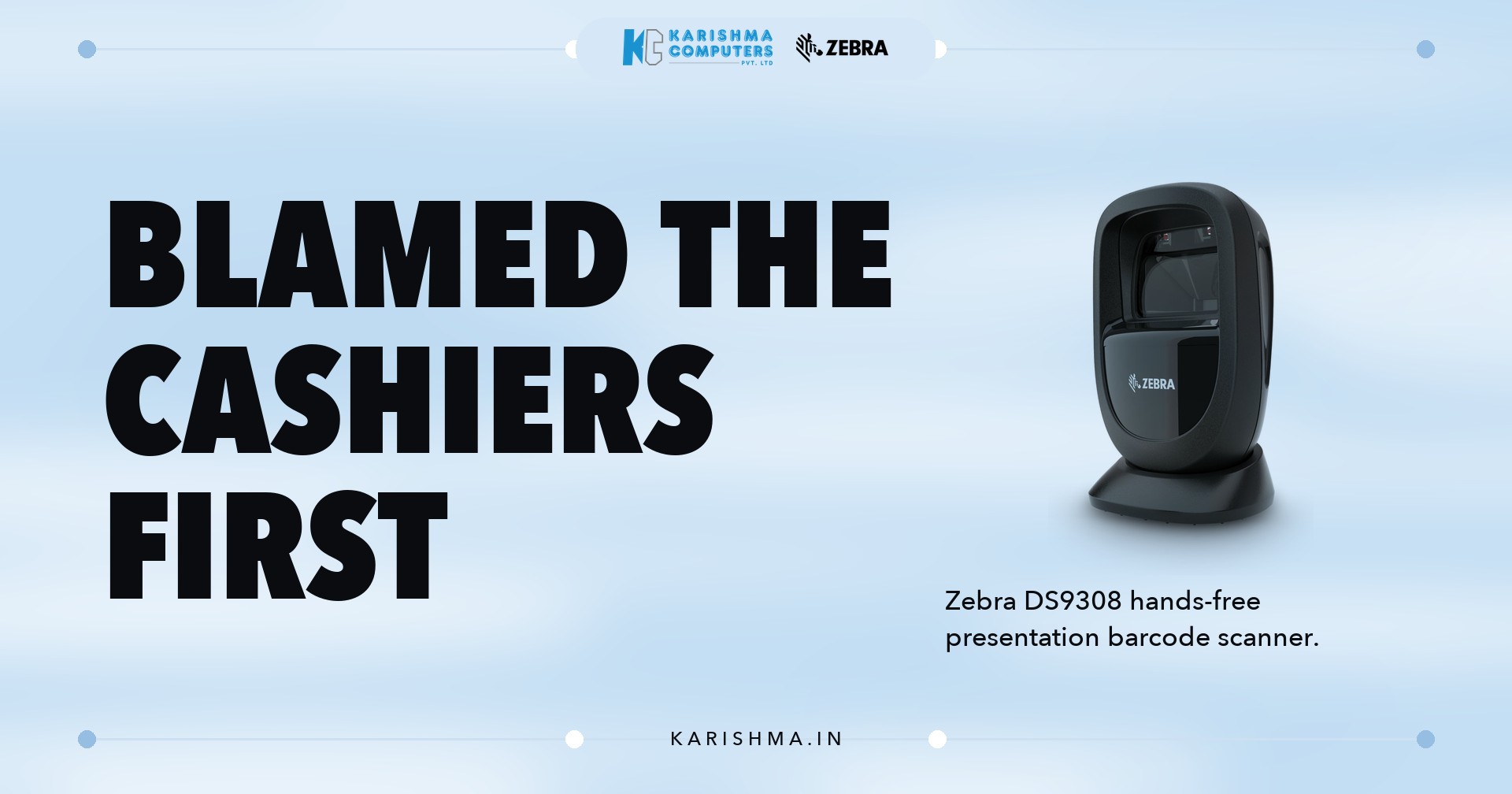
The chain replaced the handheld scanners at both struggling outlets with the Zebra DS9308 barcode scanner, a hands-free presentation imager built around an 800 MHz processor and a high-resolution megapixel sensor using Zebra's PRZM Intelligent Imaging technology. The difference showed up within the first evening rush. Phone-screen barcodes that had needed three attempts under the old scanners registered on the first pass, including coupons displayed at awkward angles that the laser units had never handled reliably. Cashiers stopped repositioning products in front of the scanner and started simply passing items through its field of view, the way a presentation scanner is meant to work.
Why the Zebra DS9308 Barcode Scanner Cut Overtime Within Two Weeks
Swipe speeds up to 50 percent faster than the previous scanners mattered less on their own than what they meant combined with the DS9308's wide field of view, the largest in its class. Items no longer needed precise alignment under the scanner window, which removed the micro-pause that had been adding up, transaction after transaction, into the queue lengths the chain had originally blamed on staff. Within two weeks, both outlets stopped needing evening overtime to clear closing-time queues, a change the regional manager only connected to the scanner after overtime hours on the payroll report dropped on their own.
The scanner's ability to read barcodes through cellophane and plastic wrap solved a second complaint the chain hadn't separately diagnosed. Several accessory products, particularly screen protectors and phone cases, ship with barcodes printed under a clear plastic window that reflects checkout lighting. The old scanners frequently failed on these, forcing cashiers to peel back packaging mid-transaction. The Zebra DS9308 barcode scanner's curved exit window reduced the glare that had been causing those failures, cutting out a manual workaround nobody upstream had ever noticed cashiers performing.
The chain's IT contact also noticed a quieter benefit during a slow Tuesday afternoon review: the adaptive illumination built into the scanner's LEDs dimmed automatically when no barcode was present and activated the moment one entered its field of view. During the evening rush, that meant the scanner itself stopped contributing to the glare and clutter of a busy counter lit by overhead fluorescents, product packaging under plastic, and a cashier's own phone screen nearby. It was a small detail nobody had asked for when specifying the replacement, but the staff noticed it within the first shift, describing the counter as feeling calmer even before anyone measured the actual checkout times.
The chain also added up what the old scanners had been costing beyond the overtime line. Two units had been sent out for repair twice in the previous year after cashiers, frustrated with failed scans, had dropped or knocked them against the counter edge while repositioning products. The Zebra DS9308's rating for five-foot drops and a thousand consecutive tumbles meant that failure mode effectively disappeared, a saving the chain hadn't originally budgeted for when it approved the replacement purely to fix checkout speed.
A fair question surfaces at this point: is a dedicated presentation imager like the Zebra DS9308 barcode scanner overkill for a mobile accessories counter. For a shop processing a few dozen transactions a day with simple printed barcodes, probably. For an outlet running high transaction volume with a mix of phone-screen coupons, QR payment codes, and cellophane-wrapped packaging during a nightly rush, the calculation changes. The real question isn't whether the scanner is more capable than a quiet Tuesday afternoon requires. It's what three failed scan attempts per transaction cost when multiplied across a full evening's queue.
The same misdiagnosis surfaces across other Delhi NCR retail counters. A mobile recharge and bill-payment chain in Dwarka spent a month blaming front-counter staff for slow service before discovering its scanners couldn't reliably read the QR codes customers were increasingly presenting from banking apps rather than printed slips. A pharmacy counter in Rajouri Garden assumed new hires needed more training before realising its ageing scanner simply couldn't read the smaller, denser barcodes now printed on compact medicine strips.
A home appliance showroom chain with outlets near Netaji Subhash Place went through a near-identical sequence the previous year, cycling through three different cashiers at its busiest counter before an outside technician, called in for an unrelated POS software issue, pointed out that the scanner itself was rejecting roughly one in five attempted scans on warranty-card barcodes printed in a smaller font than the chain's older product lines used. Nobody on staff had been counting failed attempts. They had only been counting minutes added to the queue.
There's a pattern worth naming on its own, independent of any specific device. Retail operators across Delhi NCR tend to diagnose checkout friction as a staffing problem first, because a training session feels faster and cheaper to arrange than replacing hardware. It rarely addresses the real constraint. The bonus scheme runs its course, the stopwatch drills end, and the same queue length returns within weeks because the device limiting every transaction never changed. A scanner that can't read a screen-displayed barcode will keep producing the same slow checkout regardless of how quickly the person holding it moves.
For retail counters anywhere from Pitampura to Dwarka and Rajouri Garden processing a growing mix of digital and printed barcodes at checkout, a Zebra DS9308 barcode scanner typically earns its cost within a single billing cycle, mostly in eliminated overtime rather than any saving on the scanner hardware itself.
The Pitampura chain didn't need faster cashiers. It needed a scanner built for the transactions customers were actually bringing to the counter, screens, QR codes, and cellophane-wrapped packaging included. Karishma Computers has walked similar conversations with retail counters across Pitampura, Dwarka, and Rajouri Garden, businesses that assumed a checkout delay was a staffing issue until someone finally timed how many attempts each scan actually took. The Zebra DS9308 barcode scanner didn't fix the chain's staff performance. It removed the one obstacle that had been making an evening rush slower than it needed to be.
To see the range, read about the Zebra DS9300 Series on our site, or Zebra's own DS9300 Series page.
Please ask Karishma Computers to confirm the current India model, configuration and availability before you order.
Questions and answers
Can the Zebra DS9308 barcode scanner read barcodes displayed on a phone screen?
Yes. Its PRZM Intelligent Imaging technology is built to capture barcodes from both printed labels and electronic screens, including loyalty app coupons, UPI QR codes, and mobile boarding passes.
How fast is the Zebra DS9308 compared to older handheld scanners?
It supports swipe speeds up to 50 percent faster than many competing scanners, combined with one of the widest fields of view in its class, reducing the alignment pauses that slow down manual handheld scanning.
Does the Zebra DS9308 work on barcodes under cellophane or plastic wrap?
Yes. Its curved exit window reduces glare and reflection, allowing it to read barcodes through cellophane, plastic wrap, and glossy packaging that commonly cause failed scans on older scanners.
Is the Zebra DS9308 durable enough for a busy retail counter?
Yes. It is rated for 5-foot drops and 1,000 consecutive tumbles, with IP52 sealing against dust and everyday spills, which matters on counters where a scanner gets knocked or dropped during peak hours.
What connectivity options does the Zebra DS9308 support?
It supports USB, RS-232 serial, keyboard wedge (KBW), and RS-485 interfaces, making it compatible with most standard POS and billing systems without requiring new integration work.
Does the Zebra DS9308 come with a warranty?
Yes. It carries a 3-year manufacturer limited warranty, with optional Zebra OneCare service plans available for extended coverage.
More from Zebra: all Zebra products · full product finder · request a quote
Related products
Not sure which fits?
Tell us what you need. Our team will help you choose and send a quote.