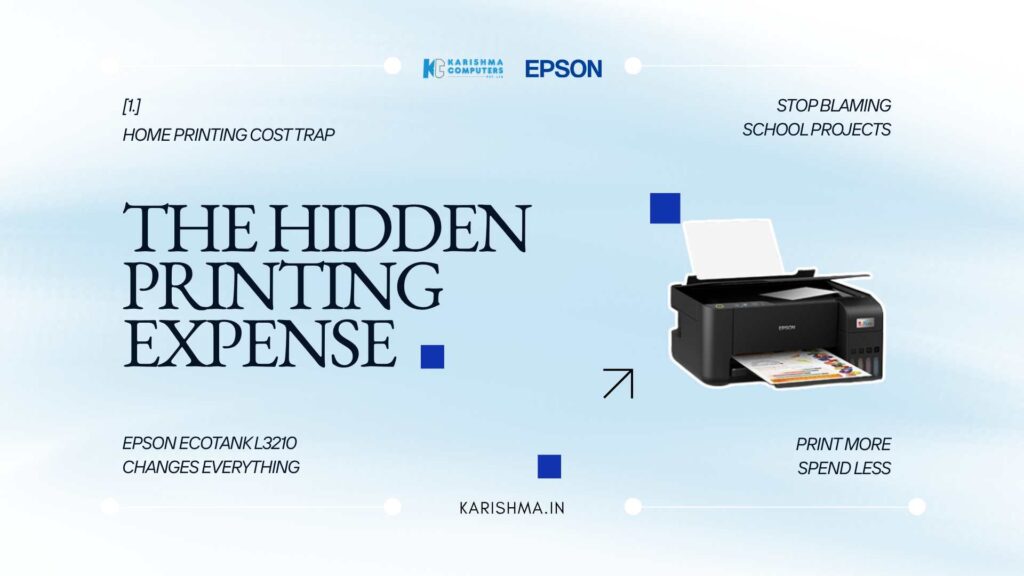
Why the Epson EcoTank L3210 Solves a Home-Printing Problem Most Families Misdiagnose
The Epson EcoTank L3210 was nowhere in the conversation when a dual-freelancer couple in a Faridabad apartment spent the previous academic year quietly puzzled about how their home printing budget had quadrupled in eighteen months. The husband ran a small content writing practice. The wife ran an independent legal advisory. Both children were in school. The family ran a cartridge-based inkjet printer purchased three years earlier that had been adequate for an occasional household need.
The cartridge bill was now arriving every three weeks. The conversation in the house had turned into a low-grade resentment of the children’s school projects, which everyone had begun to blame for the cost spike. The wife mentioned it to her sister at a family lunch. The sister, a teacher, pointed out that her own children had similar project loads and that her own printing bill had not moved in two years. The wife went home and audited the actual print volume. The children’s school projects accounted for less than fifteen per cent of the household’s print volume. The remaining eighty-five per cent was the husband’s client briefs and the wife’s case research.
The cost was a household cost. The blame had been incorrectly assigned to the most visible and least powerful members of the household.
What Most Home Offices Get Wrong About Their Printer Economics
The misattribution is common in working-from-home households. The cartridge model presents a sticker price that looks reasonable at the point of purchase. The actual cost lives in the cartridges, which are sold at a margin that has nothing to do with the cost of the ink they contain. A typical cartridge holds eight to twelve millilitres of ink and is priced at multiples of what those millilitres are worth as a raw material. For a household with low print volume, the math is tolerable. For a household where two adults are printing daily client work, the math becomes punishing.
The household did not have a children’s project problem. The household had a printer architecture problem.
What the Epson EcoTank L3210 Brings to a Family Home
The L3210 is an integrated ink-tank multifunction printer that prints, scans and copies. The relevant feature is structural rather than functional. The ink does not sit inside a cartridge. The ink sits inside refillable tanks visible on the side of the printer. The user pours ink from bottles directly into the tanks when refilling becomes necessary, which is significantly less often than cartridge replacement.
How the Epson EcoTank L3210 Compares to a Cartridge Printer Over Three Years
A typical cartridge inkjet printer in a freelancer household consumes a set of colour and black cartridges every six to ten weeks at moderate volume. Across three years, that translates to roughly twenty to twenty-five cartridge replacements, each costing a multiple of what a single bottle of EcoTank ink costs. The L3210’s starter set of ink bottles is rated to print roughly 4,500 pages in black and 7,500 pages in colour. A freelancer household that prints fifty pages a week reaches the first refill at month eighteen. A cartridge printer would have been refilled twelve to fifteen times by then.
This is not a cost optimisation argument. It is a cost-structure replacement argument. The L3210 changes the unit economics of home printing rather than reducing them at the margin.
Why the Refill Cycle Matters More Than the Sticker Price
The refill cycle also changes how the household thinks about printing. A cartridge printer creates a low-grade anxiety around print volume because every page is being silently measured against the next cartridge replacement. The household begins to think about printing as an expense rather than as a productivity tool. A child asks to print an extra copy of a project for a friend, and the parent does a quick mental calculation. A freelancer needs to print a longer brief than usual, and the unconscious calculation interferes with the work itself.
The L3210 removes the calculation. The tanks hold enough ink that the next refill is months away. Printing returns to being a tool rather than a budgeted activity. The household’s relationship with the printer changes.
The Wrong Spending Pattern That Came First
The Faridabad family had tried something else before they bought the L3210. The husband had switched to printing his client briefs at a neighbourhood photocopy shop in the building below, on the assumption that the per-page commercial rate would work out cheaper than at-home cartridge printing. The wife had pointed out within a month that the time cost of walking down and back, the wait, the conversation and the irregular availability had made the photocopy shop more expensive in practice than the cartridges had been. The shop was abandoned. The cartridge cycle resumed.
This is the wrong turn that home offices routinely take. The instinct is to find a workaround for the cost of the existing printer. The actual solution is to replace the printer with one whose cost structure does not need to be worked around.
Where the Real Cost of the Old Printer Was Hiding
The cost of the cartridge printer had been hiding in places that did not look like printer costs. It had been hiding in the household’s small accumulating resentment of the children’s school projects, which was beginning to affect bedtime conversations. It had been hiding in the husband’s reluctance to print a second draft of his work for proofreading, which was producing client briefs with avoidable errors. It had been hiding in the wife’s late-night legal research, which she was beginning to do on screen rather than on paper because the printing felt expensive, even though her professional judgment was better when she annotated paper.
The Epson EcoTank L3210 absorbed all of it. The cartridge anxiety dissolved. The husband returned to printing second drafts. The wife returned to her paper-annotation habit. The children’s projects, exonerated, became the source of conversation they had always been before the cartridge bill had soured the topic.
The Same Printer in a Tutoring Practice Context
The principle generalises. A part-time tutor running maths and physics classes from a converted bedroom in Vasant Kunj had been struggling with the cost of printing weekly worksheets for fifteen students. The cartridge math had pushed her to printing on both sides of every sheet, which the students were finding difficult to read because the show-through made the equations on the reverse side bleed into the equations on the obverse. The L3210 allowed her to return to single-sided printing without the cost penalty. Her teaching effectiveness recovered. Her student feedback scores climbed back to where they had been before the cost pressure had forced the change.
Why Epson’s EcoTank Architecture Sits Where It Does
Epson’s ink-tank technology is the product of a deliberate strategic choice that the company has been refining for over a decade. The PrecisionCore print-head technology that sits inside the L3210 was engineered specifically for sustained continuous use rather than for the burst printing that cartridge printers were designed for. The heat-free printing process reduces the maintenance overhead that older inkjet designs required. The combination explains why an EcoTank printer that is used heavily lasts longer in practice than a cartridge printer that is used lightly. The architecture rewards use rather than penalising it.
A Standalone Observation
A pattern is visible across freelancer households and small home offices in Delhi NCR right now. The home printer is treated as a low-stakes purchase made years ago and rarely revisited. The cost structure that printer imposes accumulates silently into the household budget without ever being audited as a printer cost. The household instead audits its visible expenses, finds the children’s school projects in the mix and assigns the blame to the wrong line item. The Epson EcoTank L3210 is one of the products that quietly ends the misattribution by removing the cost structure entirely.
Karishma Computers, as an Epson channel partner in Delhi NCR, supplies the L3210 across home offices, freelancer households, tutoring practices, small clinics and start-up workspaces in Faridabad, Vasant Kunj, Indirapuram, Gurgaon and the dense residential corridors of Delhi proper. The printer is one of the few household-grade purchases where a single decision shifts the family’s printing economics for the next several years.
Q1. What kind of household or small office is the Epson EcoTank L3210 designed for?
The Epson EcoTank L3210 is designed for home offices, freelancer households, small professional practices, tutoring setups and any environment where the printing volume is regular enough that cartridge economics become punitive. It is a multifunction device that prints, scans and copies, which makes it suitable for households that need a single device handling all three tasks.
Q2. How does the EcoTank ink system differ from a cartridge printer?
A cartridge printer uses sealed cartridges that must be replaced when empty. The L3210 uses refillable ink tanks built into the printer, which the user fills from ink bottles. Each set of bottles supplies enough ink for thousands of pages, which changes the cost structure rather than reducing it at the margin.
Q3. What is the page yield of a single ink bottle set?
The standard ink bottle set is rated to print approximately 4,500 pages in black and 7,500 pages in colour at typical print coverage. Actual yield varies with page content. A freelancer household printing fifty pages a week typically reaches the first refill at around eighteen months of regular use.
Q4. Is the L3210 a wireless printer?
The standard L3210 is a USB-connected printer. Epson offers wireless variants in the same EcoTank series for households that need Wi-Fi printing from phones or laptops. Karishma Computers can advise on the variants currently available in Delhi NCR based on the household’s specific usage.
Q5. Does the L3210 require professional installation?
No. The L3210 ships with clear instructions for initial setup, including the first-time ink-tank filling, alignment and connection to a computer. Most households complete the setup in under thirty minutes. Karishma Computers offers installation guidance for households that prefer a hands-on first setup.
Q6. Where can a Delhi NCR family or small office buy the Epson EcoTank L3210?
Karishma Computers is an Epson channel partner serving Delhi NCR. The L3210 is supplied across home offices, freelancer households, small practices and tutoring setups in Faridabad, Indirapuram, Vasant Kunj, Gurgaon, Ghaziabad and the residential corridors of Delhi proper, with after-sales support including refill bottle availability.