
Honeywell 1950g HD Scanner Manufacturing Floor
In short An illustrative look at how a high-density scanner can help with a recurring mis-scan problem that a manufacturing unit had blamed on its night-shift workers.
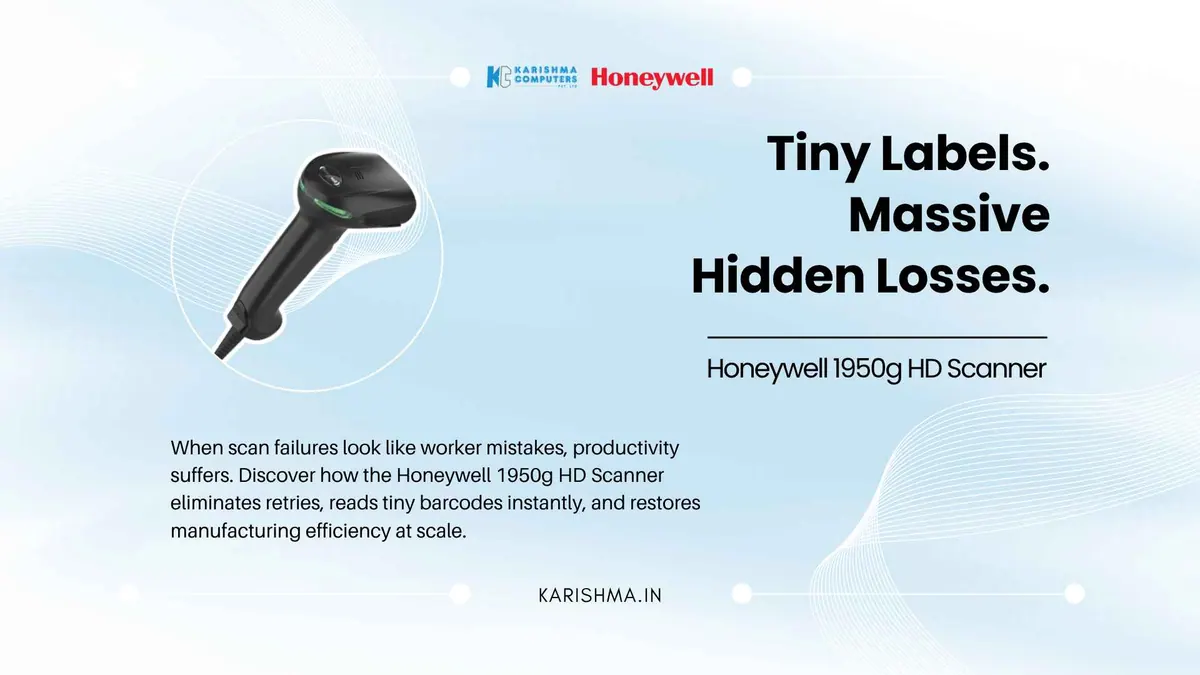
Why the Honeywell 1950g HD Scanner Fits a Manufacturing Floor Problem
The Honeywell 1950g HD scanner was not in the conversation when, in this scenario, an auto-component unit in Bhiwadi Industrial Area spent a year struggling with a mis-scan rate its quality manager could not explain. The unit assembled small electronic sub-components for a tier-one auto supplier. At the goods-in inspection station, the mis-scan rate had climbed over a financial year. Each mis-scan triggered a manual reconciliation that used inspector time. The quality manager suspected the night shift was rushing through scans.
He introduced a dashboard that tracked individual scan accuracy. He sent two night-shift workers for recertification. He added supervisory attention at the station. The mis-scan rate did not move.
The cause was the labels. The component labels from one supplier had shrunk to a much smaller printed area, and the scanner in use had been chosen when labels were larger. Reads were failing on the first attempt. Workers were retrying, and the retries registered as separate scans. The data layer showed the duplication as mis-scans.
What Manufacturing Operations Can Overlook About Scan Accuracy
A rising error rate is often treated as a behavioural issue and answered with training and supervision. The cause can instead be a quiet change on the supplier side that the receiving side has not registered. Labels can shrink when space on small components is tight. A scanner chosen for the earlier labels may no longer be the best match. Reads fail, operators retry, and the data layer counts retries as errors.
In this scenario the night shift was not rushing. They were scanning the same label several times until the device registered a read.
What the Honeywell 1950g HD Scanner Brings to a Manufacturing Line
The 1950g HD is a general-duty 2D scanner from Honeywell’s Xenon XP series, with a high-density option. HD refers to Honeywell’s high-density range, intended for small, tightly packed barcodes. Specifications, warranty and kit contents depend on the India model; please ask us for the India datasheet before you order.
How the Honeywell 1950g HD Scanner Fits Small Component Labels
Honeywell positions the HD variant for small, high-density barcodes, which are common on small electronic and auto components. Please share the smallest label your line uses and ask us for a trial before deciding.
Why High-Density Imaging Matters on a Manufacturing Floor
Failed reads add up. Every retry takes a few seconds, and across many component scans per shift those seconds become lost line time. A scanner matched to the label size reduces the need for retries.
The Discipline Approach That Came First
In this scenario, the unit tried the discipline approach first. The dashboard, the recertification and the extra supervision each gave a brief improvement followed by a return to the earlier rate, because none of them addressed the actual cause. When a problem is visible, the first response is often to manage the people. The cause can sit in a piece of hardware specified years earlier under different supplier conditions.
Where the Cost of Mis-Scans Was Hiding
The cost does not appear under a line item called scanning losses. It can appear in shift productivity numbers, in inspector overtime as manual reconciliations take more shift time, in a customer’s comments on slower fulfilment, and in night-shift morale when a dashboard scores people on something they cannot control.
In this scenario, a scanner matched to the smaller labels reduced the retries, the dashboard stopped being a topic of conversation, and the night shift was no longer being blamed.
The Same Question in Pharmaceutical Manufacturing
The principle applies elsewhere. A pharmaceutical unit assembling blister packs could see a similar pattern on its packaging line when unit-dose labels shrink to fit more printed information. Matching the scanner to the label size is worth checking.
Where the 1950g HD Sits in Honeywell’s Range
The 1950g HD is a general-duty 2D scanner with a high-density option. For a manufacturing line that needs a scanner for small labels connected to existing line management software, it is worth shortlisting. Please share your label sizes and host software with us so we can confirm the right model.
A Standalone Observation
In Delhi NCR’s industrial corridors, equipment specified during a unit’s initial setup tends to be reviewed only after a visible failure. Labels change. A scanner that suited the labels of five years ago is worth rechecking against the labels of today. The Honeywell 1950g HD scanner is one of the products worth considering for units that look at the equipment before they look at their people.
Karishma Computers supplies Honeywell products in Delhi NCR, including for auto-component, pharmaceutical packaging, electronics assembly and medical device units in Bhiwadi, Faridabad, Manesar, Greater Noida and the industrial belts of NCR. Tell us your workflow and we will help you shortlist a model from the datasheets.
Q1. What does HD stand for in the Honeywell 1950g HD scanner?
HD refers to Honeywell’s high-density range, intended for small, tightly packed barcodes. It matters when the labels being scanned are very small, as in electronics, jewellery and pharmaceutical work. Please ask us for the India datasheet for details on your model.
Q2. How does the 1950g HD differ from other 1950g variants?
Honeywell offers the 1950g in more than one variant, including HD (high density) and SR (standard range). The HD variant is aimed at smaller barcodes. Please ask us to confirm which variant suits your label sizes.
Q3. Is the 1950g HD a corded or cordless scanner?
It depends on the India model and kit. Please confirm the India model and kit with us, and tell us whether your station needs a fixed corded scanner or one that moves with the operator.
Q4. What kind of business should consider the 1950g HD?
Businesses handling small-label items may want to consider it, such as auto-component makers, pharmaceutical packagers, electronics assemblers, medical device producers and jewellery businesses. Tell us your labels and we will help you decide.
Q5. Will it work with existing inventory and POS software?
Interfaces and compatibility depend on the India model and on your host software. Please tell us your inventory, POS or ERP system, and ask us for the India datasheet, before you order.
Q6. Where can a Delhi NCR business get the Honeywell 1950g HD scanner?
Karishma Computers supplies Honeywell products in Delhi NCR, including for manufacturing units and trade businesses in Bhiwadi, Faridabad, Manesar, Karol Bagh, Chandni Chowk and Nehru Place. Please ask us about the exact model and availability.
This article uses an illustrative scenario. Names, figures and outcomes are examples, not customer results.
Keep reading
Not sure which fits?
Tell us what you need. Our team will help you choose and send a quote.