Why a Honeywell Industrial Barcode Printer Solved a Throughput Problem Blamed on the Team
The Honeywell industrial barcode printer and a throughput problem misread as a labour shortage
A large e-commerce fulfilment centre in Noida spent months convinced it had a labour-capacity problem at outbound. Order volumes were rising, the labelling and dispatch line could not keep pace at peak, and the operations head kept requesting more headcount for the outbound shift. The assumption was straightforward: more parcels needed more people.
The extra hands helped for a week and the bottleneck returned, because the constraint was never labour. The printer feeding the outbound line was a mid-range unit running at the edge of its capacity, pausing frequently for media reloads and slowing whenever the queue built, so the line throttled itself regardless of how many people stood beside it. Adding staff to a printer bottleneck simply put more people in a queue waiting on the same machine.
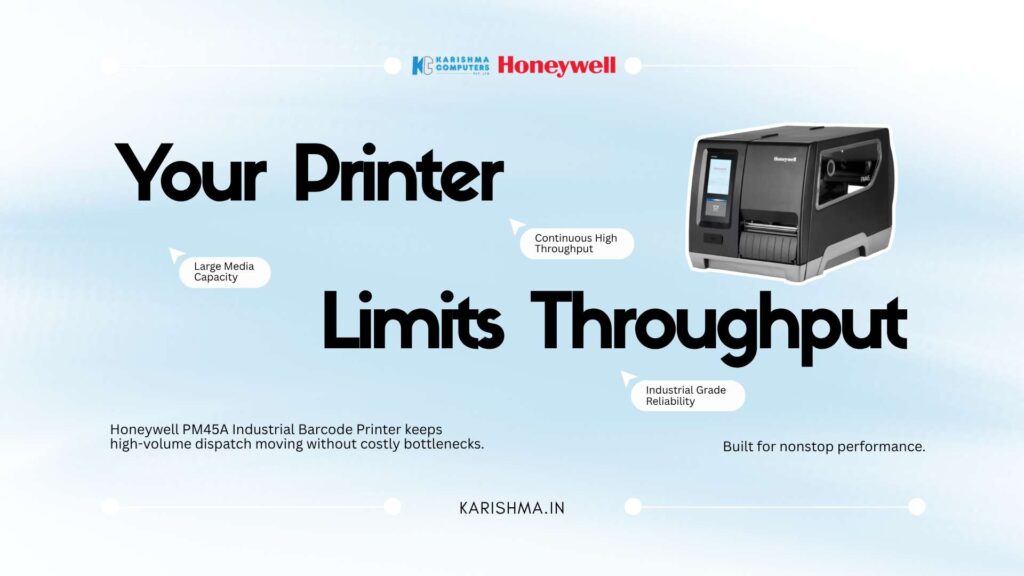
This is where a Honeywell industrial barcode printer of the right class changes the maths. The PM45A is a high-throughput industrial printer engineered for continuous, high-volume operation, with fast print speeds and large media capacity that keeps an outbound line moving through a peak shift. Once the PM45A replaced the underspecified unit, the outbound line kept pace with volume, and the headcount the centre had been adding to chase throughput turned out to be unnecessary.
What high-throughput industrial printing changes at 203 dpi
The PM45A is built around sustained speed and endurance rather than occasional use. It drives fast, consistent output and carries large media rolls, so it runs far longer between reloads than a mid-range printer, and every avoided reload is a stoppage the line does not suffer. At 203 dpi it produces clean, scannable barcodes for cartons, shipping labels, and compliance marks at the volumes a fulfilment or manufacturing operation generates.
For high-volume environments, the metric that matters is uptime under load. A printer that slows or pauses at peak becomes the pacing item for the entire line, and no amount of downstream capacity can outrun it. The PM45A is engineered to hold its speed through a full shift, which is the specific behaviour a peak-season fulfilment line depends on and a lighter printer cannot deliver.
Where the Honeywell industrial barcode printer proves its worth
Manageability and integration close the case. The PM45A offers a clear colour interface and guided operation that shortens operator training, and it supports the connectivity and enterprise management tools that let IT provision, monitor, and update printers across a large site centrally. For a fulfilment centre running many printers, that central control is the difference between a fleet that is managed and a fleet that is chased.
Reliability compounds the throughput benefit. Honeywell’s industrial build is engineered for the dust, heat, and continuous duty of a warehouse floor, so the PM45A keeps running where a lighter printer would begin generating faults. A printer that stays up through peak is worth far more than its speed rating alone, because availability under load is where fulfilment operations are won or lost.
The cost hidden in the headcount budget
The Noida centre was paying a real invoice and posting it to the wrong line. The throughput shortfall triggered temporary staffing at peak, overtime for the outbound shift, and eventually a permanent headcount request, all of it charged to labour. The missed dispatch cut-offs that followed a slow peak were absorbed as a service cost, and the seller penalties for late shipments were treated as a marketplace problem. None of it was attributed to the printer that set the pace.
A printer is a small item on a fulfilment centre’s capital plan, and peak-season labour and penalties are among its largest variable costs. The two were connected, but no ledger connected them. When the PM45A lifted the throughput ceiling, the outbound line kept pace without the extra shift, the overtime fell, and the late-shipment penalties eased. The saving appeared in the labour and service budgets, which had never been part of a printing decision.
Adding people to a machine bottleneck adds cost, not capacity
There is a principle here that operations leaders relearn constantly. When a line cannot keep up, the instinct is to add people, because people are the most flexible lever available. But if the constraint is a machine, adding people does not add capacity, it adds cost, because the extra people simply wait on the same bottleneck. The line moves at the speed of its slowest fixed component regardless of how many hands surround it.
Finding the true constraint before spending on the visible lever is the discipline that separates efficient operations from expensive ones. A bottleneck at a machine is solved by fixing the machine, not by surrounding it with labour that the machine will throttle anyway. The operations that scale well are the ones that identify the pacing item before they scale the payroll.
The throughput ceiling that a Honeywell industrial barcode printer is designed to lift
Every line has a pacing item, the single component that sets the maximum speed of the whole, and in a labelling-driven dispatch operation that item is very often the printer. A printer that pauses for reloads and slows as the queue builds becomes the ceiling on the entire line, and no amount of downstream capacity or added labour can push output above it. The PM45A is built specifically to raise that ceiling, with sustained high speed and large media capacity so the printer stops being the pacing item and the line runs at the speed of its people rather than the speed of its slowest machine.
Uptime under load is the specification that matters here, and it is distinct from headline speed. A printer can be fast on a single label and still fail an operation if it slows or stalls when the queue is deep, because peak is exactly when the ceiling bites. A Honeywell industrial barcode printer engineered to hold its speed through a full peak shift delivers the behaviour a fulfilment line actually depends on, which is consistent output when volume is highest, not a good number on a quiet afternoon.
Why a Honeywell industrial barcode printer changes the scaling decision
The instinct to scale a struggling line with labour is expensive precisely because it addresses the wrong constraint. If the bottleneck is a machine, added people wait on that machine, converting a capacity problem into a payroll problem without lifting output. Correctly sizing the printer to the throughput target removes the constraint at its source, which is almost always cheaper than the recurring peak-season labour, overtime, and penalty costs that an underspecified printer quietly generates. The right machine is a one-time capital decision; the wrong one is a recurring operating cost.
Central manageability compounds the benefit across a large site. A fulfilment centre runs many printers, and a fleet that IT can provision, monitor, and update centrally is a fleet that can be kept ready rather than repaired reactively. A printer that reports its status and integrates into the warehouse system lets an operation see a developing problem before the line stops, which turns maintenance from a crisis into a schedule. For operations that scale by season, that predictability is worth as much as the raw throughput number, because a fast printer that fails at peak is worse than a steady one that never does.
For fulfilment lines, packaging floors, and distribution centres across Noida, Bhiwadi, and the industrial belts of Faridabad and Gurgaon, a Honeywell industrial barcode printer sized to real throughput is not an optional upgrade. It is the difference between scaling capacity and scaling cost.
Q1. What is the Honeywell PM45A designed for?
The PM45A is a high-throughput industrial barcode printer built for continuous, high-volume label printing in fulfilment centres, warehouses, and manufacturing lines that run heavy daily volumes.
Q2. How does the PM45A help with high-volume throughput?
It drives fast, consistent print speeds and carries large media rolls, so it runs far longer between reloads. Fewer stoppages and sustained speed under load keep an outbound line moving through a peak shift rather than throttling it.
Q3. What resolution does the PM45A print at?
The PM45A prints at 203 dpi, which produces clean, scannable barcodes for cartons, shipping labels, and compliance marks at the sizes fulfilment and industrial operations use.
Q4. Can the PM45A be managed across a large site?
Yes. The PM45A offers a clear colour interface and supports enterprise connectivity and management tools, so IT can provision, monitor, and update a fleet of printers across a large facility centrally.
Q5. Why does printer uptime matter more than raw speed in fulfilment?
A printer that pauses or slows at peak becomes the pacing item for the whole line, and downstream capacity cannot outrun it. Sustained availability under load, not just top speed, is what keeps a fulfilment operation on pace.
Q6. Where can Delhi NCR operations buy the Honeywell PM45A?
Karishma Computers is an authorised Honeywell channel partner in Delhi NCR and supplies the PM45A with media and deployment support for fulfilment, warehouse, and manufacturing lines.