
Honeywell 1472g Wireless Scanner Retail Counters
In short How a Honeywell 1472g wireless 2D scanner can help Delhi NCR retail counters reduce billing delays and manual entry during peak hours.
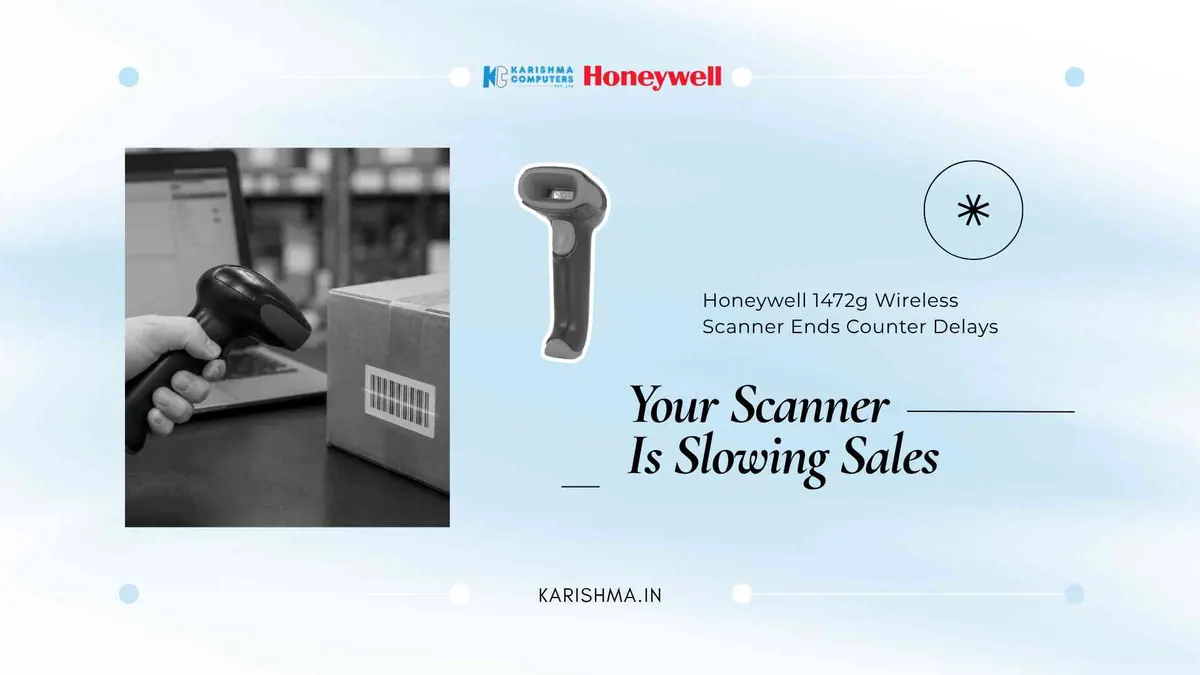
Retail Counters, Real Delays: How the Honeywell 1472g Wireless Scanner Can Shorten the Wait
In this scenario, a queue builds at counter two of a mid-sized pharmacy near Lajpat Nagar. The store manager has tracked counter delays for weeks, and every note in his register points to the same conclusion: the afternoon shift is slower than the morning shift. He assumes it is a discipline problem. Newer staff, less urgency, more chatting between customers.
Then he watches what happens at the counter itself. The corded 1D scanner at counter two needs each strip held flat and steady under a fixed beam. Some packaging now carries 2D codes, which 1D scanners do not read, while a 2D imager reads both. Staff are retyping batch numbers by hand for a growing share of transactions. The delay has little to do with attitude. It comes from the workflow around the scanner.
The Fix That Added Cost Instead of Speed
The first response is reasonable on paper. Management adds a second staff member during peak afternoon hours. Queue times improve marginally for about a week, then creep back up. Adding people to a process that the device cannot complete does not fix the process. It spreads the same friction across more shifts.
This pattern is familiar across Delhi NCR retail counters, from Karol Bagh chemists to Okhla general stores. A device limitation gets framed as a staffing or training issue because those feel like problems a manager can act on immediately. Looking at the equipment layer early can save time.
Where the Honeywell 1472g Wireless Scanner Fits the Counter
The 1472g is a cordless area-imaging scanner. An area imager reads line barcodes and 2D codes, so manual retyping of codes can drop out of the workflow.
Cordless movement matters too. Staff can leave the counter to verify stock on a back shelf mid-transaction. During restocking hours, the same device can move from counter to storeroom without anyone unplugging a cable. Connection range in a store depends on walls, shelving and interference, and battery life depends on usage. Specifications, warranty and kit contents depend on the India model; please ask us for the India datasheet before you order.
What the Hidden Cost Looks Like
In this scenario, the pharmacy’s overtime budget absorbed the cost for months, filed under staffing rather than equipment. Equipment costs often hide this way: not as a line item labelled hardware, but as a rise in the categories that sit closest to the symptom.
Retailers across Vasant Kunj, Saket and Connaught Place can face a similar pattern whenever packaging changes faster than the scanning hardware at the counter.
Choosing a Scanner for High-Footfall Counters
Staff drop scanners and counters get busy, so durability is worth checking on any scanner you consider. Durability ratings depend on the India model; please ask us for the India datasheet before you order.
The cordless freedom extends past the billing counter. Distribution points and small warehouses attached to retail operations can use a single scanning device across receiving, shelving and point-of-sale. That can reduce both the equipment budget and the training effort of maintaining several device types in one small operation.
Chemists and general stores near busy areas such as Nehru Place and Cyber City Gurgaon often have one staff member managing billing, shelf checks and customer queries in parallel. A cordless imaging scanner keeps that person mobile instead of anchored to a fixed terminal.
The Pattern Worth Noticing Beyond This Counter
Organisations often investigate the layer closest to the customer complaint before the layer that causes it. A slow queue gets attributed to the people in the line of sight, because that is the visible layer. The equipment underneath, doing the work of reading and confirming each transaction, is worth a look early, not last.
What This Means for Retail and Distribution Counters Across Delhi NCR
For pharmacy chains, apparel retailers and small distributors weighing counter upgrades, the practical question is rarely about brand preference. It is whether the current device reads what current packaging contains, and whether cordless movement matches how staff work during a shift. The 1472g is worth evaluating against both questions: it uses an area imager and is cordless.
Comparing a Honeywell 1472g wireless scanner with another option purely on upfront price leaves out manual re-entry hours, overtime and queue-driven customer drop-off. Tell us your daily billing volume and we will help you choose.
Karishma Computers supplies Honeywell scanners in Delhi NCR. Businesses evaluating a Honeywell 1472g wireless scanner can ask us for a live demonstration against their own product mix before making a procurement decision.
Q1. What barcode formats does the Honeywell 1472g wireless scanner read?
It is an area-imaging scanner, which reads line barcodes as well as 2D codes such as QR and Data Matrix. Please ask us for the India datasheet for the exact list on the model you are considering.
Q2. How far can the scanner operate from its base?
Range depends on the model and on your store: walls, shelving and interference all affect it. Specifications depend on the India model; please ask us for the India datasheet before you order, and test it in your own premises.
Q3. Is the scanner suitable for pharmacy billing counters with QR-coded packaging?
A 2D area imager reads both line barcodes and 2D codes. Whether a particular pharmacy code reads well depends on the code and print quality, so we suggest testing with your own packaging.
Q4. How long does the battery last on a single charge?
Battery life depends on the India model and on how you use the scanner. Please ask us for the India datasheet and the current manufacturer information before you order.
Q5. Is the scanner suitable for a busy counter where it may be dropped?
Durability ratings depend on the India model. Please ask us for the India datasheet before you order, and check your product’s warranty terms.
Q6. Can one scanner be used across billing, stock verification and receiving?
A cordless design allows a single unit to move between point-of-sale, shelf verification and small-scale receiving tasks without separate hardware for each. Tell us your workflow and we will help you shortlist a model.
This article uses an illustrative scenario. Names, figures and outcomes are examples, not customer results.
Related products
Keep reading
Not sure which fits?
Tell us what you need. Our team will help you choose and send a quote.