Zebra MC2200 Mobile Computer Warehouse Scanning
In short Warehouses across Bhiwadi and Faridabad can consider the Zebra MC2200 mobile computer for warehouse scanning and stock accuracy.
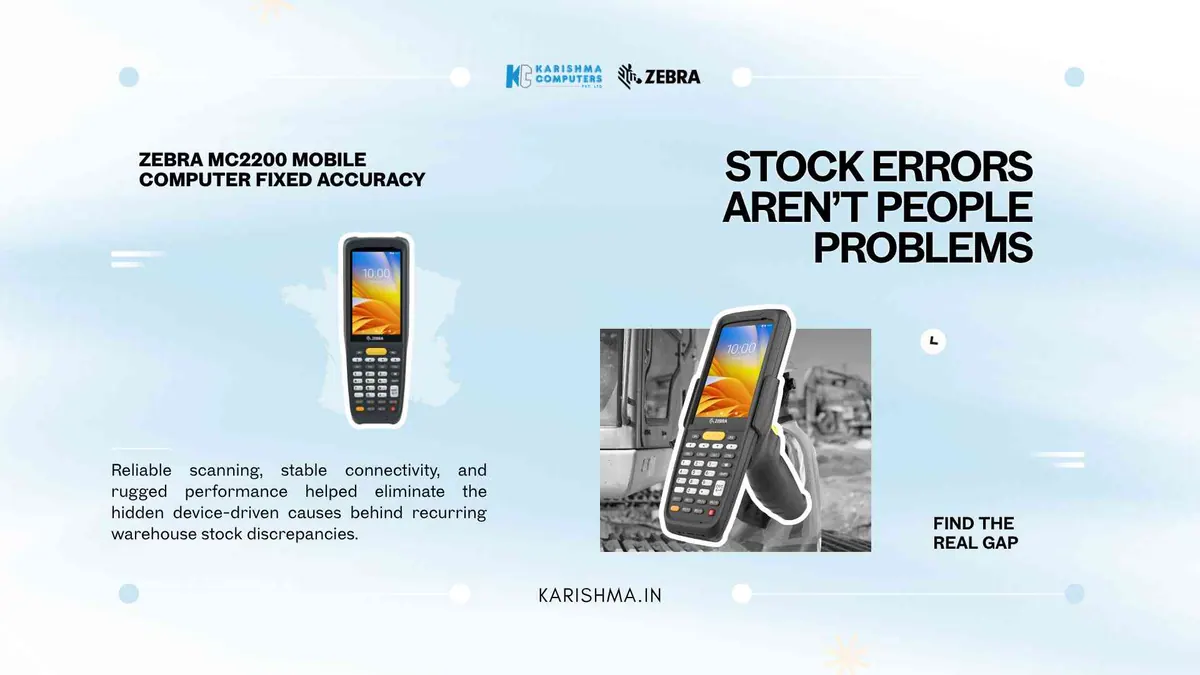
Stock Discrepancies, Real Causes: How the Zebra MC2200 Mobile Computer Can Help Close the Gap
Every stock discrepancy report at a Bhiwadi distribution warehouse got filed under the same heading for a long time, and the Zebra MC2200 mobile computer that was eventually considered was nowhere near that filing. The operations head had taken the mismatches between physical counts and the warehouse management system as a shrinkage problem, staff either miscounting under pressure or, in his more suspicious moments, pilfering small quantities during shift handovers. Extra CCTV coverage went up near the high-value racks. Spot checks increased. The discrepancies kept appearing anyway.
What actually broke the count was never the people. It was the scanning setup: staff were using a barcode app on their own phones, and scans were missed or sessions dropped near the cold storage section where WiFi signal dropped without warning. Every failed scan or dropped session forced a manual re-entry later, from memory, hours after the actual count. That gap between the physical action and the recorded action is where the discrepancies were being born.
The Investigation That Looked in the Wrong Direction First
Management’s first serious response was procedural. A second staff member was assigned to verify every scan against a printed checklist before shift end, adding labour cost to stock verification without changing the scanning set-up. Discrepancies dropped slightly, mostly because the checklist caught some errors after the fact, but the scan failures in the cold storage zone remained. Doubling the audit layer treats a symptom; it does not change where the work actually happens.
This is a pattern across NCR’s logistics corridor, from Faridabad to Greater Noida, where warehouses scale operations faster than they scale the hardware supporting them. A stopgap set-up is reasonable when budgets are tight and volumes are manageable; the question comes up when volume, storage complexity and connectivity demands grow.
Where the Zebra MC2200 Mobile Computer Can Help
The Zebra MC2200 mobile computer is built for warehouse scanning, with an integrated SE4100 1D/2D imager listed on Zebra’s specification sheet. In this scenario, staff at the Bhiwadi facility saw fewer failed scans once the device was used across the receiving and picking teams.
Connectivity and battery life matter too. Please ask us for the manufacturer’s published wireless and battery specifications for the India variant and check them against your cold storage zones and shift lengths. Zebra lists the MC2200 as Android Enterprise Recommended, running Android 11, with a 1-year warranty (specifications can vary by model and region; please confirm the India variant with us). Please check your product’s warranty terms.
The Cost Nobody Had Been Billing to the Scanning Set-Up
The warehouse’s shrinkage provision, a budget line reserved for unexplained inventory loss, had been quietly absorbing the cost of this gap. Finance treated it as an operational risk cost, priced into margins, rather than tracing it back to the scanning set-up. The loss shows up in inventory reconciliation, but the cause can sit several steps upstream, in the tools handed to the floor staff.
Distribution operations across Sector 62 Noida and Indirapuram can face a comparable situation whenever growth outpaces the original hardware decision. A set-up chosen when volumes were modest and storage conditions simpler deserves a fresh look once the operation adds cold storage, higher shelving or denser SKU counts.
Third-party logistics providers running multi-client warehouses face this decision earlier than most, since a single scanning failure affects reconciliation across several client accounts at once. For operations at that scale, standardising on one device can make support simpler.
Choosing the Zebra MC2200 Mobile Computer for Growing Warehouse Operations
The MC2200 is a rugged Android mobile computer. Zebra’s specification sheet lists IP65 sealing, 1.52 m (5 ft) drops, 500 tumbles and an operating range of -20 C to 50 C; please confirm the India variant with us and compare these figures with the daily handling on your warehouse floor.
The Android-based interface may feel familiar to staff, and Zebra’s Mobility DNA tools (such as StageNow, DataWedge and EMDK) help manage a fleet.
There is also a procurement point worth stating directly. When comparing a Zebra MC2200 mobile computer with other options, look beyond upfront device cost to re-scan attempts, manual re-entry hours, the shrinkage provision and replacement cycles. Please ask us for current prices so you can run the comparison for your operation.
The Broader Pattern Behind One Warehouse’s Shrinkage Line
There is an observation here that extends past any single facility. Organisations tend to look first at what they can see and question most easily, usually staff behaviour, before reviewing the equipment staff are working with. Reviewing the equipment alongside the people often brings a faster answer.
That holds whether the operation runs medicine, apparel or industrial components through its racks: recurring, unexplained operational loss deserves an equipment review alongside any people review.
What This Means for Warehouses Scaling Across Delhi NCR
For distribution and logistics operations across Bhiwadi, Faridabad and the wider NCR industrial belt, the practical takeaway is straightforward: match the scanning device to the conditions on your floor. A Zebra MC2200 mobile computer is built for reliable data capture where conditions are demanding, and is one option to consider.
Karishma Computers supplies Zebra products in Delhi NCR. Tell us about your warehouse conditions and we will help you match a device; please confirm the exact model and availability with us.
FAQs
Q1. What does the Zebra MC2200 mobile computer offer for warehouse scanning?
It has an integrated SE4100 1D/2D imager and runs Android, so scanning and your warehouse app sit on one device. Please confirm the India variant with us.
Q2. Is the Zebra MC2200 mobile computer rugged enough for daily warehouse handling?
Zebra’s specification sheet lists IP65 sealing, 1.52 m (5 ft) drops and 500 tumbles. Zebra lists a 1-year warranty; specifications can vary by model and region, so please confirm the India variant and your product’s warranty terms with us.
Q3. Does the Zebra MC2200 mobile computer require extensive staff training?
The device runs an Android-based interface (Zebra lists Android 11), which may feel familiar to staff, while the scanning hardware is built for warehouse use.
Q4. How does the device stay connected to the warehouse management system?
Integration with your warehouse management system depends on your software and Wi-Fi coverage. Please ask us to confirm the details for your setup.
Q5. What battery life can a warehouse team expect from the Zebra MC2200 mobile computer?
Battery life depends on your usage, so please check Zebra’s specification sheet and ask us how it suits your shift pattern. Zebra lists Warm Swap for changing batteries.
Q6. Can the Zebra MC2200 mobile computer be standardised across multi-client 3PL operations?
Standardising on a single device type can simplify support. Please contact us to discuss your requirements.
This article uses an illustrative scenario. Names, figures and outcomes are examples, not customer results.
Keep reading
Not sure which fits?
Tell us what you need. Our team will help you choose and send a quote.