Zebra DS2208 Barcode Scanner Delhi NCR Warehouse
In short An illustrative look at how a Delhi NCR warehouse that blamed its pickers for wrong picks looked at its barcode scanner first, with the Zebra DS2208.
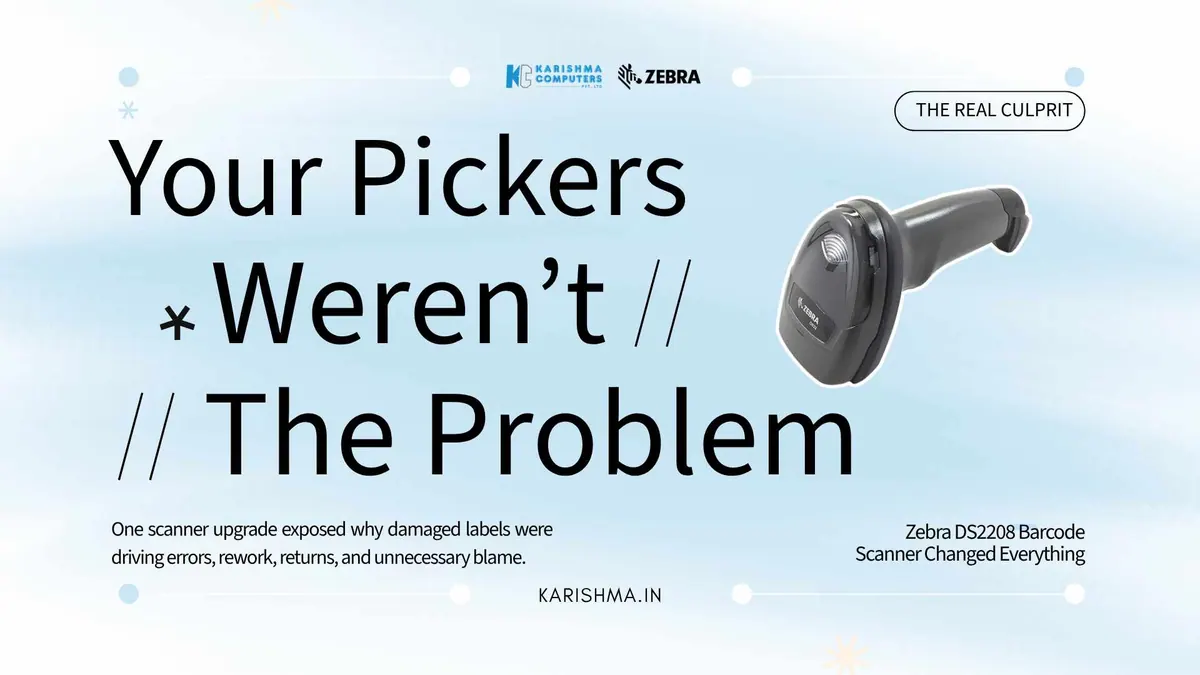
The Warehouse Blamed Its Pickers. A Zebra DS2208 Barcode Scanner Showed Where to Look.
Zebra DS2208 barcode scanner purchases at a Bhiwadi packaging warehouse started as a shift-performance conversation, not an equipment one.
The warehouse had been logging a rise in dispatch errors, wrong cartons going out against right order numbers, for a long stretch. The floor supervisor’s first read on the problem was straightforward: newer pickers on the night shift were rushing, skipping verification steps to hit their per-hour targets. The response was procedural. Pickers were retrained on the scan-before-pack protocol, and a supervisor was rotated onto the night shift specifically to enforce it.
Error rates dipped slightly for a short while, then climbed back to where they started.
Nobody had looked closely at what the pickers were actually working with. Cartons often arrived with labels that had already passed through two other facilities before reaching Bhiwadi. Pickers facing a label that would not scan on the first or second attempt developed a habit: after a few failed attempts, they would manually key in the barcode number from memory or a squint at the label, then move on to keep pace. That manual entry, done under time pressure, was where the wrong-carton errors were actually originating.
Why the Zebra DS2208 Barcode Scanner Was Worth a Trial
This is where the Zebra DS2208 entered the picture, brought in as a trial on two picking stations before the warehouse considered a wider rollout. Zebra describes the DS2208 as a corded 1D/2D array imager that reads 1D and 2D barcodes. Please confirm the India model with us before ordering. In this scenario, an imager suited to the labels reduced the friction point that had been pushing pickers toward manual entry.
The corded design also mattered on a warehouse floor already dealing with cable management around packing stations in Bhiwadi and similar facilities across the Delhi NCR logistics corridor stretching into Greater Noida. A scanner that connects through a cable, with no separate base station or charging cradle to track, can be simpler for the IT team supporting multiple shifts to standardise across stations. Please confirm the interfaces with us.
What the DS2208 Changed on the Floor
In this scenario, manual barcode entry on the picking floor dropped sharply after the rollout. Pickers were not scanning correctly out of newfound discipline. They were scanning correctly because the scanner worked readily on labels that used to need several tries. The scanner removed the moment where a rushed picker used to reach for the keyboard instead of the trigger.
The Cost Nobody Was Billing to the Scanner
The warehouse had never tracked mis-picks as an equipment cost. The number that leadership watched closely was returns and re-shipping charges, a line item that sat inside the logistics and customer service budget, not procurement. Every wrong carton meant a return pickup, a replacement dispatch, and in a few cases a customer credit issued to keep an account from walking. None of that expense was connected back to the scanner at each picking station. Once the DS2208 went in and returns dropped, the connection became clear in hindsight.
Retail counters and warehouses across Okhla, Faridabad and Indirapuram often see the same pattern. A rise in picking or billing errors reads first as a training issue, because it is easier to schedule a retraining session than to audit scanner hardware across dozens of stations. The audit in this scenario showed workers adapting around a tool in ways that looked like carelessness but were the predictable result of labels the scanner found hard to read.
Where a Zebra DS2208 Barcode Scanner Fits in a Delhi NCR Operation
The DS2208 is a general-purpose handheld scanner for a picking station, a retail counter, or a reception desk. For a retail counter in Nehru Place scanning items at checkout, a warehouse in Bhiwadi moving cartons at close range, or a logistics office in Greater Noida processing returns, it suits the working distance of everyday scanning.
A retail or warehouse manager evaluating a barcode scanner should start with the label condition on the floor. A facility handling clean, freshly printed labels in a controlled environment has different needs from one receiving cartons that have travelled through two or three handling points. The DS2208 suits the second scenario, which describes many Delhi NCR retail and logistics operations.
The pattern extends past this one warehouse. When errors rise, it helps to audit the tool alongside the training, and in this scenario the facility looked at scanner and labels together before anything else.
What Setting Up a Zebra DS2208 Barcode Scanner Involves
Please check host software compatibility with your point-of-sale or warehouse management system before rollout, and confirm the interfaces for the India model with us. Ask us if you need help with that check.
A corded 1D/2D imager that reads both 1D barcodes and the 2D codes appearing on shipping labels can cover mixed label formats without needing two separate devices at each station.
For a warehouse in Bhiwadi, the real test is whether a picker under time pressure, holding a damaged label, can get a clean read without reaching for the keyboard. In this scenario, the Zebra DS2208 barcode scanner met that test on the trial stations.
The night shift in Bhiwadi never had a discipline problem. Looking at the Zebra DS2208 barcode scanner earlier might have saved the facility the retraining budget and the returns bill it never knew were connected. Planning a barcode setup for your shop or warehouse? Tell us what you scan, and we will help you shortlist. Karishma Computers supplies Zebra products in Delhi NCR; please confirm the exact model and availability with us.
FAQs
1. What does the Zebra DS2208 (please confirm the India part number with us) scan?
Zebra describes the DS2208 as a corded 1D/2D array imager that reads 1D and 2D barcodes. Please check Zebra’s Asia-Pacific product page and ask us about label conditions you are concerned about.
2. Is the Zebra DS2208 (please confirm the India part number with us) a wired or wireless scanner?
The DS2208 is a corded scanner. Please confirm the interface options of the India model with us.
3. Can the Zebra DS2208 barcode scanner read damaged or wrinkled labels?
Read performance on damaged or wrinkled labels depends on the label condition. Please bring sample labels and we can discuss what to expect.
4. What is the ideal use case for the Zebra DS2208 in a Delhi NCR business?
It suits everyday scanning at picking stations, retail billing counters and reception desks across Delhi NCR, including retail counters in Nehru Place, warehouses in Bhiwadi, and logistics offices in Greater Noida.
5. How long does it take to set up a Zebra DS2208 barcode scanner at a picking station?
Please check host software compatibility for your point-of-sale or warehouse management system, and ask us for help with setup.
6. Can the right scanner reduce manual barcode entry errors?
A scanner that suits your label conditions can reduce the situation where staff under time pressure resort to manually keying in a barcode number, which is a common source of mis-scan and mis-pick errors. Results depend on your labels and workflow.
This article uses an illustrative scenario. Names, figures and outcomes are examples, not customer results.
Keep reading
Not sure which fits?
Tell us what you need. Our team will help you choose and send a quote.