
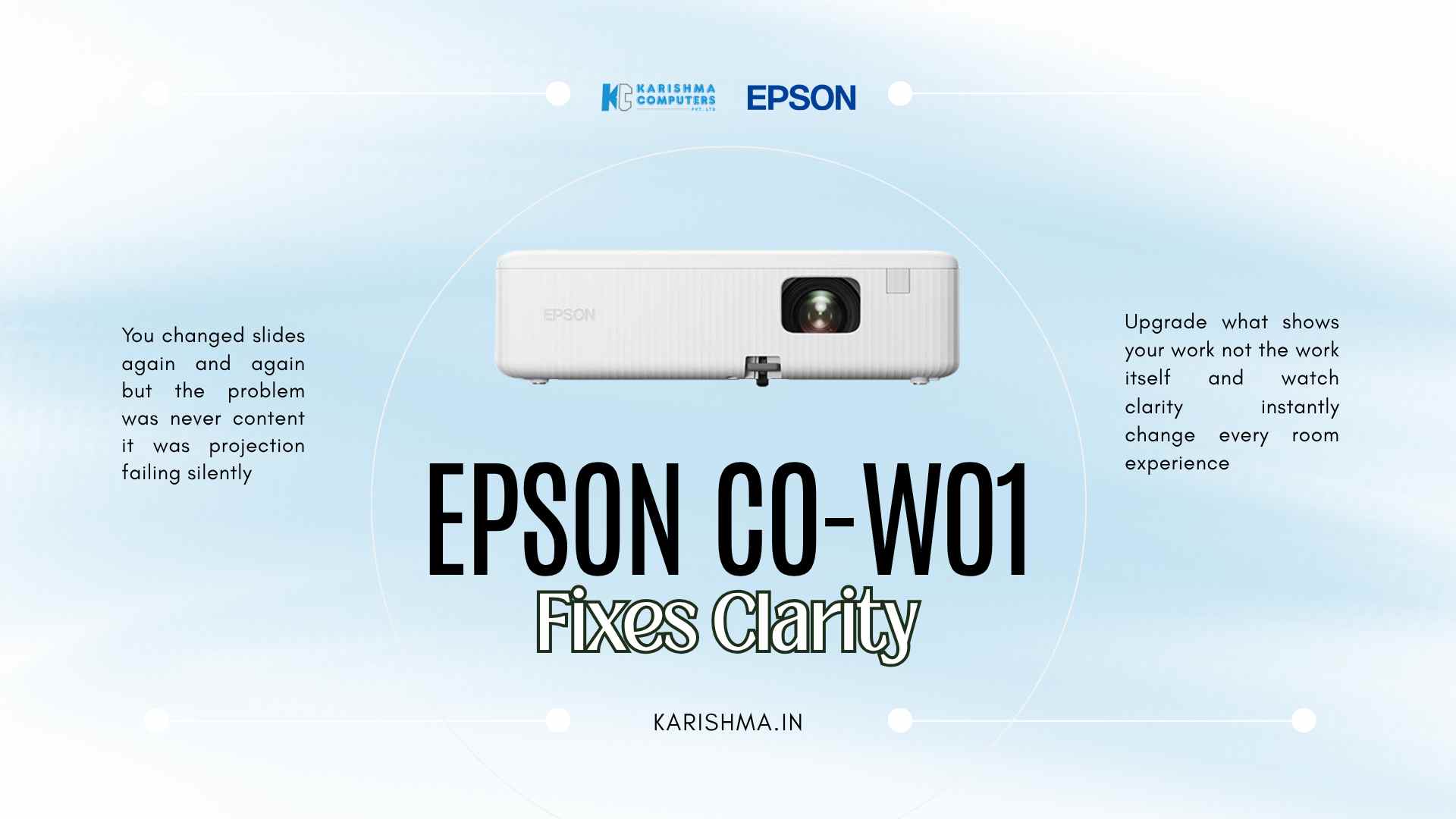
Poor Projection or Poor Preparation: Why the Epson CO-W01 WXGA Projector Settles the Debate
For three months, the Epson CO-W01 WXGA projector in a Noida Sector 62 training facility sat at the centre of a problem nobody diagnosed correctly. The training team had revised slide decks four times. Session durations were trimmed. A consultant reviewed the adult learning framework. One senior facilitator quietly stopped accepting bookings for that specific room. Review scores for sessions held there ran consistently below scores for the same content delivered elsewhere. Nobody had examined the equipment. This is a pattern visible across conference rooms and training spaces throughout Delhi NCR. The medium degrades, the message takes the blame, and the teams caught between them spend months adapting their communication style to the limitations of failing hardware. What the Team Got Wrong First Before the facilities team brought in a vendor to audit the room, the training department had already attempted a fix. Every slide deck was redesigned with high-contrast layouts, white text on dark backgrounds, enlarged fonts throughout. Data tables were broken into multiple slides to avoid small figures. The effort moved participant scores slightly. It did not address the actual problem. What was happening: a six-year-old single-chip unit, acquired when the training room was half its current size, was projecting washed-out images under the room’s ambient light. The resolution existed on the specification sheet, but single-chip projection cannot deliver colour brightness equal to white brightness. Data-heavy slides were unreadable past the fourth row of chairs regardless of font size. Colour-coded performance charts meant to carry the session’s core argument arrived at participants as indistinct grey patches. The invisible cost had been charged to trainer performance. Review scores were tracked against individual facilitators. One of the most experienced trainers in the department had started declining bookings in that room specifically. The projector had never appeared in any conversation about the problem. Why the Epson CO-W01 WXGA Projector Changed What Slide Redesigns Could Not The equipment change produced results within the first week that eighteen months of slide redesigns had not. Three aspects of the transition are worth examining closely. 3LCD Technology and the Colour Accuracy Gap Most Organisations Never Benchmark Epson’s 3LCD technology uses three separate liquid crystal display panels, one dedicated to each primary colour channel. The outcome is that colour brightness equals white brightness, a claim single-chip DLP projectors cannot make. In practical terms, a spreadsheet with green, amber, and red performance cells projected in a Gurgaon Sector 44 boardroom at eleven in the morning, with blinds half-drawn against direct light, looks the same as it does at seven in the evening in a darkened room. Most organisations do not measure colour brightness independently of white brightness. The distinction is invisible until the projector changes. What teams observe is that certain presentations seem to work better in certain rooms, and they attribute this to lighting, room size, or presenter skill. The equipment is doing the work, and when the equipment works well it disappears entirely from the analysis. Why the Epson CO-W01 WXGA Projector’s Lamp Life Matters More Than Purchase Price Up to 6,000 hours of lamp life in eco mode is the figure that changes the total cost of ownership calculation for operations teams. For a training facility in Connaught Place running two sessions daily, that figure translates to approximately four years before lamp replacement enters the maintenance schedule. Organisations that compare projector prices without including lamp replacement cycles are comparing incomplete numbers. In practice, training rooms and mid-size boardrooms across Delhi NCR run projectors harder than the equipment’s light-use case assumes. Four to six hours daily, five days a week, across twelve months of NCR conditions. The lamp life figure is not promotional in that context. It is a procurement variable, and it belongs on the same line as the purchase price. What Offices in Delhi NCR Are Discovering An architecture firm in Okhla Industrial Area had been printing large-format reference images for client presentations for several months. The practice began after the principal architect noticed that rendered images presented via projector consistently prompted feedback that the colours were different from the files. The office manager eventually raised the question that led to the equipment review: why are clients being asked to imagine what the screen cannot show them? A supplier training programme in Faridabad, running three times weekly with different vendor cohorts, had been adding a disclaimer slide at the start of every session. It explained that the reference materials would look different on participants’ own screens. The disclaimer had become standard procedure. No one had connected it to the projection equipment. In both cases, the Epson CO-W01 WXGA projector replaced equipment that had required behavioural workarounds for long enough that the workarounds were no longer recognisable as workarounds. They had become process. The Resolution Specification That Addresses the Most Common Boardroom Complaint WXGA resolution, 1280 by 800 pixels, provides a 16:10 aspect ratio that matches contemporary widescreen laptop displays more accurately than XGA standard projectors. When a presenter’s laptop shows a slide designed for a widescreen display, the projected image fills the screen without vertical compression or letterboxing. The visual consistency across different presenters and different devices depends directly on the projector’s native resolution aligning with the source material’s native format. This matters in rooms where multiple presenters connect sequentially with different laptops and different display configurations. Mixed-resolution projection environments, common in older office setups across Nehru Place and DLF Cyber City, introduce a category of visual inconsistency that looks exactly like a content design problem. It is an equipment problem. One Observation Worth Carrying Beyond This Conversation Organisations adapt to their tools more readily than they question them. This is consistent across industries and equipment categories. When a medium consistently distorts the message, the first response is nearly always to change the message. Fonts grow larger. Colour palettes shift to compensate for projection weakness. Presenters move physically closer to the screen. Disclaimers get added to the start of presentations. By the time the tool is replaced, the adapted behaviour has frequently