
Honeywell Mobile Computer EDA52
In short A rugged Honeywell mobile computer, the EDA52, is a rugged Android handheld computer for Delhi NCR field and warehouse teams.
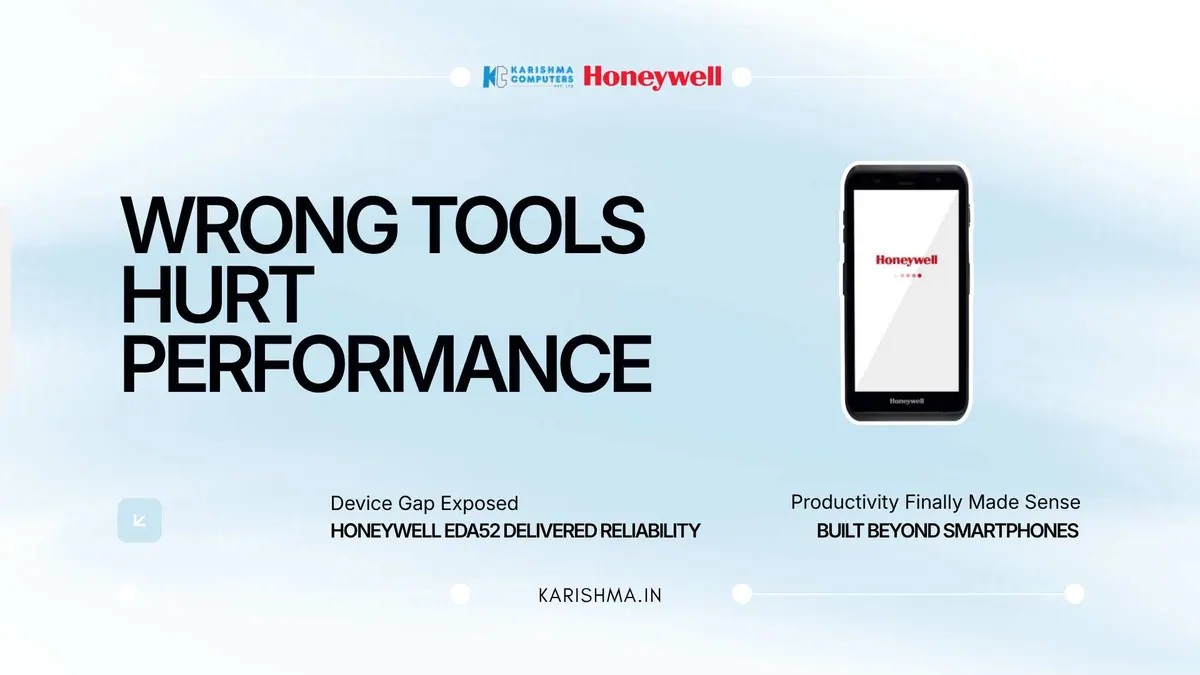
Why a Honeywell Mobile Computer Is Worth Considering When Field Scans Keep Missing
The Honeywell mobile computer and a productivity gap that was really a workflow gap
In this scenario, a last-mile delivery company in Noida Sector 62 spends a long stretch convinced it has a field-team performance problem. Deliveries per rider are below target, proof-of-delivery scans are missing, and the operations head begins tightening incentives and adding performance reviews. The working theory is that riders are cutting corners.
The incentives change the mood on the floor and not the numbers. Riders scan parcels and capture proof of delivery on handsets that were not chosen for scanning all day. Scans miss, screens are hard to read outdoors, batteries run low, and glass cracks after a drop on a service road. The riders are not underperforming. The workflow needs a device chosen for it.
A purpose-built Honeywell mobile computer can fit that workflow. The EDA52 is a rugged Android handheld computer with an integrated 1D/2D imager. Specifications, warranty and kit contents depend on the India model; please ask us for the India datasheet before you order, and please ask us whether the EDA52 is available in India. In this scenario, once the fleet moves to a purpose-built handheld, scanning problems ease.
What a dedicated handheld offers a field team
The EDA52 runs Android, so it feels familiar to a rider, and it carries a dedicated imager built for scanning rather than relying on a phone camera. A dedicated scan engine can remove some of the missed scans that were being read as rider error.
Ruggedisation is the second point. Field conditions are rough on devices, so durability and protection ratings are worth checking on the India datasheet for any handheld you consider.
Where a Honeywell mobile computer earns back its cost
Battery handling is where field mobility succeeds or fails. Please ask us how battery options suit your route length and shift pattern.
The cost hidden inside the HR budget
In this scenario, the company pays a real cost and posts it to the wrong function. Missed scans and low delivery counts trigger performance management. The cost shows up as HR time on reviews, as attrition when good riders leave under pressure they did not deserve, and as recruitment to replace them. All of it is booked against people, and none of it against devices.
When a purpose-built handheld fleet goes in, scan rates can recover and the pressure on riders can ease. The benefit lands in HR and recruitment, departments that are rarely part of a hardware conversation.
Looking at the tool before the person
This applies well beyond logistics. When output falls, organisations tend to look first at the person producing it and last at the equipment that person was given. A field worker can only be as effective as the tools allow. The organisations that get field mobility right ask what the worker was equipped with before they ask what the worker did.
Choosing between a rugged handheld and a phone in a protective case
A common half-measure is a phone in a protective case. A case addresses breakage, while the scanning workflow still depends on a phone camera. A dedicated handheld has an integrated imager designed for scanning. Please check the India datasheet for the codes and conditions you need to scan.
Where a Honeywell mobile computer changes the economics of a field fleet
Total cost of ownership is worth calculating. Replacement, downtime and support costs often never appear in the original purchase comparison. Please ask us for the details so you can compare over the life of the device.
For delivery fleets, warehouse teams and field-service operations across Noida, Gurgaon and the industrial corridors of Faridabad, a rugged Honeywell mobile computer is worth shortlisting. Tell us your workflow and we will help you shortlist a model from the datasheets.
Q1. What is the Honeywell EDA52 used for?
The EDA52 is a rugged Android handheld computer with an integrated 1D/2D imager for field, warehouse and delivery work. Please ask us whether the EDA52 is available in India.
Q2. How does a dedicated rugged handheld differ from using a phone for scanning?
A rugged handheld has a dedicated imager built for scanning and is made for field conditions, whereas a phone scans through its camera. Details such as battery, durability and protection depend on the India model; please ask us for the India datasheet.
Q3. Does the EDA52 run Android?
It is an Android handheld. Please confirm the Android version shipped with the India model with us.
Q4. Can a handheld last a full work shift on one charge?
It depends on the model and on your scanning and connectivity use. Please ask us to help you plan for your shift pattern.
Q5. Is the EDA52 suitable for managing a large device fleet?
Fleet management options depend on the India model and your own systems. Please ask us which device management options suit your fleet.
Q6. Where can Delhi NCR businesses ask about the Honeywell EDA52?
Karishma Computers supplies Honeywell products in Delhi NCR. Please ask us about the EDA52 and its availability.
This article uses an illustrative scenario. Names, figures and outcomes are examples, not customer results.
Keep reading
Not sure which fits?
Tell us what you need. Our team will help you choose and send a quote.