The Epson EcoTank L3210 sits in thousands of Delhi NCR homes, doing something most families did not plan for: ending a monthly expense that was being absorbed into grocery budgets, school supply lists, and petty cash drawers, quietly, without a single line item tracking it.
The Problem That Was Diagnosed Wrong
A family in Vasant Kunj spent two years rotating through cartridge-based printers. Two machines replaced in 24 months. The assumption, shared honestly in a conversation at the service counter, was that the printers were defective. The second machine cost more specifically because the first seemed cheap. The third purchase, a tank-based system, revealed the actual problem within weeks.
Cartridge drying. Not hardware failure. The family printed an average of 40 pages a week. At that volume, cartridges dried between print sessions because the gap between uses was long enough for nozzles to clog. They had replaced two printers for a reason that had nothing to do with the printers.
This pattern repeats across homes in Noida, Faridabad, Rohini, and Indirapuram. The diagnosis is consistently wrong the first time. The solution gets purchased twice.
What the Epson EcoTank L3210 Actually Solves
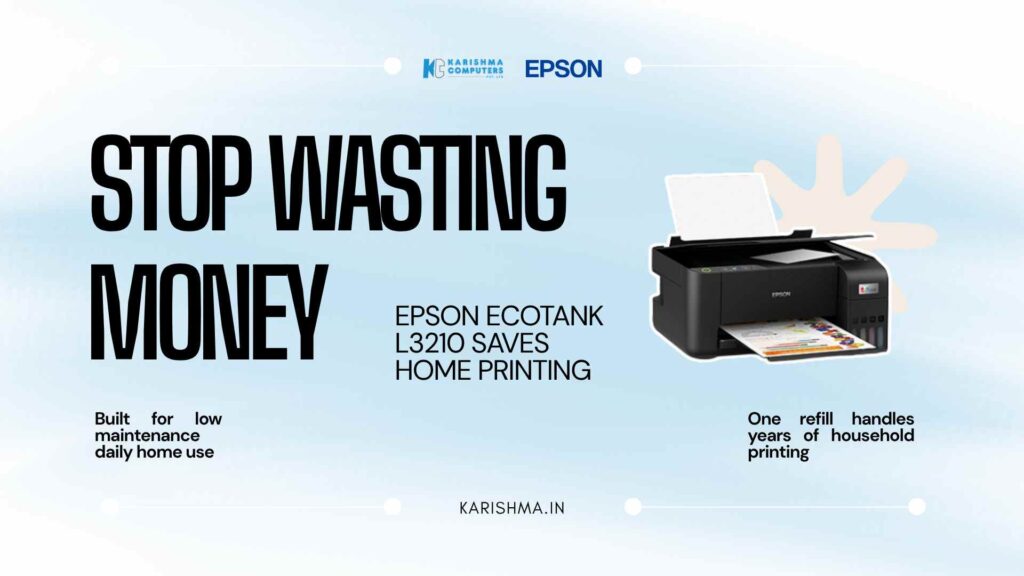
The Epson EcoTank L3210 is a three-in-one unit handling print, scan, and copy. At Rs 9,499 to Rs 11,000 depending on retailer, it enters a segment where most buyers are comparing upfront cost and ignoring what happens at the second ink purchase.
With the EcoTank system, ink arrives in bottles, not cartridges. The tank holds enough for 4,500 black-and-white pages and 7,500 color pages per fill. At a household printing average of 150 to 200 pages a month, that translates to roughly two to three years between ink purchases. The annual printing cost drops below Rs 1,000 in most household scenarios, compared to Rs 3,000 to Rs 5,000 per year on cartridges.
The transparency tanks are not a design choice. They solve a specific problem: households run out of ink mid-assignment, mid-report, mid-form. The visible ink level removes that uncertainty.
How Heat-Free Technology Changes Home Printer Economics
Epson’s Heat-Free Technology inside the Epson EcoTank L3210 is the reason the drying problem disappears. Traditional inkjet print heads use heat to push ink through nozzles. Heat accelerates evaporation. When printing frequency drops, the residual ink in the nozzle dries faster.
Heat-Free Technology eliminates heat from the ink delivery mechanism entirely. The print head uses piezoelectric pressure instead. Ink is pushed mechanically, not thermally. A printer sitting idle for two weeks does not behave the same way it would with a heat-based system. Nozzles remain ready. The cost of a missed use session is zero rather than one cleaning cycle plus wasted ink.
For a student household where printing happens in bursts at the beginning of a term and then not at all for six weeks, this is the specific advantage that justifies the product.
The Invisible Invoice in Most Home Printing Setups
The cost of a failed print is rarely calculated. A document printed in faded output is reprinted. A nozzle-check printout consumes ink. A cleaning cycle runs before the actual job. These micro-costs appear nowhere in the household budget. They show up as unexpectedly empty cartridges and the accompanying frustration of discovering this at 10 PM before an exam.
The real budget line being affected was not the printer line. It was the school supply line. Families buying cartridges frequently were categorising them as stationery, not as printer maintenance. The Epson EcoTank L3210 does not just reduce ink costs. It removes the event from the purchase calendar entirely.
The Print Quality Argument for Home Use
At 5760 x 1440 dpi resolution, the L3210 handles borderless photo printing at 4R size, A4 document output at quality that reads cleanly on submitted schoolwork, and color graphics that hold accuracy across repeated prints. The Micro Piezo print head technology inside the unit is part of Epson’s 40-year investment in precision printing. It is not a feature added for the home segment. It is the same fundamental technology present in Epson’s professional and commercial line.
This matters when teachers and institutions print marking guides, when freelancers working from Lajpat Nagar apartments print client-facing materials, and when family photo albums are assembled from home prints rather than lab orders.
A Pattern Observed Across Delhi NCR Homes
A 2023 retail purchase analysis across Nehru Place and Connaught Place stores identified the most common trigger for ink-based printer replacement as clogged nozzles, not hardware failure. The customers replacing printers were reporting the same sequence: print frequency dropped, quality declined, a cleaning cycle did not resolve it, a new machine was purchased.
In almost every case, the original machine was functional. The failure was a system mismatch. A heat-based cartridge printer in a low-frequency household environment was the wrong tool. The machine was working exactly as designed for high-frequency environments, and poorly for the household it was actually in.
The Epson EcoTank L3210 is the correct match for that household profile. Low-frequency printing, occasional high-volume bursts, cost sensitivity over multi-year horizons, and a strong preference for zero-maintenance operation.
The Scan and Copy Functions in Practice
The flatbed scanner in the Epson EcoTank L3210 handles A4-size documents. For households managing school records, medical documents, tax filings, and property papers, a scanner at this price point eliminates the need for a courier shop visit. A scanned PDF of a rent agreement, a copied identity document, a preserved exam paper from a previous year. These are not enterprise needs. They are household administrative tasks that currently require going somewhere else to complete.
Households in Dwarka, Pitampura, and Sushant Lok where the nearest photocopy shop requires a vehicle trip or a 15-minute walk have a practical calculation to run. The Epson EcoTank L3210 charges that cost against a one-time hardware purchase rather than a recurring shop visit.
What Changes After the First Refill
The first ink bottle set comes bundled with the machine. The second purchase, when it eventually arrives, is where the economics become visible. A full set of EcoTank ink bottles costs approximately Rs 800 to Rs 1,200 at authorised retailers. That set handles between 4,500 and 7,500 pages depending on content type.
For a household printing 150 pages monthly, the math runs to 30 to 50 months of printing per ink set. Most households refill once every three to four years. At that frequency, the Epson EcoTank L3210 becomes one of the lowest total-cost-of-ownership devices in a home, comparable to sustained appliance usage rather than recurring consumable spending.
The standalone observation that applies beyond this product: most household technology decisions are evaluated on sticker price because the running cost arrives in small enough increments that it never triggers a review. The moment running costs are aggregated over 24 months, the more expensive upfront purchase frequently wins the calculation. This is not unique to printers. It is how subscription software, car maintenance, and energy consumption behave as well.
Karishma Computers Supplies the Epson EcoTank L3210 Across Delhi NCR
Karishma Computers, an authorised Epson distributor and reseller serving Delhi NCR, supplies the Epson EcoTank L3210 with full warranty and post-purchase support. Enquiries can be directed to karishma.in.