How the Fujitsu fi-800R Scanner Ends a Bottleneck Hospitals Misdiagnose
The Fujitsu fi-800R scanner was not in the conversation when a four-branch diagnostic chain operating its administrative headquarters from a Karol Bagh building spent the previous calendar year struggling with a records digitisation backlog that kept growing. The backlog was eight months old when the chief operating officer first noticed it as a serious concern and was fourteen months old when he commissioned an external consultant to recommend a fix. The consultant’s recommendation, after a two-week study, was that the records department needed three more staff members.
The recommendation was acted on. The three staff members joined. The backlog continued to grow.
What Hospitals and Diagnostic Chains Get Wrong About Records Backlogs
A medical records department is a peculiar kind of operation. The documents arriving for digitisation are not uniform. A single patient file might contain referral letters on doctor’s letterhead, prescription printouts on thermal paper, laboratory report sheets in A4 size, ultrasound images on glossy photo paper, scanned films, identity card photocopies, insurance authorisation forms in landscape orientation and signed consent documents on legal-size paper. Every patient file is a different combination.
The diagnostic chain was running this digitisation through a refurbished sheet-fed scanner that had been adequate for back-office paperwork in its first life and was hopelessly inadequate for medical documentation. Each file required pre-sorting by paper type, weight and size. The thermal-paper prescriptions had to be flattened first because they curled. The glossy ultrasound images had to be scanned separately because they jammed against thinner paper. The records staff had become unconscious experts in paper management, and the actual job, which was digitising patient files, was happening in the gaps between paper management.
The misdiagnosis is widespread. A backlog gets treated as a throughput problem solved by adding people. The actual problem is often a per-item handling problem that adding people does not solve. Three new staff joining an inefficient process produce three more inefficient operators.
What the Fujitsu fi-800R Scanner Replaces in a Hospital Records Department
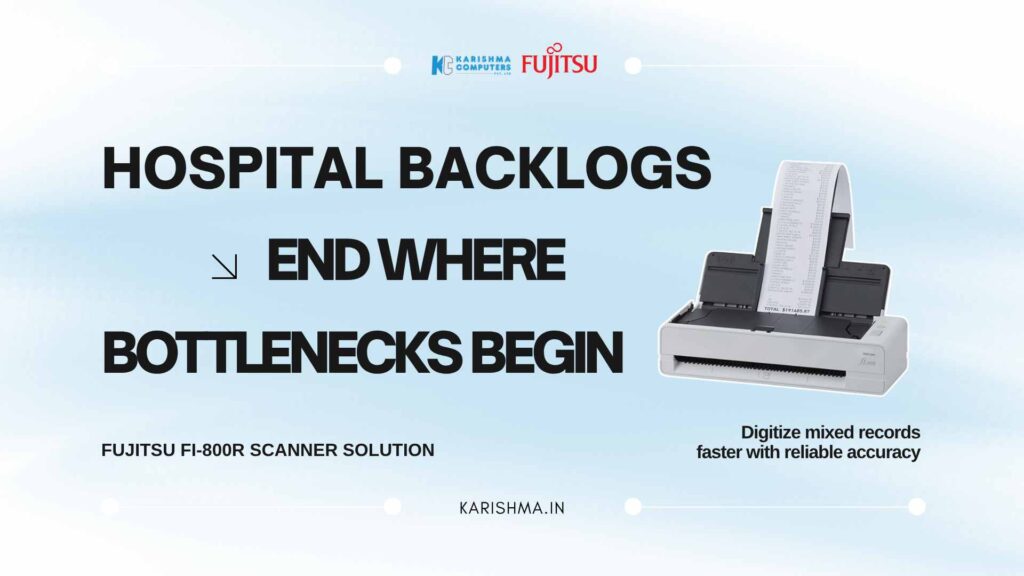
The fi-800R is engineered for exactly this kind of high-mix, low-uniformity document workflow. Its paper-protection sensors handle the differences in paper weight without jamming. The intelligent multi-feed detection accepts the mixed stacks that medical files inevitably are. The thirty-page automatic feeder allows an entire patient file to be loaded at once and processed without staff intervention.
How the Fujitsu fi-800R Scanner Handles Mixed Medical Documentation
The crucial feature for medical environments is the mixed-batch acceptance. A patient file does not need to be sorted before scanning. The records clerk loads the file as it arrives, and the device handles the rest. Thermal-paper prescriptions, glossy image prints, embossed identity cards, thin lab-result slips and standard A4 letterhead all pass through the same feed path. The image quality is consistent across paper types, which matters because medical documentation that loses detail in the scanning process is documentation that has to be re-scanned, and re-scanning compounds the backlog rather than reducing it.
Why a Hospital Records Desk Has Different Requirements
A hospital records department also has a different operational rhythm than an office back-room. The records clerk is rarely working in a quiet environment. The phone rings constantly. Patients and family members arrive at the counter asking for old reports. Insurance verifiers call asking for authorisation documentation. The clerk cannot afford to stand at a slow scanner waiting for it to finish. The fi-800R’s front-loading design allows the clerk to load a file, walk to the counter to handle a patient query and return to find the file digitised. The geometry of the device is built for an operator who has multiple competing demands on attention.
The Recruitment Drive That Did Not Solve the Problem
The chain’s three new records staff arrived in February. The backlog continued to grow through March, April and May. The chief operating officer began to wonder whether the consultant had misread the problem. The consultant had read the symptoms correctly. The recommendation had been wrong because the consultant had not examined the actual document handling at sufficient depth. The bottleneck was at the device, not at the desk.
This is the wrong turn that hospital and diagnostic administrators routinely take. People shortages are visible. Equipment inefficiencies are not. The visible answer gets pursued first, and the invisible answer reveals itself only after the visible answer has failed.
Where the Real Cost of the Backlog Was Quietly Sitting
The cost of the records backlog had been hiding in places that did not look like backlog costs. It had been hiding in the chain’s insurance reimbursement cycle, which had stretched because authorisation documents could not be located quickly. It had been hiding in the legal compliance audit, which had flagged record retention concerns that the chain was now scrambling to address. It had been hiding in the patient satisfaction scores, which had begun to mention difficulty in retrieving past reports for second opinions. It had been hiding in the chief operating officer’s stress levels, which had begun to affect his decision-making in other parts of the business.
The Fujitsu fi-800R scanner absorbed it. The backlog began to shrink within the first month of deployment. The three new staff members the chain had hired turned out to be exactly the right number of staff once they were equipped properly. The chief operating officer’s external consultant had been right about the headcount and wrong about the bottleneck. The chain ended up with a properly staffed records department working at the throughput the staffing implied.
The Same Device in an Insurance Claims Context
The pattern repeats in adjacent industries. A health insurance third-party administrator operating from a Bhikaji Cama Place office had been struggling with claim processing turnaround. The investigation pointed to staff inefficiency. The actual cause was a scanner workflow that turned every claim file into a paper-management exercise. The same scanner ended the workflow problem inside two months and the claim turnaround recovered to the levels promised in the administrator’s service-level agreements.
Why the fi-800R Is the Right Device for Compliance-Heavy Workflows
The fi-800R earns its position in compliance-heavy industries because of two characteristics that the published specifications do not foreground. The first is the image-quality consistency that makes OCR output trustworthy enough to feed directly into records systems without manual verification. The second is the operational reliability that comes from a device engineered for daily heavy use. Compliance workflows cannot tolerate scanner downtime in the middle of a regulatory deadline. The fi-800R is built to keep running through the kind of intense weeks that compliance departments routinely have. The device’s daily duty cycle is rated for sustained mixed-document throughput, which is the metric that matters in compliance environments where the volume rises sharply around audit dates, statutory cycles and grant reporting windows.
What Procurement Teams Often Underweight
A procurement team evaluating scanners for a compliance environment often focuses on the speed specification on the product datasheet. The speed matters, but it is rarely the binding constraint in practice. The binding constraints are the per-page handling time before scanning, the failure rate on mixed-paper batches and the operator time lost to scanner downtime. The fi-800R wins on all three. The mixed-batch acceptance removes the pre-sort step. The paper-protection design reduces jam-driven downtime to near zero. The image-quality consistency removes the re-scan loop. These three characteristics, taken together, are what convert a scanner from a tool into a piece of infrastructure that the records department can actually rely on.
A Standalone Observation
A pattern is visible across compliance-heavy industries in Delhi NCR. The instinct when faced with a backlog is to add headcount. The braver decision is often to audit the equipment first. A scanner upgrade that costs less than a single annual salary can sometimes do the work of three additional staff members. The choice gets made for headcount because headcount looks like a decision and equipment looks like maintenance. The Fujitsu fi-800R scanner is rarely the most expensive scanner in the conversation. It is often the one that closes the file.
FAQs
-
Q1. Is the Fujitsu fi-800R scanner suitable for hospital records workflows?
Yes. The Fujitsu fi-800R scanner was engineered specifically for the kind of mixed-paper, mixed-size, mixed-weight workflow that hospital records, diagnostic chains and insurance claim processing routinely involve. Its paper-protection sensors, intelligent multi-feed detection and front-loading design suit a counter where the operator has multiple competing demands on attention.
-
Q2. Can the fi-800R handle thermal paper prescriptions without jamming?
Yes. The fi-800R’s feed path and paper-handling sensors accept thermal paper, including prescriptions that have curled with age. The device’s image-quality output on thermal originals is generally good enough to support OCR processing without manual re-keying.
-
Q3. How does the fi-800R handle glossy ultrasound images?
The device accepts glossy photo-paper documents through its standard feed path. The image-quality calibration is suited for medical imaging documents, and the multi-feed detection prevents the jam-prone situations that occur when glossy and standard paper are mixed in the same batch.
-
Q4. Does the fi-800R work with hospital management software?
The fi-800R is supplied with TWAIN and ISIS drivers, which are compatible with most hospital management, electronic medical record and document management systems used in India. Integration is typically a configuration task rather than a software development task.
-
Q5. What is the duty cycle of the fi-800R?
The fi-800R is rated for daily scanning volumes appropriate to medium and high mixed-document workflows. Diagnostic chains and hospital records departments processing hundreds of patient files per day are within its operating envelope.
-
Q6. Where can a Delhi NCR healthcare or insurance business buy the Fujitsu fi-800R?
Karishma Computers is the authorised channel for Fujitsu imaging products in Delhi NCR. The fi-800R is supplied with deployment guidance and integration support for hospital, diagnostic and insurance back-office environments across Karol Bagh, Bhikaji Cama Place, Saket, Faridabad and the medical corridors of NCR.