Why the Fujitsu ScanSnap SV600 Solves a Problem Sheet-Fed Scanners Cannot Touch
The Fujitsu ScanSnap SV600 was not in the conversation when a third-generation law publishing house operating from a building in Daryaganj’s publishing district spent three years stalled on a digitisation project that had been promised to its institutional clients. The publisher held a reference collection of pre-Independence case-law volumes, royal commission reports and government gazettes that ran to several thousand bound volumes. The institutional clients wanted searchable digital access. The publisher wanted to deliver it. The project had not moved in three years because every digitisation vendor approached had returned the same answer. The volumes would need to be unbound. Each page would have to be fed through a sheet-fed scanner. The spines would need to be cut. The originals would need to be rebound afterwards, or replaced with replicas.
The publisher could not accept the unbinding. Several of the volumes were the only surviving copies of certain editions. The university libraries that owned other copies would not permit destructive scanning. The project sat. The institutional clients moved on. The publisher’s reputation took a quiet hit.
What Most Archive Digitisation Approaches Get Wrong
The misattribution in archive digitisation is structural. Sheet-fed scanners, including very good ones like the Fujitsu fi-series, are designed for unbound documents. They cannot handle a bound book without unbinding it. The industry default for bound-document digitisation became, by necessity, the destructive route. The originals were sacrificed to produce the digital copies. For most modern documents this trade-off was acceptable. For archival, irreplaceable or culturally significant volumes, it was not. The result was a category of documents that simply did not get digitised because the only available method was unacceptable.
The publisher’s three-year stall was a category problem, not a procurement problem. No amount of negotiation with sheet-fed scanner vendors was going to produce a different answer.
What the Fujitsu ScanSnap SV600 Brings to a Reference Archive
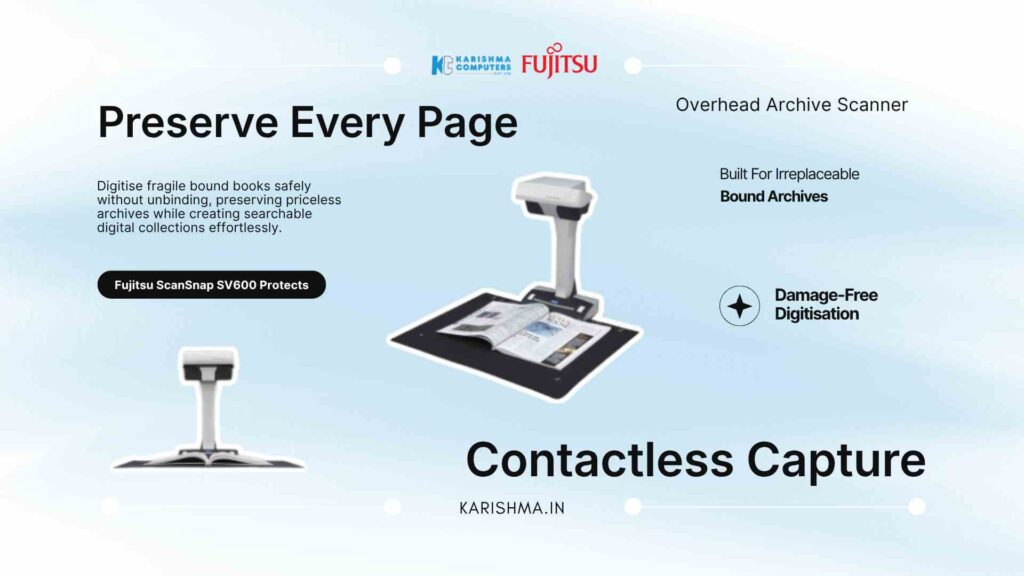
The SV600 is an overhead contactless scanner. The book or document is placed face-up on the scanner’s base. An overhead lamp arm illuminates the page. A camera mounted in the arm captures the image from above. The book is never closed, never unbound, never even touched by the scanning mechanism. The page being captured is exposed for the duration of the scan and then turned by the operator.
How the Fujitsu ScanSnap SV600 Handles a Bound Book Without Damage
The mechanical design of the SV600 is the entire point of the product. There is no feed roller, no glass platen pressing down on the page, no force applied to the spine. A two-hundred-year-old bound volume can be scanned without putting any more stress on the binding than reading the book by hand would. The scan completes in roughly three seconds. The operator turns the page. The next scan begins.
The SV600’s image-processing software handles the curvature of an open book automatically. The page that bends towards the spine, which would distort badly in a flat-bed scan, is corrected in real time so that the captured image reads as if the page were flat. The text in the gutter, near the spine, comes out at the same scale and clarity as the text near the outer edge.
Why Overhead Contactless Scanning Is a Different Category
The SV600 is not competing with sheet-fed scanners. It is occupying a category that sheet-fed scanners cannot enter. This distinction matters for procurement teams who have spent years specifying scanners by speed and feed capacity. Those specifications are meaningless for bound, fragile or oversized originals. The relevant specifications for the SV600 category are page-curvature correction, lamp intensity uniformity, capture area dimensions, finger-detection software that excludes the operator’s hand from the captured image and the overhead clearance required for the device to operate.
The Wrong Compromise That Came First
The Daryaganj publisher had considered, before accepting that the SV600 existed, an unhappy compromise. The publisher had begun negotiating with a vendor who proposed photographing each page with a high-resolution camera mounted on a copy stand, with the volumes held open by hand by an operator. The image quality was inconsistent. The capture rate was slow. The cost per page was high enough to make the full project economically unviable.
This is the wrong turn that archive holders routinely take. The instinct, when the obvious method is unacceptable, is to improvise a custom workflow. The improvisation rarely scales. The actual answer is to use a device that was designed specifically for the use case, which is exactly what the SV600 is.
Where the Real Cost of the Bound-Document Problem Was Hiding
The cost of the un-digitised archive had not been appearing under any line item called archive cost. It had been appearing in the publisher’s lost institutional contracts, which had moved to digital-first competitors who happened not to have legacy holdings of the same depth. It had been appearing in the publisher’s senior editor time, which was being consumed by physical retrieval requests that a searchable digital archive would have handled in seconds. It had been appearing in the publisher’s relationship with research scholars, who had begun to view the holdings as inaccessible rather than valuable. It had been appearing in the slow erosion of a generational reputation that the publishing house had been built on.
The Fujitsu ScanSnap SV600 absorbed all of it. The digitisation project moved from indefinitely stalled to actively producing within a single month. The institutional contracts began to return. The senior editors returned to editorial work. The scholars returned to using the archive, this time digitally.
The Same Device in a University Library Setting
The principle generalises across institutional libraries, museum archives, religious manuscript collections and personal heritage archives. A private trust managing the personal library of a former Indian diplomat in Lutyens Delhi had been holding eight hundred bound volumes that the trustees wanted digitised for family access without dispersing or risking the originals. The SV600 made the project possible in a way that no sheet-fed scanner could. The trust scanned the entire collection over six months. The originals stayed bound and shelved exactly as they had been.
Why the SV600 Sits Where It Does in Fujitsu’s Imaging Portfolio
Fujitsu’s imaging portfolio spans the high-volume production scanners that run document factories, the mid-range office scanners like the fi-800R, the small-office ScanSnap range and the specialised SV600 in the overhead category. The SV600 is the device that handles the documents the rest of the portfolio cannot. This positioning is deliberate. Fujitsu engineered the SV600 specifically for the use cases that sheet-fed scanning cannot serve, and the product has occupied that category essentially alone in the Indian market for over a decade. A buyer considering the SV600 is rarely also considering a sheet-fed scanner. The two devices answer different questions, and an organisation with serious archival holdings often ends up owning both, with the SV600 handling the bound originals and a sheet-fed device handling the modern unbound paperwork that flows through the same operation.
A Standalone Observation
A pattern is visible across institutional and heritage holdings in Delhi NCR right now. The default assumption in any digitisation conversation is that scanning means sheet-fed scanning. This assumption rules out a significant share of the documents that most need to be digitised. The Fujitsu ScanSnap SV600 is one of the few products that breaks the assumption by offering a method that the rest of the scanner industry has not chosen to compete in.
Karishma Computers, as the Delhi NCR distributor for Fujitsu imaging products, supplies the SV600 across law publishers, university libraries, religious trusts, private archives, museum collections and family heritage holdings in Daryaganj, Lutyens Delhi, Old Delhi, Civil Lines and the heritage corridors of NCR. The device is a niche product in volume terms. It is an essential product in the category it serves, because no comparable alternative exists for the work it does.
FAQs
-
Q1. What kind of documents is the Fujitsu ScanSnap SV600 designed for?
The Fujitsu ScanSnap SV600 is designed for bound books, magazines, newspapers, fragile originals, oversized documents, photographs and any material that cannot be safely fed through a conventional sheet-fed scanner. It is the standard choice for archival, heritage and reference collections where preserving the original is non-negotiable.
-
Q2. How does overhead contactless scanning work?
The document is placed face-up on the scanner’s base. A camera mounted in an arm above the document captures the image from above. The document is never closed, fed or pressed against glass. The scan completes in approximately three seconds per page, after which the operator turns the page manually for the next capture.
-
Q3. Does the SV600 correct for the curvature of an open book?
Yes. The SV600’s image-processing software automatically corrects for the curvature of pages near the spine of an open book, so that the captured image reads as if the page were flat. The text near the gutter comes out at the same scale and clarity as the text near the outer edge.
-
Q4. What is the maximum document size the SV600 can scan?
The SV600’s capture area accommodates documents up to A3 size when laid flat. For bound books, the device captures both facing pages in a single scan, which significantly accelerates the digitisation of multi-volume archives.
-
Q5. Can the SV600 produce OCR-ready output?
Yes. The SV600 ships with ScanSnap Home software, which includes OCR processing for the captured images. The output can be saved as searchable PDF, indexed Word documents or plain text files, depending on the workflow being built around the device.
-
Q6. Where can a Delhi NCR institution or practitioner buy the Fujitsu ScanSnap SV600?
Karishma Computers is the authorised channel for Fujitsu imaging products in Delhi NCR. The SV600 is supplied with deployment guidance for law publishers, advocate chambers, university libraries, religious trusts, private archives and museum collections across Daryaganj, Defence Colony, Lutyens Delhi, Civil Lines and the heritage corridors of NCR.