Why a Honeywell Industrial Label Printer Solved a Problem the Maintenance Team Missed
The Honeywell industrial label printer and a misread maintenance signal
A pharmaceutical packaging unit in Bhiwadi treated its labelling line as a maintenance problem for eighteen months. The desktop printer feeding the line jammed, stalled, and needed a technician two or three times a week, so the plant manager scheduled it into the preventive maintenance calendar and absorbed the stoppages as the cost of running old equipment. The assumption was that more frequent servicing would settle it down.
It never settled. A desktop-class printer was being asked to run an industrial duty cycle, thousands of labels a day in a dusty, warm environment, and no service schedule could compensate for a machine operating far outside its rating. The real issue was not maintenance frequency. It was a category mismatch. The plant had bought an office printer and deployed it as a production asset.
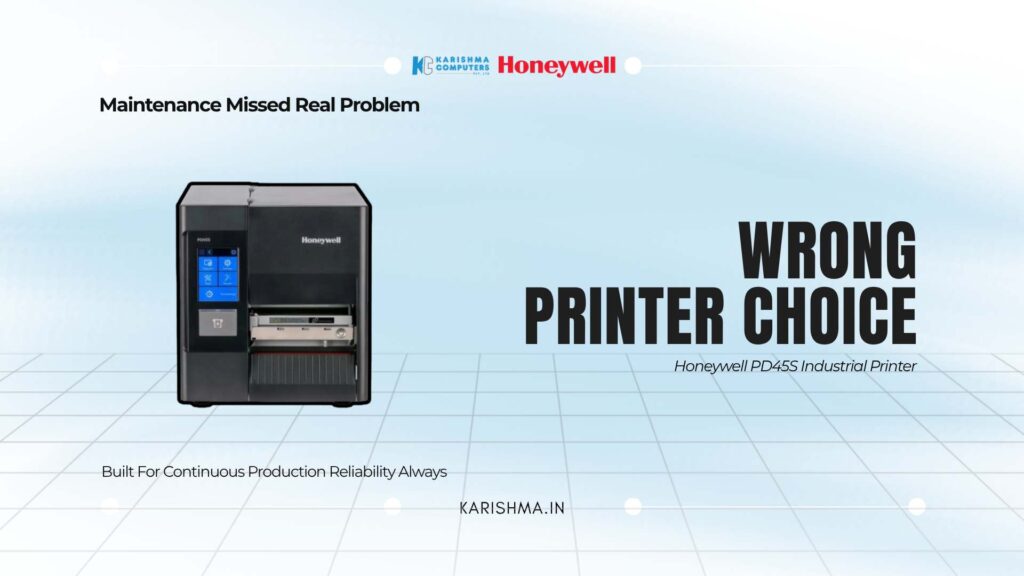
The correct answer was a Honeywell industrial label printer built for exactly that duty. The PD45S is a mid-range industrial unit engineered for continuous throughput in demanding environments, the kind of conditions a Bhiwadi packaging floor generates every hour. Once it replaced the overworked desktop, the line stopped appearing on the maintenance log altogether.
What industrial-grade actually means at 203 dpi
The PD45S is designed around throughput and endurance rather than desk footprint. It handles larger media rolls, so operators reload far less often, and it drives a robust print mechanism rated for the volumes a production line demands rather than the occasional batch an office prints. At 203 dpi it produces crisp, scannable barcodes for cartons, pallets, and compliance labels at the sizes industrial packaging uses.
For pharmaceutical, food, and logistics applications, print consistency is not a convenience, it is a regulatory and traceability requirement. A carton that cannot be scanned at a distribution centre is a carton that fails an audit trail. The PD45S holds barcode definition across a long shift, which is the specific reliability that a compliance-bound operation needs and an office printer cannot promise.
Where a Honeywell industrial label printer changes the economics
Honeywell’s industrial line is engineered for the conditions that break lighter equipment: dust, vibration, temperature, and sheer volume. The PD45S offers a bright colour display and guided setup that shortens the learning curve for line operators, along with connectivity options that let it integrate into a plant’s existing warehouse or manufacturing execution system rather than sitting as an island.
The larger media capacity matters more than it first appears. Every reload is a line stoppage, and a printer that runs a full shift on fewer roll changes is a printer that keeps the line moving. Across a month, the difference between a printer that needs attention twice a week and one that runs untouched is measured in recovered production hours.
The cost that lived in the maintenance budget
The Bhiwadi plant had a genuine invisible invoice, and it was misfiled. Every printer jam pulled a maintenance technician away from the machines that actually needed preventive care, so the real cost was not just the labelling downtime, it was the deferred maintenance on packaging and sealing equipment that the technician never reached. Those machines then developed their own faults, which the plant attributed to age rather than to neglect caused by a printer eating the maintenance team’s hours.
The label printer was quietly draining the entire maintenance function, and the ledger recorded the damage under half a dozen other equipment lines. When the PD45S took over and the printer stopped generating tickets, the maintenance team recovered enough capacity to get back on top of the rest of the floor. The improvement showed up across machines that had nothing to do with labelling, which is exactly how an invisible invoice reveals itself once it is finally paid to the right account.
Matching the tool to the duty, not the desk
There is a durable observation here that outlives any single product. Organisations routinely buy equipment for its purchase price and its footprint rather than for the duty they will actually impose on it. A desktop printer looks like a saving on the invoice and behaves like a liability on the floor, because the specification that matters, the duty cycle, is invisible at the point of purchase and expensive at the point of use.
The gap between what a machine costs and what a machine is rated to endure is where most equipment disappointment lives. A tool sized correctly for its workload is rarely the cheapest line on the quote, and it is almost always the cheapest line by the end of the year. For manufacturing and packaging floors across Bhiwadi, Faridabad, and the industrial belts of Noida, a Honeywell industrial label printer sized to the real duty cycle is not an indulgence. It is the difference between a maintenance calendar and a production calendar.
The duty-cycle number that a Honeywell industrial label printer is actually sold on
Every printer carries a recommended duty cycle, the volume it is engineered to produce comfortably over a given period, and this single specification separates an office device from a production one more decisively than any feature on the box. A desktop printer rated for a few hundred labels a day will physically produce a few thousand, but it will do so while wearing out, jamming, and demanding service, because it is operating far beyond the workload it was designed for. The PD45S is rated for the continuous volumes a production line generates, which is why it runs where a lighter machine breaks.
Print consistency across that duty cycle is the requirement that regulated industries cannot compromise on. A pharmaceutical or food operation must be able to prove that every carton leaving the floor carried a scannable, correctly formatted barcode, because a single unreadable code at a distribution centre can break an audit trail and trigger a compliance failure. The PD45S holds its 203 dpi barcode definition across a full shift precisely so that this proof holds, which is a fundamentally different promise from an office printer that prints acceptably for the first hour and drifts after that.
Why a Honeywell industrial label printer lowers total cost despite a higher sticker
The purchase price of an industrial printer is higher than a desktop unit, and this is exactly where the underspecified decision is usually made. But the sticker price is the smallest part of the total cost. The larger costs are downtime, service call-outs, the maintenance hours consumed, the deferred servicing on other machines, and the audit and traceability risk, and every one of those falls when the printer is correctly sized. A machine that costs more on the quote and runs untouched for months is cheaper by any honest accounting than a machine that costs less and generates a service ticket twice a week.
There is a manageability dividend as well. Because the PD45S integrates into the plant’s warehouse or manufacturing execution system and can be monitored and updated centrally, IT gains visibility of the device rather than discovering a problem only when the line stops. A Honeywell industrial label printer that reports its own status is a printer that can be maintained on a schedule rather than in a crisis, and predictable maintenance is always cheaper than reactive repair. For a plant standardising across a floor, that central visibility compounds into a materially calmer operation.
The printer that stops appearing in the fault log is not the one that gets serviced most often. It is the one that was built for the job in the first place.
Q1. What class of printer is the Honeywell PD45S?
The PD45S is a mid-range industrial label printer built for continuous, high-volume printing in demanding environments such as warehouses, factories, and packaging lines, rather than for occasional office use.
Q2. What resolution does the PD45S print at?
The PD45S prints at 203 dpi, which produces clear, scannable barcodes for cartons, pallets, and compliance labels at the sizes industrial and logistics applications typically require.
Q3. Why choose an industrial printer over a desktop unit for a production line?
Industrial printers like the PD45S are rated for a far higher duty cycle, handle larger media rolls to reduce reload stoppages, and withstand dust, heat, and vibration. A desktop printer run at industrial volume tends to jam frequently and generate ongoing maintenance costs.
Q4. Does the PD45S support easy setup for line operators?
Yes. The PD45S includes a bright colour display and guided setup that shortens the learning curve, so line operators can load media and change settings with minimal training.
Q5. Can the PD45S integrate with warehouse or manufacturing systems?
The PD45S offers multiple connectivity options that allow it to integrate into an existing warehouse management or manufacturing execution system rather than operating as a standalone device.
Q6. Is the Honeywell PD45S available in Delhi NCR?
Yes. Karishma Computers is an authorised Honeywell channel partner in Delhi NCR and supplies the PD45S with media, ribbons, and deployment support for manufacturing, pharmaceutical, and logistics operations.