How a Zebra Handheld Barcode Scanner Ended Queues Blamed on Slow Staff
The Zebra handheld barcode scanner and a queue misdiagnosed as a staffing problem
A supermarket chain with branches around Lajpat Nagar and Rajouri Garden spent a season convinced its checkout queues were a staffing and speed problem. Customers complained about waiting, the operations team timed cashiers, and the response was a productivity drive: faster billing targets, a mystery-shopper programme, and pressure on the counter staff to move quicker.
The cashiers were already fast. The bottleneck was the ageing scanners on the counters, which needed two or three passes to read a crumpled or glossy barcode, and every retry added seconds that multiplied across a busy evening into a visible queue. The staff were absorbing the blame for hardware that was failing to read on the first attempt. The diagnosis targeted the people. The cause sat on the counter.
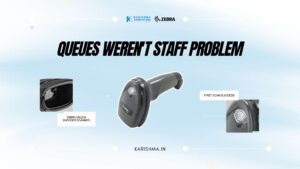
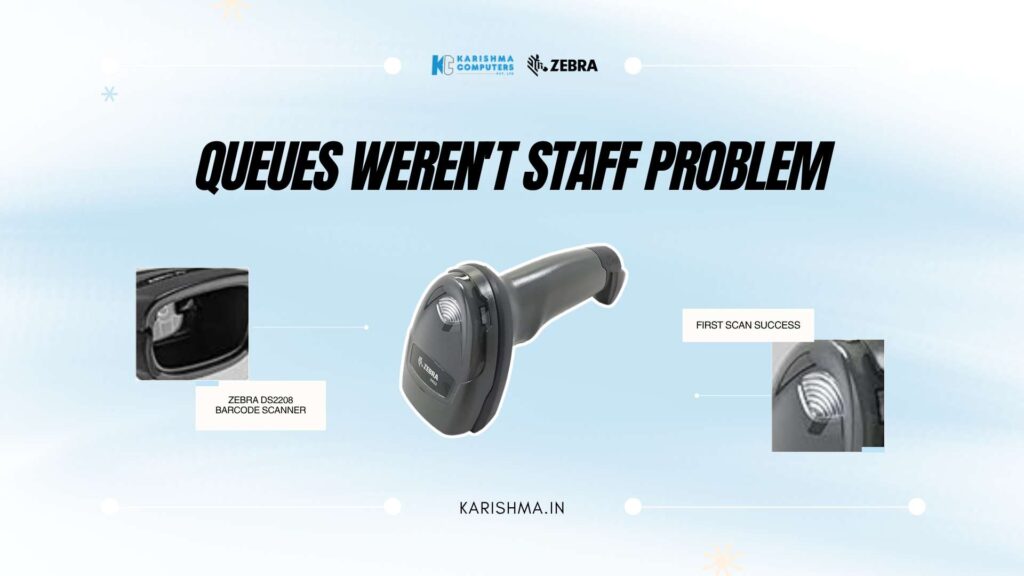
This is where a Zebra handheld barcode scanner resets the picture. The DS2208 is a corded 1D and 2D imaging scanner that captures barcodes on the first pass, including damaged, low-contrast, and mobile-screen codes, at a speed the old laser units could not sustain. Once the counters moved to the DS2208, the retries vanished, the per-item scan time dropped, and the queues the chain had been trying to discipline away simply shortened on their own.
Why area-imaging beats ageing laser scanners at the counter
The DS2208 uses area-imaging technology, which reads a barcode as an image rather than sweeping a laser line across it. That distinction matters at a modern checkout. Laser scanners read only linear barcodes and struggle with anything creased, curved, or displayed on a phone. An imager reads 1D and 2D codes from any angle, off paper or screen, which is essential now that loyalty cards, coupons, and payment codes all arrive as QR codes on a customer’s phone.
First-pass read rate is the metric that decides checkout speed, and it is precisely where imaging pulls ahead. A scanner that reads on the first attempt removes the small hesitations that accumulate into queues. For a retail floor measured on throughput and customer experience, the difference between a first-pass read and a third-pass retry is the difference between a moving line and a complaint.
Where the Zebra handheld barcode scanner proves its value
Durability underwrites the value. The DS2208 is built to survive the drops that end a consumer-grade scanner’s life at a busy counter, and Zebra rates it for the repeated handling of a full retail shift. A scanner that keeps working after the inevitable fall is a scanner that does not become an unplanned replacement cost every few months.
It is also plug-and-play over USB, so it drops into an existing point-of-sale system without configuration overhead, and it handles the mobile-barcode and coupon scanning that modern retail and warehouse workflows demand. For a distributor rolling out scanners across multiple branches, that simplicity means a store can be equipped in minutes rather than scheduled for an IT visit.
The cost hidden in the customer-experience budget
The supermarket chain was paying a real invoice and filing it under the wrong heading. The queues drove customer complaints, and the response, additional staff at peak, a customer-experience consultant, extended counter hours, was all booked as a service and staffing cost. The lost baskets from customers who saw a long line and walked out were quietly attributed to competition and location. None of it was billed to the scanners that created the delay.
A scanner is one of the smallest line items in a retail fit-out, and checkout abandonment is one of the most direct forms of lost revenue. The two were linked, but no ledger linked them. When the DS2208 units went in and first-pass reads became the norm, the queues eased, the peak-staffing cost fell away, and the walk-outs that had been treated as a market problem stopped. The saving appeared in service and staffing budgets that had never been part of a scanning decision.
The bottleneck is rarely where the pressure is applied
There is a durable lesson in this pattern. When a process slows, pressure gets applied to the most visible point, usually the person at the end of the line, because that is where the delay is seen. But the visible point of a delay is almost never its cause. The cashier is visible; the scanner two inches from their hand is not, so the cashier gets the productivity drive and the scanner gets a pass.
Improving a system requires finding the actual constraint rather than squeezing the part that happens to be in view. A team pushed harder against a hardware bottleneck does not go faster, it just gets more stressed while the constraint holds firm. The operations that run smoothly are the ones that measure where the seconds are actually lost before they decide who to hold accountable for losing them.
The read-rate specification that a Zebra handheld barcode scanner lives or dies on
First-pass read rate is the single specification that determines whether a scanner helps or hinders, and it is precisely the number a price comparison ignores. A scanner that reads on the first attempt removes the micro-hesitations that accumulate into queues; a scanner that needs a second or third pass adds a small delay to every item, and those delays compound across a busy shift into a visible, complaint-generating slowdown. The DS2208, as an area-imaging Zebra handheld barcode scanner, is engineered for a high first-pass rate across the range of codes a modern counter encounters, which is where its value actually lives.
The breadth of code support matters more each year. Retail has moved decisively toward 2D and mobile codes, loyalty cards, coupons, UPI and payment QR codes, digital passes, and a laser scanner reads none of them reliably. An imager reads them all, from paper or from a phone screen, at any angle, which future-proofs a counter against a shift that has already happened. A scanner bought today that cannot read a phone screen is a scanner bought obsolete.
Where a Zebra handheld barcode scanner proves durable value
Durability underwrites the economics quietly. A busy counter drops a scanner, and a consumer-grade unit that fails after a fall becomes an unplanned replacement every few months, a recurring cost that never appears in the original purchase decision. A scanner rated to survive repeated drops onto hard surfaces and full-shift handling removes that recurring cost, which over a couple of years typically exceeds the price gap that made the cheaper scanner look attractive in the first place.
Deployment simplicity is the final piece. A scanner that is plug-and-play over USB drops into an existing point-of-sale system without configuration, which means a store can be equipped in minutes and a distributor can roll out across many branches without an IT project per site. For a multi-branch retailer, that simplicity, combined with a standard device across every counter, turns scanning from a per-store problem into a solved, standardised part of the fit-out. The least glamorous virtues, reliability, compatibility, and consistency, are the ones that compound into real operational calm.
For checkout counters and receiving benches across Rajouri Garden, Lajpat Nagar, and the retail districts of Noida and Gurgaon, a Zebra handheld barcode scanner is not a marginal upgrade. It is the removal of a bottleneck that a whole floor was being blamed for and could never have fixed with effort alone.
FAQs
-
Q1. Does the Zebra DS2208 read both 1D and 2D barcodes?
Yes. The DS2208 is an area-imaging scanner that reads both 1D linear barcodes and 2D codes such as QR codes, including codes displayed on a mobile phone screen, which laser scanners cannot reliably do.
-
Q2. What is the advantage of an imaging scanner over a laser scanner?
An imaging scanner captures the barcode as an image and reads it from any angle, off paper or screen, including creased and low-contrast codes. This produces a higher first-pass read rate, which is the metric that determines checkout and scanning speed.
-
Q3. Is the DS2208 a corded or wireless scanner?
The DS2208 is a corded scanner that connects over USB. It is plug-and-play with most point-of-sale systems, so it can be deployed quickly without configuration overhead.
-
Q4. Is the DS2208 durable enough for a busy retail counter?
Yes. The DS2208 is built to survive the repeated drops of a busy retail or warehouse environment and is rated for full-shift handling, which reduces unplanned replacement costs.
-
Q5. Can the DS2208 scan coupons and loyalty codes from a phone?
Yes. As a 2D imager, the DS2208 reads QR codes and barcodes displayed on mobile screens, which is essential for modern loyalty, coupon, and payment workflows.
-
Q6. Where can Delhi NCR retailers buy the Zebra DS2208?
Karishma Computers is an authorised Zebra channel partner in Delhi NCR and supplies the DS2208 with point-of-sale integration and rollout support for retail and warehouse operations.