Why A Sarojini Nagar Store Blamed Staff Before Finding The Zebra LS2208 Fix
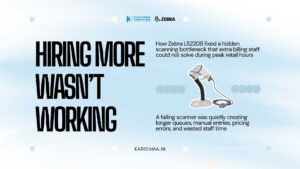
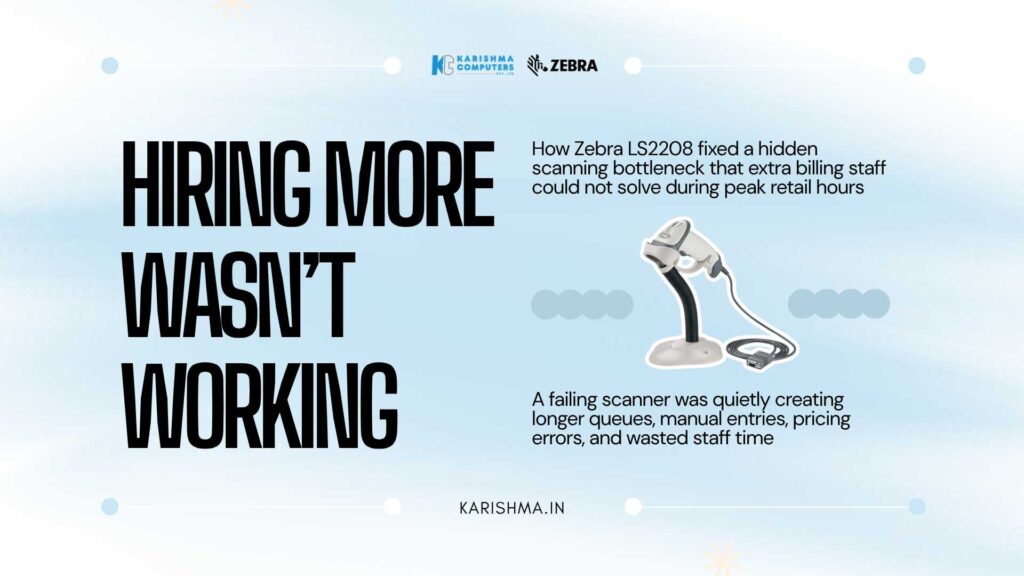
Inside a garments store in Sarojini Nagar market, the Zebra LS2208 solved a queue problem the owner had spent an entire festive season trying to solve by hiring more people.
The store ran three billing counters during the October sale rush, and the complaint that kept surfacing wasn’t about stock or pricing. It was the line. Customers were abandoning baskets mid-queue during peak hours, and the owner’s read on this was simple: counters needed more hands. Two additional billing staff were brought on for the season. The queue barely got shorter.
What The Extra Staff Didn’t Fix
The actual bottleneck sat at the till itself, not behind it. One of the store’s two barcode scanners had stopped reading half the SKU tags reliably months earlier, a problem staff had quietly worked around by typing product codes into the billing software by hand. Manual entry took roughly four times longer per item than a clean scan, and on garments with similar codes across sizes and colours, it also produced pricing errors that meant re-checks, refunds, and the occasional argument at the counter.
Nobody had billed that delay to the scanner. It showed up instead as “slow counters” in the owner’s notes, as extra wage cost for two billing staff who were, in effect, compensating for a piece of hardware rather than adding real capacity, and as a small but steady stream of one-star mentions of “long wait times” in customer feedback that nobody connected back to equipment.
This is a pattern that shows up across small and mid-sized retail in Delhi NCR more often than most owners realise. A queue problem gets treated as a staffing problem, more people get hired, and the actual constraint sitting at the scanner never gets examined.
Why A Replacement Scanner, Specifically
The fix the store’s owner eventually landed on wasn’t a software upgrade or a counter redesign. It was replacing the failing scanner with a Zebra LS2208, a decision driven less by brand loyalty than by a straightforward requirement: something that would scan reliably, first time, without retraining staff on new billing workflows.
The scanner is built around a frictionless liquid polymer scan element and a scratch-resistant tempered glass exit window, both aimed at holding up to daily counter abuse rather than the occasional careful scan. For a garments counter handling hundreds of billing transactions a day, that durability matters more than most buyers realise until the alternative scanner starts failing intermittently rather than outright.
Read range was the second factor. It captures standard 13 mil UPC barcodes from over 25 inches away, which meant staff no longer needed to hunt for the exact angle and distance a failing scanner had started demanding. High-density barcodes, common on smaller garment tags, scanned just as reliably as the larger codes on packaged accessories, something the store’s old scanner had never handled consistently even when it worked.
Zebra LS2208 Setup Across Three Billing Counters
Deployment took under an hour across all three counters. The Zebra LS2208 connects over USB with plug-and-play installation, and keyboard wedge support meant it worked directly with the store’s existing billing software without any driver configuration or IT visit. Support for 97 international keyboard layouts wasn’t something the store specifically needed, but it removed any risk of compatibility issues with the billing terminal’s regional settings, one less variable to troubleshoot during a busy sale weekend.
What Changed At The Counter
Average transaction time at the affected counter dropped by more than half within the first week. That number matters less than what it represented: the counter was no longer waiting on a person typing codes by hand, it was waiting on customers themselves, which is the only kind of wait a retail queue should have. The two additional billing staff hired for the season stayed on, now genuinely adding throughput rather than compensating for a scanner that had quietly stopped doing its job.
Pricing errors at the counter, the kind that triggered refunds and awkward exchanges, dropped alongside the queue length. That wasn’t a coincidence. Manual entry had been the source of both problems, and neither had ever been billed to the scanner that caused them.
What The Zebra LS2208 Actually Cost Against The Alternative
Retailers pricing a replacement scanner tend to compare unit cost against a cheaper unbranded alternative and stop there, which misses most of what actually determines the real cost over a year of daily counter use.
Zebra LS2208 Running Cost Versus A Failing Scanner
The garments store’s old scanner hadn’t failed outright, which was part of why it stayed in use for months after it started misreading tags. It scanned intermittently, well enough to avoid an obvious replace-it-now decision, poorly enough to push a meaningful share of transactions into manual entry without anyone tracking how often that was actually happening. That’s a cost that hides precisely because it never announces itself as a failure.
Once the Zebra LS2208 replaced it, the comparison stopped being about scanner price and became a straightforward throughput question. With over eight million units sold globally, the LS2208 has a long track record of holding up to exactly this kind of daily retail abuse, and Zebra backs new units with a warranty that reduces the risk of the store finding itself back in the same intermittent-failure situation within a year or two.
There was a second saving that never showed up on the equipment budget at all. Staff time previously spent double-checking manually entered prices, correcting mis-keyed codes, and handling the occasional customer dispute over a wrong price got redirected back to actual service, the reason the extra billing staff had been hired in the first place. That time had been sitting inside the store’s wage bill for months, misattributed to “counter speed” rather than to a scanner that was never actually doing its job properly.
The Zebra LS2208 wasn’t the only scanner available to the store on price. It was the option that matched how a busy garments counter actually needed hardware to behave under daily pressure, which turned out to be the more relevant comparison once someone finally ran the numbers.
A Pattern Worth Recognising
Retail businesses tend to look at the people in front of them first when a counter is slow, because staffing is the variable that feels most directly controllable during a busy season. Equipment sits quietly in the background, doing an increasingly poor job, until someone finally traces a complaint back far enough to find where the delay actually starts.
For retail counters, warehouses and billing desks across Delhi NCR still running scanners nobody has audited in years, the honest question isn’t whether another billing hand would help during the next sale. It’s whether the real bottleneck has been sitting at the scanner the entire time, quietly billed to wages instead.
That audit rarely happens on its own schedule, because a scanner that fails gradually never produces a single moment that forces the question. It just produces a slow accumulation of manual entries, a handful of pricing disputes each week, and a set of customer reviews mentioning slow counters that nobody reads as an equipment complaint. Markets like Sarojini Nagar, Lajpat Nagar and Karol Bagh run enough daily transaction volume that this kind of gradual failure compounds faster than in a lower-footfall store, which is exactly why the pattern tends to surface first in exactly these kinds of high-turnover retail environments before anyone notices it elsewhere.
FAQs
-
How far can the Zebra LS2208 scan a barcode?
The Zebra LS2208 captures standard 13 mil UPC barcodes from over 25 inches away, and reads high-density barcodes common on smaller product tags at closer range, covering most retail and warehouse scanning needs in a single device.
-
Does the Zebra LS2208 require any special setup?
No. The Zebra LS2208 connects over USB with plug-and-play installation and keyboard wedge support, so it typically works with existing billing or inventory software without driver configuration.
-
How durable is the Zebra LS2208 for daily counter use?
The scanner uses a patented frictionless liquid polymer scan element and a scratch-resistant tempered glass exit window, built for continuous daily scanning in retail, healthcare and warehouse environments.
-
What barcode types does the Zebra LS2208 read?
The Zebra LS2208 reads standard 1D barcodes, including everyday UPC codes and high-density barcodes found on smaller retail items, making it suitable for general-purpose retail and inventory scanning.
-
Is the Zebra LS2208 suitable for multilingual billing setups?
Yes. It supports keyboards in 97 languages, allowing plug-and-play operation across different regional billing terminal configurations without additional setup.
-
What warranty does the Zebra LS2208 carry?
New Zebra LS2208 units are backed by Zebra’s standard warranty coverage, reflecting the scanner’s track record as one of the best-selling handheld laser scanners globally, with over eight million units sold.