
Fujitsu Fi 800r Scanner Finance Teams
In short How a compact scanner like the Fujitsu fi-800R can ease document-capture bottlenecks for audit teams, KYC desks and admission offices in Delhi NCR.
Why Audit Teams Still Underestimate the Ricoh fi-800R (formerly Fujitsu) Scanner
The Ricoh fi-800R (formerly Fujitsu) scanner was nowhere in the conversation when a 22-partner chartered accountancy practice in a Connaught Place chamber complex spent the better part of the last financial year convinced it had a discipline problem. What had entered the conversation was a series of frustrated emails from clients whose Form 26AS reconciliations were running late. Junior associates were missing client commitments. Files were sitting on desks for days longer than expected. The managing partner introduced a new file-tracking sheet, ran a refresher training on time discipline and finally sent out a circular about workplace seriousness.
None of it worked. The deadlines kept slipping. Several quarterly audit submissions to the same listed-company client were filed close to the cut-off, and the partners began to wonder if the firm had simply grown beyond its supervisory capacity.
It had not. The problem was sitting on a shared table near the photocopier.
What Most Finance Practices Get Wrong About Document Capture
The firm was running its document digitisation through the scan function of a multi-function photocopier purchased in 2019. On paper, the device could scan quickly. In practice, every audit file that came through it required a small ceremony. Staples had to be removed. Different paper sizes had to be sorted into similar stacks before feeding. Bank statements on thin paper jammed against thicker letterhead pages. Passbook photocopies on glossy paper needed a separate run. The image quality on some receipts was inconsistent enough that the audit associate often re-typed numbers by hand to verify what the OCR had captured.
Each individual delay was a minute or two. Across an engagement, the minutes compounded into hours. Across a quarter, the hours compounded into deadlines.
This is the misattribution that catches most growing professional services firms. Slow turnaround gets blamed on the people doing the work. The actual cause is sitting one floor below the partner’s cabin, quietly forcing every team member to become a manual pre-sorter before they can do any of their actual job.
What the Ricoh fi-800R Scanner Actually Replaces in a Finance Department
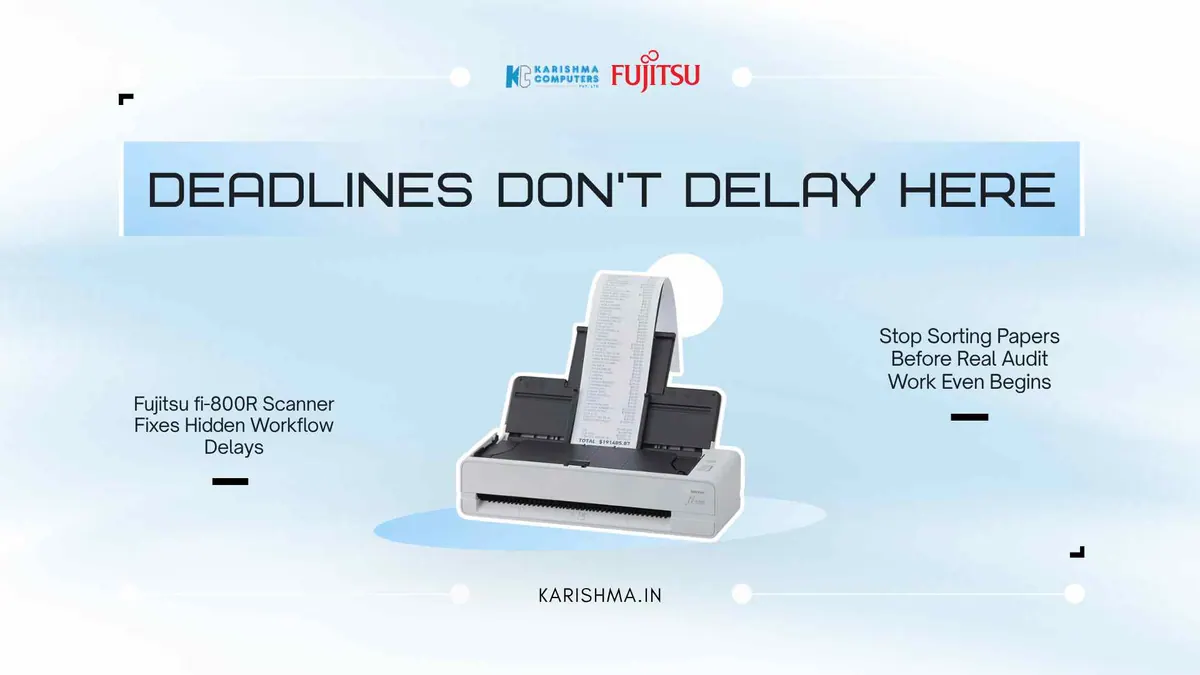
The fi-800R is a compact desktop scanner. The Ricoh fi Series page lists scanning speeds up to 40 pages per minute (80 images per minute, double-sided); specifications can vary by model and region, so please confirm the India variant with us. Beyond the speed number, it matters for the time before scanning and the time after scanning.
How the Ricoh fi-800R Scanner Handles a Mixed Batch Without Pre-Sorting
The mixed-batch handling matters in a real audit workflow. A single client file might contain A4 ledger printouts, A5 receipts, plastic identity cards and thermal-paper bank slips. Ricoh lists multifeed (overlap) detection, automatic skew correction and active separation, along with a 20-page automatic document feeder and a dedicated front feeder for thick items such as IDs, booklets and passports (up to 5 mm thick). Different media can be scanned through the appropriate path, which reduces the sorting the associate has to do first. Please check your documents against the Ricoh specifications.
Why a Compact Design Matters More Than Speed Numbers
The compact design is the other feature that earns its desk space in a city like Delhi where the typical chartered accountancy chamber is not large. The Ricoh fi Series page lists the fi-800R at 296 x 105 x 83 mm and 2.0 kg, so it needs little desk space. In a workspace where every square foot of partner-cabin real estate is calculated against rent in lakhs per year, the footprint argument is not a minor one.
The Failed Prior Attempt
The Connaught Place practice had tried something else before it considered the fi-800R. It had hired a second junior associate, specifically to manage the document flow. That associate became the unofficial scanning coordinator. Over time, the firm was paying a qualified person to do work that a properly chosen device would have eliminated. This is the wrong turn that growing firms often take before they look at their equipment.
The Invisible Invoice
The cost of the slow scanner was never appearing under any line item called “scanner cost”. It was appearing inside the performance review of the junior associate who was spending a large part of his billable hours on document handling. It was appearing in the apologetic phone calls the managing partner was making to listed-company clients about delayed submissions. It was appearing in the partners’ own evening hours, spent verifying figures that should have been clean by the time they reached partner review. The equipment was generating the cost. The cost was being billed to the wrong departments.
What Changed After the fi-800R Took the Desk Corner
In this scenario, after installation the same associate who had been the scanning coordinator returned to audit work, the pre-sort step shrank, and the deadline scares eased in the following quarter.
What the Hardware Does Differently in a KYC Setting
The same principle applies in a different industry to the same effect. A non-banking financial company operating its onboarding desk from a CR Park office had been struggling with a backlog of physical KYC files that the compliance team was meant to digitise within a fixed window per applicant. The fi-800R scanner became part of that desk after the compliance head spent a Saturday morning timing how long each step of the current process took. The scanning step alone, the part everyone had assumed was the simplest, was consuming a large share of total handling time. The bottleneck was not the verification work. The bottleneck was the act of capturing the documents that were going to be verified.
In this scenario, the fi-800R changed the time distribution. The compliance head later mentioned that the most useful thing about the device was not the speed but the fact that it removed a step the team had stopped seeing. The pre-sorting had become invisible through repetition. Once the device removed the need for it, the team noticed how much mental load they had been carrying.
Why the Front-Counter Use Case Matters in Delhi NCR
The Ricoh (formerly Fujitsu) fi-800R scanner suits growing professional practices and front-counter environments that scan a steady mix of documents. Tell us your daily page count and we will point you to the right fi Series model.
A Standalone Observation
There is a wider pattern visible across professional-services firms in Delhi NCR right now. Most are scaling on the basis of people rather than infrastructure. A partner adds an associate to absorb the rising work volume, and within a year, that associate is doing more administrative coordination than the technical work they were hired for. The equipment that should have absorbed that coordination is sitting under-specified at the corner of a shared room. The fi-800R is a useful object lesson in what gets fixed when a firm asks the harder question, which is whether the next person on the payroll is genuinely the right next investment.
Karishma Computers supplies Ricoh fi Series (formerly Fujitsu) scanners in Delhi NCR and sees this pattern in audit practices, KYC desks, college admission offices and hospital records rooms.
FAQs
Q1. What kind of office is the Ricoh fi-800R scanner designed for?
The Ricoh fi-800R scanner is designed for offices where the same person who scans is also handling other front-of-house responsibilities, such as audit firms, admission counters, KYC desks, hospital records rooms and compliance teams. Its compact footprint allows it to fit on a busy counter, and its automatic feeder and front feeder reduce the pre-sorting of mixed documents.
Q2. How does the fi-800R differ from the scan function on a multi-function printer?
A multi-function printer’s scan unit is generally optimised for the printing workflow rather than for high-mix document capture. The fi-800R is a dedicated document scanner with multifeed (overlap) detection and a dedicated front feeder, in a compact body. These differences become important in any workflow where document variety is high and counter space is limited.
Q3. What is the typical scanning speed of the Ricoh fi-800R?
Ricoh lists scanning speeds up to 40 pages per minute (80 images per minute, double-sided). Specifications can vary by model and region; please confirm the India variant with us. The bigger practical advantage in many workflows is less pre-sorting time rather than raw page speed.
Q4. Can the fi-800R scan IDs and booklets?
Ricoh lists a dedicated front feeder for items such as IDs, booklets and passports, up to 5 mm thick. Please ask us about your exact documents.
Q5. Where can a business in Delhi NCR purchase the Ricoh fi-800R scanner?
Karishma Computers supplies Ricoh fi Series (formerly Fujitsu) scanners in Delhi NCR. Please ask us about the fi-800R and current availability for your firm.
Q6. How do I choose the right fi Series model?
The fi-800R suits mixed-document work at a front counter or desk. Tell us your daily page count and we will point you to the right fi Series model.
This article uses an illustrative scenario. Names, figures and outcomes are examples, not customer results.
Keep reading
Not sure which fits?
Tell us what you need. Our team will help you choose and send a quote.