Why the Zebra MC2200 Mobile Computer Belongs in a Mid-Sized Warehouse
The Zebra MC2200 mobile computer was nowhere in the conversation when an FMCG distribution operation running out of a four-thousand-square-foot warehouse in Okhla Industrial Area had spent two years convinced that its night-shift pickers were the source of its dispatch error rate. What was in the conversation was a quarterly report showing that roughly two and a half per cent of outbound cartons were reaching the wrong retailer or contained the wrong product mix. The general manager had run training sessions, replaced two team leaders and introduced a double-check sign-off at the dispatch dock. The error rate dropped briefly, then climbed back to where it had been.
The actual cause was not on the warehouse floor at all. It was in the picker’s hands. Or more accurately, it was in what the picker did not have in his hands.
What Mid-Sized Warehouses Get Wrong About Picking Accuracy
The pickers were working from printed pick lists, with handheld laser scanners that captured the barcode of each item but did not display whether that scan matched what the pick list required. The scanner beeped, the picker assumed correctness, and the item went into the carton. If the wrong SKU had been pulled from a similar-looking carton on the adjacent shelf, the scanner had no way of knowing.
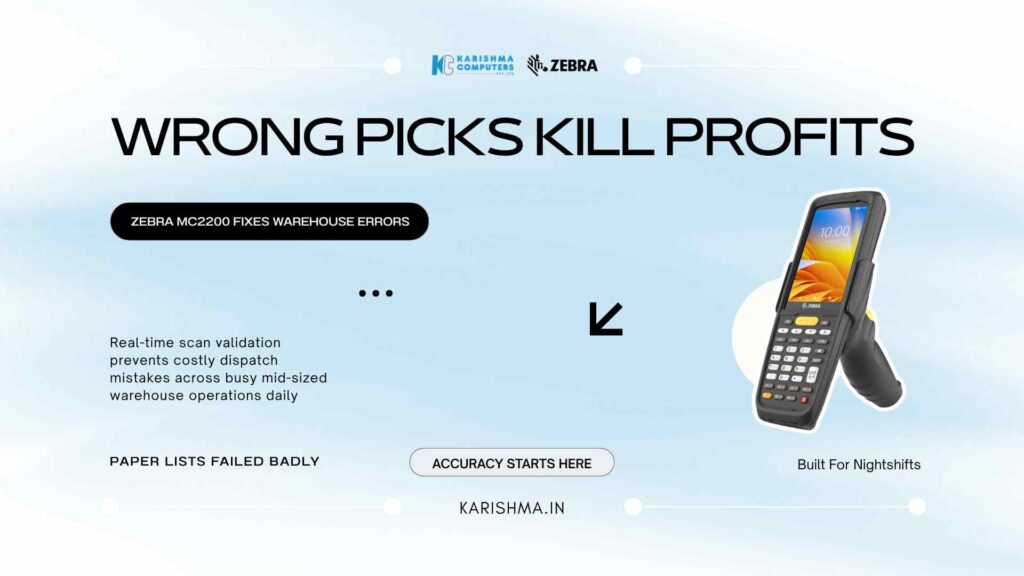
This is the gap that the Zebra MC2200 was designed to close. It is not a scanner. It is a mobile computer that happens to scan, and the difference is not a marketing distinction. It is the difference between equipment that captures data and equipment that compares data against a known-correct answer in the same second.
What the Zebra MC2200 Mobile Computer Brings to a Warehouse Floor
The Zebra MC2200 is built on Android, which means the pick list lives inside the device. When the picker scans an item, the screen confirms whether that item matches the next line of the pick list. A mismatch produces a different audible cue and a screen prompt. The picker knows immediately. The wrong carton does not leave the aisle, let alone leave the dispatch dock.
How the Zebra MC2200 Mobile Computer Handles Multi-Step Picking
Multi-step picking is where the device’s value compounds. A typical FMCG order might require items from twelve bin locations across three aisles. The Zebra MC2200 displays the optimal walking sequence, the bin location and the quantity for each line, and confirms each scan against the running total. The picker is no longer carrying a printed sheet that has to be cross-referenced with a separate scanner. The two tools are one tool, and the cross-referencing happens inside the device rather than inside the picker’s head.
Why the Display Matters as Much as the Scan Engine
The four-inch touchscreen is what makes the Zebra MC2200 a Link-OS device worth choosing over a basic scanner. The display gives the warehouse supervisor a real instrument of control. Reprioritised orders push to the device. Stock locations update as bins are emptied. The supervisor at the workstation and the picker in the aisle are working from the same screen, separated only by physical distance.
The Failed Prior Attempt
The Okhla distribution firm had tried something else first. It had invested in a more advanced warehouse management system, upgrading from a spreadsheet-based pick list to a proper WMS module within its accounting software. The investment was significant. The error rate moved by a fraction. The WMS was producing better pick lists, but the lists were still being printed on paper and handed to pickers using simple scanners. The intelligence was on the manager’s screen. It was not in the picker’s hand.
This is the wrong turn that mid-sized warehouses frequently take. They upgrade the back-end software before they upgrade the front-line device. The result is a faster planning system feeding a slower execution layer.
Where the Dispatch Errors Were Actually Being Paid For
The cost of the picking errors was not appearing under any line item called warehouse losses. It was appearing in the returns processing team, which was running at three people instead of the one person the operation should have needed. It was appearing in the customer relationship manager’s calendar, where two days a week were spent on apologetic calls to retailers about wrong deliveries. It was appearing in the credit notes issued, which had become large enough that the finance head had started raising the question at monthly reviews without anyone connecting the credit notes to the pick list paper in the warehouse aisle.
The Zebra MC2200 absorbed all of it. Returns processing came down. The customer relationship manager got two days back. The credit notes shrank to a level where they no longer required a separate line in the finance report.
The MC2200 in a Cold-Chain Pharmacy Context
A different version of the same principle appears in a pharmacy distribution context. A regional cold-chain distributor servicing diagnostic laboratories across Delhi and Noida had been losing roughly two per cent of its temperature-sensitive consignments to mis-routing. The investigation had pointed to label errors at the sorting bay. The actual cause was a corded scanner that captured the consignment barcode but could not display whether that consignment was scheduled for the next outbound vehicle or for tomorrow’s. The picker scanned, the system logged a scan, and the consignment went into whichever vehicle was nearest. The Zebra MC2200 mobile computer replaced the corded device, pushed the routing logic directly to the picker’s hand and ended the mis-routing inside the first month.
Why the Total Cost of the Device Compares Favourably
The price of a Zebra MC2200 mobile computer sits comfortably below the cost of a single month of returns processing labour in the kind of warehouse that needs the device. This is the calculation that most mid-sized owners do not run because the returns processing labour is treated as an operational cost while the scanner is treated as a capital expense. The two numbers are rarely placed side by side. When they are placed side by side, the device’s payback period is usually less than a quarter.
Why the Battery and Charging Architecture Matter
Warehouses run on shifts. The Zebra MC2200’s hot-swappable battery design is the small detail that makes it usable across a night shift without the device needing to leave the picker’s hand. The charging cradle is engineered for the rhythm of a warehouse rather than for the rhythm of an office desk. Devices that look similar on paper often fail this practical test in the first month of deployment. Owners who have replaced consumer-grade devices in their warehouses know this lesson well. The Zebra MC2200 is built so that the lesson does not need to be learned a second time.
What Most Procurement Teams Miss in the Specification Sheet
A procurement team comparing the Zebra MC2200 against alternatives often focuses on processor speed, memory and scan rate. The features that matter most in practice are not on the front of the specification sheet. The hot-swap battery, the Link-OS firmware management that allows an entire fleet to be updated remotely, the IP54 sealing that survives dust in an Indian warehouse, and the cradle ecosystem that supports continuous shift operation are the practical differentiators. These features explain why the device tends to be the survivor in a warehouse where competing devices have been retired.
A Standalone Observation
A pattern is visible across Delhi NCR’s distribution and retail operations right now. Owners are investing in software because software is what gets recommended at industry conferences and what consultants like to sell. The hardware in the hands of the people doing the actual work is often two generations behind the software it is meant to support. The Zebra MC2200 is one of the products that closes the gap because it brings the software into the hand, not just onto the supervisor’s monitor.
Karishma Computers, as a Delhi NCR partner for Zebra Technologies, sees this gap regularly in warehouses across Okhla, Faridabad, Bhiwadi and the logistics corridors around Noida and Greater Noida. The Zebra MC2200 sits at a price point that mid-sized operations can absorb without enterprise-level budgeting, which is part of why it has become a quiet standard for businesses scaling past the spreadsheet era of warehouse management.
FAQs
-
Q1. What makes the Zebra MC2200 mobile computer different from a barcode scanner?
A barcode scanner captures data. The Zebra MC2200 mobile computer captures data and verifies it against a known-correct answer on its own display in the same moment. The device runs Android, holds the day’s pick list or work order, and tells the operator whether the item just scanned matches the expected line. This is the distinction between data capture and verified data capture, and it is the reason warehouses move to the MC2200 from simpler corded scanners.
-
Q2. Is the MC2200 suitable for a mid-sized warehouse rather than a large enterprise?
Yes. The MC2200 was deliberately positioned by Zebra at a price point that mid-sized distribution operations can absorb without enterprise-level procurement. It carries the same commercial-grade build quality as Zebra’s higher-tier devices and runs on Link-OS, which means it integrates cleanly with warehouse management systems already in use across Delhi NCR.
-
Q3. How rugged is the MC2200 in real warehouse conditions?
The MC2200 is rated for industrial use, with drop and tumble specifications designed for the warehouse floor. This is one of the reasons it tends to outlast consumer Android devices retrofitted with scanner attachments. A retrofitted consumer phone generally needs replacement within months in a warehouse environment. The MC2200 is designed to operate for years in the same conditions.
-
Q4. Can the MC2200 work with an existing warehouse management system?
Yes. The device runs on Android and is Link-OS compatible, which means most existing WMS platforms can push pick lists, orders and stock locations to it. In practice, the deployment is usually a configuration exercise rather than a software replacement exercise.
-
Q5. Where can a business in Delhi NCR purchase the Zebra MC2200?
Karishma Computers is a Zebra channel partner serving Delhi NCR. The MC2200 is supplied with deployment guidance, configuration support and after-sales service appropriate to mid-sized distribution operations across Okhla, Faridabad, Bhiwadi, Noida and the surrounding logistics corridors.
-
Q6. Does the MC2200 require a separate scanner module?
No. The MC2200 has an integrated 1D or 2D scan engine, depending on the chosen variant. The scanner and the computer are a single device, which is the core design principle behind the product.