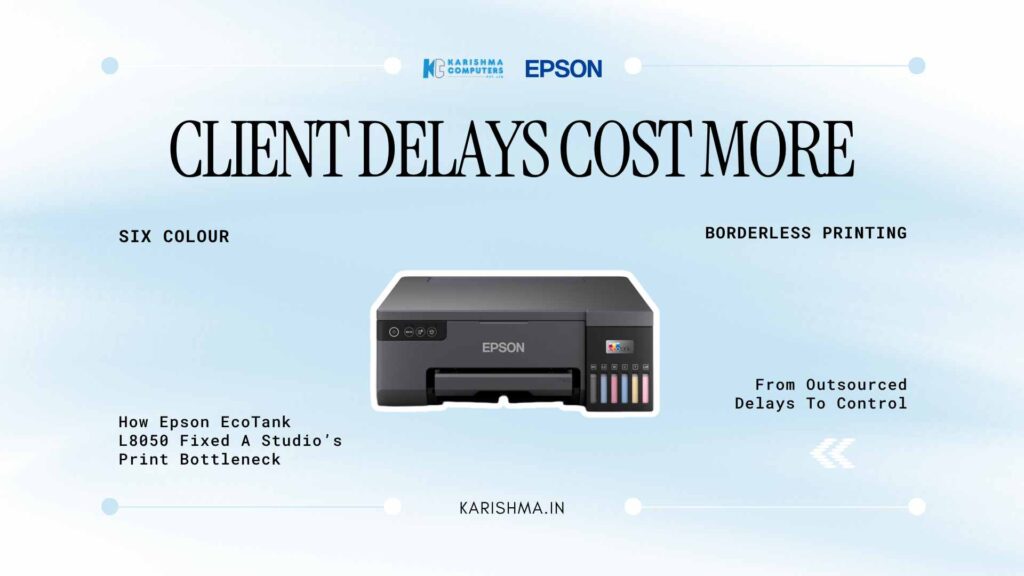
What a CR Park Studio Learned From the Epson EcoTank L8050 After Months of Client Delays
Inside a small photography studio in CR Park, the Epson EcoTank L8050 became the answer to a problem nobody had diagnosed correctly for almost a year.
The studio’s owner ran a two-person operation shooting weddings, birthdays and corporate headshots across South Delhi. Client complaints had started piling up, all variations of the same line: “You promised the album in five days, it’s been eleven.” The owner’s first read on this was simple. The retouching was slow. So a freelance retoucher was brought on to speed up editing turnaround. Delivery times barely moved.
That’s the part of this story most vendors never hear, because most studios never trace the delay back far enough to find where it actually starts.
What Was Actually Happening
The retoucher finished files within 48 hours, most of the time. The real bottleneck sat one step later, at the local print lab the studio had used for three years. Every album order went out to be printed externally, and that lab’s own queue, not the studio’s editing speed, decided when a client finally held their photographs. During wedding season, that queue stretched past a week on its own.
Nobody had billed that delay to printing. It showed up instead as client dissatisfaction, as the studio quietly knocking ten percent off invoices to keep angry clients from leaving bad reviews, as the owner personally calling the lab twice a week to “just check where the order stands.” None of that appeared on a printing line item anywhere. It appeared as discounts given, as goodwill spent, as hours the owner wasn’t shooting or editing because they were chasing a vendor.
This is a pattern that shows up across small service businesses in Delhi NCR more often than owners realise. A workflow bottleneck gets treated as a people problem, staffing gets adjusted, and the actual constraint sitting outside the building never gets examined.
Why The Fix Wasn’t More Staff
Bringing printing in-house meant the studio needed a machine that could handle 10x15cm and A4 borderless prints without turning colour accuracy into a gamble. That’s where the Epson EcoTank L8050 got shortlisted over a standard home inkjet, largely because of what Epson calls Heat-Free Micro Piezo technology, a printhead approach that doesn’t rely on heating ink to eject it. For a studio printing skin tones and wedding décor colours all day, consistent output across a long run matters more than most buyers expect walking in.
The six-colour dye ink system on the Epson EcoTank L8050 was the second deciding factor. Photo labs use six-colour setups for a reason: skin tones, gradients and shadow detail hold up better than they do on a standard four-colour desktop printer. A 10x15cm borderless print comes out in roughly 12 seconds, and the printer’s integrated, front-facing ink tanks are refilled using key-lock bottles designed to avoid the spills that put people off ink tank systems in the first place.
The studio’s owner didn’t initially care about ink economics. That mattered later. A single set of replacement bottles is rated for up to 2,100 borderless 4R photographs before another refill is needed, which changed a recurring outsourcing cost into an occasional bottle purchase every few months.
The Corporate Side Nobody Mentions
There’s a second use case that rarely comes up when photo printers get discussed, and it’s worth naming because it explains why this model keeps appearing on procurement lists that have nothing to do with photography.
Offices, schools and small hospitals across Noida and Gurgaon regularly need visitor badges, staff ID cards and event passes printed on PVC, along with the occasional CD or DVD label for archived records. The Epson EcoTank L8050 supports direct printing onto PVC ID cards and disc surfaces without needing a separate specialty printer sitting idle between uses. A front office handling admissions season ID cards for a school in Indirapuram, for instance, gets more practical use out of that single feature than most marketing material for the printer ever mentions.
What Changed, In Practical Terms
Within three weeks of bringing the machine in-house, the studio’s delivery window dropped from an average of nine to eleven days down to four. That number matters less than what caused it: printing was no longer a step the studio had to wait on someone else to finish. Wi-Fi and Wi-Fi Direct connectivity meant orders could go straight from the editing laptop to the printer without a USB drive changing hands, and the Epson Smart Panel app let the owner check ink levels and run a nozzle check from a phone between shoots.
With the Epson EcoTank L8050 handling both jobs, the discount line disappeared from most invoices within the first month. That’s the part worth sitting with. The studio wasn’t losing money on labour or talent. It was losing money on a workflow step it had outsourced without ever calculating what the wait was actually costing in client goodwill.
Where The Epson EcoTank L8050 Fits Into Studio Economics
Every studio owner who has priced a photo printer against continued outsourcing eventually asks the same practical question: does the arithmetic actually work, or does it just feel better to own the equipment. It’s a fair question, and it deserves a real answer rather than a marketing one.
Epson EcoTank L8050 Cost-Per-Print Compared To Outsourcing
The local print lab the CR Park studio had been using charged per photograph, with rush fees layered on top during wedding season when volume spiked and turnaround mattered most. Those rush fees, ironically, were the studio’s own money being spent to solve a problem the studio itself hadn’t caused. Once printing moved in-house, the studio paid for ink bottles rated to produce roughly 2,100 borderless 4R photographs before needing another refill, at a fixed, predictable cost that didn’t multiply during busy months.
That predictability changes how a studio prices its own packages. Wedding season no longer meant negotiating rush charges with a third party and quietly absorbing some of that cost to protect the client relationship. It meant running the numbers once, knowing the machine’s replacement bottles wouldn’t be needed again for months, and pricing accordingly.
There’s a second, less obvious saving that rarely makes it into a spreadsheet. The hours previously spent driving to the lab, following up on delayed orders, or explaining delays to an unhappy client were hours the owner wasn’t shooting, editing, or meeting new clients. Once the Epson EcoTank L8050 removed the external handoff entirely, those hours went back into the business rather than into managing a vendor relationship that had quietly become a liability.
None of this means every studio needs to own a photo printer. A studio shooting a handful of assignments a month may genuinely be better served by an occasional outsourced print run. But past a certain volume, usually somewhere around a few hundred prints a month, the outsourcing model starts working against the business rather than for it, and that’s precisely the volume range where this conversation tends to resurface.
A Pattern Worth Recognising
Service businesses tend to look inward first when something is slow, at people, at process, at motivation, because those are the variables that feel controllable. Equipment sits quietly in the background until someone finally asks whether the bottleneck was ever a people problem at all. That question is worth asking earlier than most businesses ask it, and usually before another round of hiring gets approved to fix what a machine was actually causing.
For studios, schools, and small offices across Delhi NCR juggling photo output, ID cards and disc printing on separate, aging equipment, the calculation is rarely about whether a photo printer is worth the investment. It’s about how long the real cost has been hiding somewhere else on the balance sheet, waiting to be noticed.
What print resolution does the Epson EcoTank L8050 support?
The Epson EcoTank L8050 prints at up to 5760 x 1440 dpi using Heat-Free Micro Piezo printhead technology, suited to photo studios and offices needing consistent colour output across long print runs.
How many photos can the Epson EcoTank L8050 print before a refill?
A single set of replacement ink bottles is rated for up to 2,100 borderless 4R colour photographs, which typically means several months between refills depending on print volume.
Can the Epson EcoTank L8050 print PVC ID cards?
Yes. The Epson EcoTank L8050 supports direct printing onto PVC ID cards along with CD and DVD surfaces, making it useful for schools, offices and institutes handling admissions or visitor badge printing alongside photo work.
Is the Epson EcoTank L8050 suitable for a small photography studio?
It is designed for exactly this use case. The six-colour dye ink system and borderless A4 printing handle skin tones and event photography well, and bringing printing in-house removes dependence on external print lab turnaround times.
How fast does the Epson EcoTank L8050 print a photo?
A borderless 10x15cm photo prints in roughly 12 seconds, which supports same-day or same-shift delivery for studios that previously relied on outsourced printing.
Does the Epson EcoTank L8050 support wireless printing?
Yes, the printer connects over Wi-Fi and Wi-Fi Direct, and the Epson Smart Panel app allows ink level checks and print head maintenance directly from a mobile device.
What is the warranty on the Epson EcoTank L8050?
The Epson EcoTank L8050 carries a standard 1-year warranty or 50,000 pages, whichever comes first, in line with Epson’s standard EcoTank coverage terms.