How a Zebra Wristband Printer Closed a Patient-Safety Gap Nobody Had Named
The Zebra wristband printer and a safety issue misread as staff error
A mid-tier private hospital in Vasant Kunj spent the better part of a year treating a recurring problem as a nursing discipline issue. Patient wristbands were coming loose, smudging, or turning unreadable, and when a ward scanner could not read a band, staff fell back to reading it by eye or checking a chart. Two near-miss medication events were logged and reviewed as human error, and the response was more training on the five-rights protocol.
The additional training did not stop the near misses, because the near misses were not being caused by a lapse in protocol. They were being caused by wristbands that could not be scanned, which forced the exact manual verification the barcode system existed to eliminate. Every unreadable band pushed a nurse back to a fallible visual check, and the risk lived there. The diagnosis had blamed the nurses. The cause was the band.
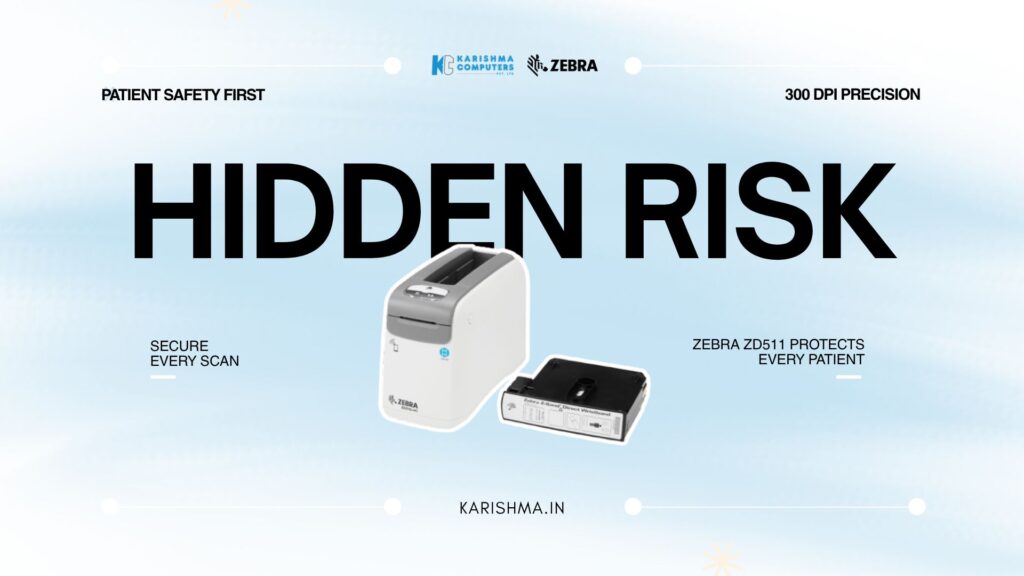
This is precisely where a Zebra wristband printer belongs in a patient-safety conversation. The ZD511 is a compact 300 dpi printer purpose-built for antimicrobial-coated wristbands that stay readable for the length of a patient stay. At 300 dpi it prints small, dense barcodes and text that scan reliably on a narrow band, which is the resolution patient identification actually requires. Once the ward moved to properly printed bands, the manual verification fell away and the near misses stopped.
Why 300 dpi and healthcare-specific media matter here
Patient wristbands are an unforgiving print surface. They are narrow, they carry a barcode plus patient details in a small space, and they must survive days of hand-washing, sanitiser, friction, and moisture without fading. A 203 dpi printer struggles to hold a scannable barcode at this size, which is why 300 dpi is the correct specification for patient identification rather than a premium upgrade.
The ZD511 is designed around this exact use. It handles antimicrobial wristband media that resists the fluids and repeated contact of a hospital environment, and it holds barcode definition across a multi-day admission. That endurance is the whole safety proposition: a band that scans on day four as reliably as on day one keeps every medication, sample, and procedure check inside the barcode system where it belongs.
Where the Zebra wristband printer fits the ward workflow
The ZD511 is compact enough to sit at an admissions desk or a nursing station without occupying clinical space, and it is Link-OS compatible, so a hospital IT team can manage bands and printer settings across every ward centrally. For a facility standardising patient identification across departments, that central control means a band printed in emergency admissions is identical in format and quality to one printed on a surgical floor.
Fast first-band output matters in admissions, where a patient should not wait on a printer to be identified and wristbanded. The ZD511 delivers a ready-to-wear band quickly and connects through the interfaces a hospital information system already uses, so it integrates into the admission workflow rather than sitting beside it as a separate step.
The cost buried in the clinical-risk register
The Vasant Kunj hospital was carrying a real cost and filing it entirely in the wrong place. The near-miss events consumed clinical governance time, incident reviews, root-cause meetings, and additional training cycles, and the reputational exposure of a medication error sat quietly on the risk register as a patient-safety liability. Not one line of it was attributed to a printer producing bands that could not be scanned.
A printer is a small line on a hospital’s capital plan, and a medication error is one of the largest liabilities a hospital carries. The two were connected, but no ledger connected them. When the ZD511 stabilised wristband quality and the manual fallback disappeared, the near-miss trend eased, the governance hours returned to the clinical teams, and a risk that had been treated as a training and culture problem resolved through a change in hardware nobody had linked to it.
The safety mechanism is only as strong as the media it runs on
There is an observation here that applies to any safety system, clinical or otherwise. A control designed to remove human error only works while the mechanism underneath it functions. The barcode wristband exists to replace a fallible visual check with a reliable scan. The moment the band cannot be scanned, the system silently reverts to the very human check it was meant to eliminate, and it does so without anyone deciding to turn the safety mechanism off.
This is the quiet failure mode of automated safety: it does not announce that it has stopped working, it just hands the risk back to a person who assumes it is still working. Organisations that take safety seriously do not only buy the safety system, they maintain the physical quality of the thing the system depends on. In healthcare that thing is a band that scans every time.
Why the media matters as much as the Zebra wristband printer itself
In patient identification, the printer and the wristband are a single system, and the media is not an afterthought. A wristband must survive several days of hand-washing, alcohol sanitiser, friction against bedding, and the moisture of a clinical environment while keeping a small barcode perfectly scannable. Antimicrobial-coated wristband media is engineered for exactly this, and a Zebra wristband printer built around that media is what turns a good barcode on day one into a reliable scan on day four. Pairing the right printer with the right band is the whole safety mechanism; either half alone is insufficient.
The 300 dpi resolution is what makes the small format work. A patient band carries a barcode plus name, identifier, and often additional details in a very narrow space, and at 203 dpi a barcode that small begins to lose the crisp bar edges a scanner depends on. At 300 dpi the ZD511 resolves that dense information cleanly, which is why the resolution is a clinical requirement rather than a premium option. The specification exists to serve the scan, and the scan exists to serve patient safety.
How a Zebra wristband printer supports standardisation across a hospital
A hospital is not one workflow but many, admissions, wards, surgical floors, diagnostics, and a patient’s band must read identically everywhere it is scanned. This is where central manageability becomes a safety feature rather than an IT convenience. Because the ZD511 is Link-OS compatible, a hospital can standardise band format, layout, and print quality across every department from a single point, so a band printed in emergency admissions carries the same reliable barcode as one printed on a surgical ward. Standardisation removes the small inconsistencies that create risk at the margins.
Speed at the point of admission closes the loop. A patient should be identified and banded promptly, without waiting on a slow first print, because the window before a reliable band exists is a window of elevated risk. A printer that produces a ready-to-wear band quickly and integrates directly into the hospital information system keeps that window as short as possible, folding identification into the admission workflow rather than adding a separate step. For a hospital standardising patient safety across its departments, prompt, consistent, durable banding is the physical foundation the entire identification system stands on.
For admissions desks and nursing stations across Vasant Kunj, Defence Colony, and the growing private-hospital corridors of Noida and Gurgaon, a Zebra wristband printer is not a back-office purchase. It is the physical foundation under a patient-safety promise the hospital has already made to everyone who walks through its doors.
FAQs
-
Q1. What is the Zebra ZD511 designed for?
The ZD511 is a compact printer purpose-built for patient identification wristbands in hospitals and healthcare settings. It prints durable, scannable barcode wristbands used to verify patient identity for medication, samples, and procedures.
-
Q2. Why does the ZD511 print at 300 dpi rather than 203 dpi?
Patient wristbands are narrow and must carry a barcode plus patient details in a small space that stays readable for days. At 300 dpi the ZD511 prints dense barcodes and text that scan reliably at that size, which 203 dpi struggles to achieve on a wristband.
-
Q3. Does the ZD511 support antimicrobial wristbands?
Yes. The ZD511 is designed to work with antimicrobial-coated wristband media that resists moisture, sanitiser, and friction, so bands stay readable across a multi-day patient stay.
-
Q4. Can the ZD511 be managed across multiple hospital wards?
Yes. The ZD511 is Link-OS compatible, allowing hospital IT teams to standardise wristband format and printer settings centrally, so bands printed in any department are consistent in quality and layout.
-
Q5. How does a reliable wristband printer improve patient safety?
Barcode wristbands replace fallible visual identity checks with reliable scans. When a band cannot be scanned, staff revert to manual verification, which reintroduces risk. A printer that produces consistently scannable bands keeps identity checks inside the barcode system.
-
Q6. Where can Delhi NCR hospitals buy the Zebra ZD511?
Karishma Computers is an authorised Zebra channel partner in Delhi NCR and supplies the ZD511 with healthcare wristband media and deployment support for hospital admissions and ward workflows.