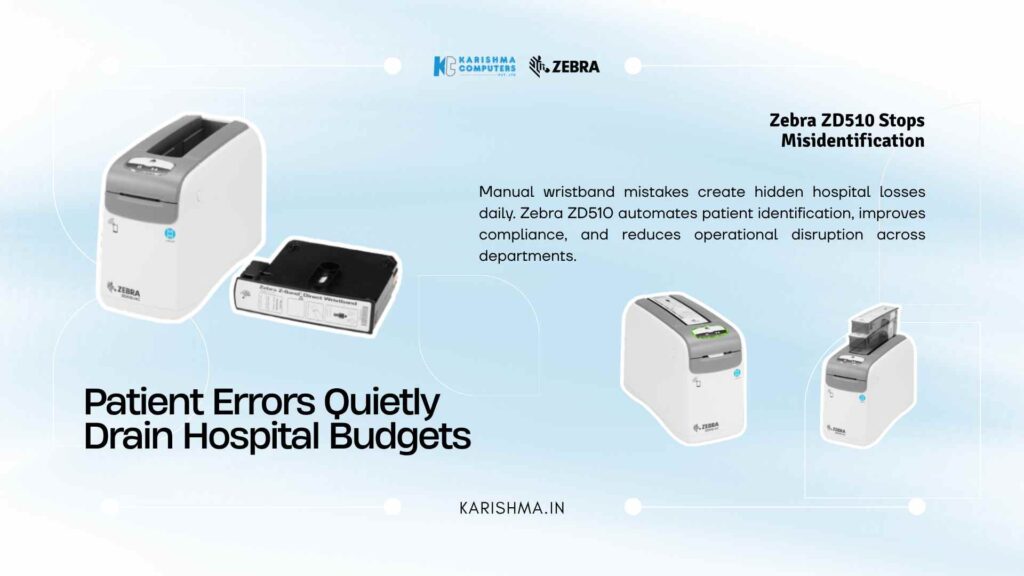
The Zebra ZD510 wristband printer arrived in a mid-size private hospital near Okhla Industrial Area approximately eight months after the administration had concluded that the patient identification problem was a training problem. By that point, the hospital had conducted two onboarding refreshers for the admissions staff, revised the wristband writing protocol, and increased supervisory rounds during admission hours. The error rate had not changed.
The Problem Was Not the Staff
The patient identification system at the hospital relied on handwritten wristbands completed during admission. The process required a nurse or admissions coordinator to transcribe patient name, ward number, doctor code, and admission date onto a paper tag inserted into a wristband sleeve.
Under normal workload, the process was manageable. During the admission peak between 6 PM and 9 PM when outpatient consultations ended and scheduled admissions converged with emergency walk-ins, the error window opened. Illegible handwriting, transposed ward numbers, missing doctor codes. The errors the hospital had documented and attributed to staff pressure were actually a product of system design.
The failed prior attempt was an illuminated workstation with a printed template guide. It reduced ambiguity in character formation but did not eliminate transcription error under high-volume conditions. The problem was not legibility. It was manual entry under cognitive load.
What the Zebra ZD510 Wristband Printer Addresses
The Zebra ZD510 wristband printer is a dedicated thermal wristband printing unit designed for healthcare environments. It connects to patient management systems and hospital information systems, pulls patient data directly, and prints pre-formatted wristbands with barcode or QR encoding on demand.
The print output on the Zebra ZD510 wristband printer includes a scannable code that, when verified against the patient record at the point of care, confirms patient identity before any procedure, medication, or transfer. The wristband itself is produced on materials tested for skin contact tolerance across extended wear periods, relevant for patients admitted for multi-day stays.
Print resolution on the Zebra ZD510 wristband printer runs to 300 dpi. At that resolution, the barcode encoding is scannable under clinical lighting conditions including low-light ward environments. This is not a specification detail. It is the difference between a barcode that scans on the first pass and one that requires repositioning the patient arm twice.
The Link-OS Integration Advantage in Clinical Settings
Zebra’s Link-OS platform is the software layer that distinguishes commercial-grade Zebra equipment from generic label or wristband printers. In a hospital context, Link-OS manages device connectivity to the hospital information system, logs print events for audit trails, and enables remote configuration from the IT desk without physical access to the unit.
For a hospital IT team managing 12 to 20 networked devices across floors and departments, remote configuration is not a convenience feature. It is a staffing calculation. The alternative is a technician physically present at each unit for every firmware update, network reconfiguration, or template change. Link-OS eliminates that movement. In a hospital environment where every uncredentialled presence in a clinical corridor carries infection risk implications, the remote management capability carries more weight than it would in a warehouse or retail context.
Where the Cost Was Actually Going
The hospital near Okhla had been tracking patient identification errors in the incident log maintained by the nursing supervisor. Errors appeared there because they were patient safety events. They were not appearing in the IT or equipment budget, in the admissions process cost, or in any line item that would have triggered a technology review.
What the incident log did not capture: the downstream cost of a wristband error. A ward transfer that required verification and re-admission paperwork. A medication pause pending re-identification. A family complaint requiring management intervention. These costs were distributed across nursing time, administrative hours, and patient relations budgets. None were attributed to the wristband system because the wristband system was not recognised as a system. It was a piece of paper and a plastic sleeve.
The invisible invoice was sitting in three separate departments simultaneously. The nursing supervisor saw it as overtime. The administration head saw it as complaint resolution. The patient relations team saw it as relationship management. The Zebra ZD510 wristband printer reduced all three simultaneously, but because the costs were distributed across department silos, the justification for the hardware investment was difficult to assemble until someone mapped the incident trail backward from the error type to the entry point.
Durability Requirements in Healthcare Environments
The Zebra ZD510 wristband printer is rated for continuous operation in the environments hospitals actually present: hand sanitiser mist, humidity from autoclave proximity, surface cleaning agents applied to countertops and equipment. The unit’s housing and internal components are specified for these exposures.
This is where Zebra’s commercial-grade reliability positioning is relevant in clinical procurement. Generic wristband printers fail in hospital environments at a rate that is not announced at purchase. The failure mode is gradual: print quality degrades, sensor calibration drifts, the unit develops paper feed errors. Each of these failures requires a service call or replacement. The total cost of three generic units over four years in a busy admissions context regularly exceeds the initial cost of a single Zebra unit over the same period.
The Delhi NCR Healthcare Context
Private hospitals across South Delhi, Noida Sector 18, and Gurugram’s Cyber City corridor have been standardising patient identification protocols in response to NABH accreditation requirements. NABH standards include provisions on patient identification at points of care. Meeting those provisions through manual wristband systems requires process controls that are difficult to sustain under admission pressure.
The shift toward printed, barcode-enabled wristbands as the identification medium is not a technology preference. It is a compliance pathway. Institutions pursuing or maintaining NABH accreditation have a documentation requirement that printed wristbands with barcode encoding satisfy more reliably than handwritten alternatives.
The broader pattern this reflects is observable across Delhi NCR’s mid-tier private hospital segment: process errors that were previously absorbed as operational variance are now audit-visible because accreditation frameworks have made them reportable. The technology decision that used to belong to IT now belongs to the compliance function as well.
Implementation in an Existing Admissions Workflow
The Zebra ZD510 wristband printer is a compact unit designed for counter placement at an admissions desk. It does not require dedicated floor space. The USB and network connectivity options allow integration with existing workstations without additional infrastructure.
Wristband media is available in multiple width and length configurations to accommodate paediatric and adult patient requirements from the same unit. A single Zebra ZD510 wristband printer at a general admission desk can therefore serve all admission types without a secondary device.
Karishma Computers Supplies the Zebra ZD510 Across Delhi NCR
Karishma Computers, an authorised Zebra distributor serving Delhi NCR healthcare and institutional clients, supplies the Zebra ZD510 wristband printer with warranty coverage and integration support. Inquiries can be directed to karishma.in.
FAQs
-
Q: How does the Zebra ZD510 reduce patient identification errors?
The Zebra ZD510 prints patient data directly from hospital systems, removing handwritten mistakes, missing details, and incorrect patient information during admissions.
-
Q: Is the Zebra ZD510 suitable for busy hospital environments?
Yes, the Zebra ZD510 is designed for continuous hospital use with reliable performance during high-volume admissions and demanding clinical workflows.
-
Q: Can the Zebra ZD510 integrate with existing hospital software?
Yes, the printer supports integration with hospital information systems and patient management software through Zebra’s Link-OS platform.
-
Q: Why are barcode wristbands important in hospitals?
Barcode wristbands help staff verify patient identity before medication, procedures, or transfers, reducing safety risks and improving compliance standards.
-
Q: Does the Zebra ZD510 support both adult and pediatric wristbands?
Yes, the Zebra ZD510 supports multiple wristband sizes, making it suitable for adult, pediatric, and general admission requirements from one device.