Why the Logitech PTZ PRO 2 Camera Changes the Boardroom Conversation
The Logitech PTZ PRO 2 camera was not in the conversation when a management consultancy operating from a tower in Cyber City Gurgaon spent the previous fiscal year wondering why its high-stakes client presentations had begun to feel less authoritative. The senior partners had run a careful internal review. They concluded that the junior associates leading hybrid presentations were lacking the executive presence required to hold a room that contained both physically present and remotely joined clients. The partners began coaching the juniors on body language, voice projection and confident pacing. The presentations did not improve in any noticeable way.
The juniors were not the problem. The problem was a fixed-position webcam mounted on the boardroom display that captured only the central two seats of a twelve-seat table and treated the remote clients to an experience that felt like watching a poorly framed home video.
What Hybrid Meetings Routinely Get Wrong About Boardroom Presence
Executive presence is a real phenomenon, and the partners were not wrong to think about it. They were wrong about where it was being lost. In a fully in-person meeting, executive presence is established through eye contact, body language, the speaker’s ability to read the room and the silent presence of supporting team members at the table. In a hybrid meeting, all of these channels run through the camera. A fixed-position webcam captures only what is in front of it. The body language of team members further down the table is invisible to the remote client. The speaker who walks to a whiteboard disappears from the frame. The remote client experiences a flat, partial version of the meeting and reads the partial-ness as low executive presence.
This is the misattribution that hybrid-working organisations across Delhi NCR are quietly making. Performance gets blamed on the people performing. The actual issue is the camera that is failing to transmit performance.
What the Logitech PTZ PRO 2 Camera Brings to a Hybrid Meeting
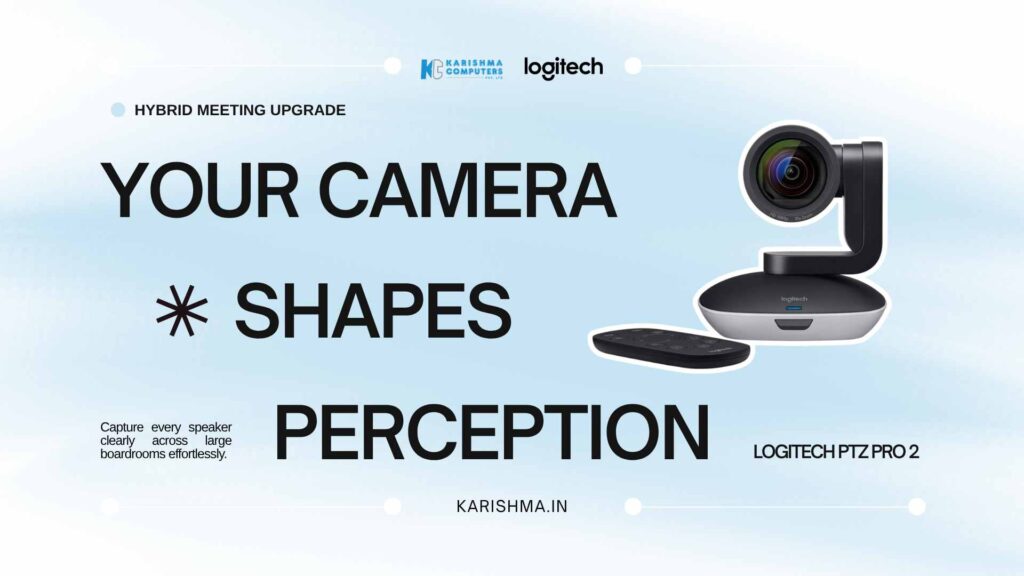
The PTZ PRO 2 is a conference-grade pan-tilt-zoom camera from Logitech’s professional video collaboration range. The relevant capabilities are in the name. Pan and tilt mean the camera can follow the speaker around the room. Zoom means it can focus on the speaker’s face when emphasis matters and pull back to show the whole team when context matters.
How the Logitech PTZ PRO 2 Camera Handles a Long Boardroom Table
A twelve-seat boardroom table is too long for any fixed-position webcam to capture meaningfully. The participants at the far end of the table become small distant figures that the remote client cannot read. The PTZ PRO 2 solves this through the combination of a ninety-degree field of view and ten-times optical zoom. The wide field captures the whole table when the meeting is in discussion mode. The optical zoom moves to the speaker when one person takes the floor. The remote client sees the meeting at the visual scale that a participant physically present in the room would naturally see it.
Why Optical Zoom Matters More Than Pixel Counts
Most fixed webcams compensate for inadequate framing through digital zoom, which is essentially cropping. Cropping degrades image quality every time it happens, because there are fewer pixels in the cropped image than in the full frame. Optical zoom, by contrast, uses the camera lens to bring the subject closer without losing pixel density. The image of the speaker at fully extended zoom remains sharp. This is what makes the PTZ PRO 2 suitable for serious client-facing video, where the difference between a sharp image and a slightly soft one is the difference between a credible meeting and an awkward one.
The Coaching That Did Not Solve the Problem
The consultancy had spent on executive presence coaching for its junior associates and on a refreshed presentation template for client decks. The coaching was useful in general terms. It did not solve the specific problem of hybrid meeting transmission. The presentation template was professionally produced. It made no difference to how the team came across through the camera.
This is the wrong turn that hybrid-working organisations routinely take. The instinct is to upgrade what is being transmitted. The actual gap is in the transmission medium. Better content through a worse camera reaches the remote audience worse than ordinary content through a better camera.
Where the Real Cost of the Old Camera Was Hiding
The cost of the fixed webcam had not been appearing under any line item called video infrastructure. It had been appearing in the consultancy’s win rate on pitches that involved remote client participation, which had quietly declined from sixty-eight to forty-nine per cent over eighteen months. It had been appearing in the partner hours invested in coaching juniors who did not need coaching. It had been appearing in the senior partner’s reluctance to put juniors in front of clients, which had constrained the firm’s ability to scale its delivery model. It had been appearing in the firm’s growing reliance on travelling partners to attend in person what could have been hybrid meetings, which was itself a cost that nobody had quite added up.
The PTZ PRO 2 absorbed it. The win rate on hybrid pitches recovered. The juniors began to read confidently in client meetings, because the camera was finally transmitting their actual capabilities. The senior partner stopped flying to Bombay for two-hour meetings that could be handled from Cyber City. The total saving in partner time alone, over a year, dwarfed the cost of the camera by a factor of many.
The Same Camera in a Healthcare Tele-Consultation Setting
The principle generalises across industries. A multi-specialty clinic in Vasant Vihar offering tele-consultation services to overseas clients had been struggling with patient confidence. The consulting doctors were excellent. The image they presented through the clinic’s original fixed webcam was not. The PTZ PRO 2 allowed the camera to frame the doctor properly during the consultation and to show diagnostic materials when relevant. Patient confidence recovered, and the clinic’s tele-consultation segment grew from a sideline to a meaningful share of revenue.
Why the PTZ PRO 2 Is Logitech’s Conference Camera of Choice for This Segment
Logitech’s RightSense suite of automatic technologies is the design philosophy that distinguishes the Logitech PTZ PRO 2 camera from generic PTZ cameras. The camera handles its own framing decisions, its own light compensation and its own focus adjustments without requiring an IT operator in the room. This matters in mid-sized professional services firms that do not have a dedicated audiovisual technician for every meeting. The camera works automatically. The meeting can begin without ceremony.
A Standalone Observation
A pattern is visible across Delhi NCR’s professional services firms right now. The hybrid meeting is treated as a slightly degraded version of the in-person meeting, which is supposed to be tolerated by everyone involved. This framing is wrong. A properly equipped hybrid meeting is not a degraded version of an in-person one. It is a different format with different requirements, and the camera is the central instrument that determines whether the format works. The Logitech PTZ PRO 2 camera is one of the products that closes this gap, because it acknowledges the format on its own terms rather than treating it as a workaround.
Karishma Computers, as a Logitech channel partner in Delhi NCR, supplies the PTZ PRO 2 across professional services firms, multi-specialty clinics, education institutions and corporate boardrooms in Cyber City Gurgaon, Aerocity, Noida Sector 62, DLF Cyber Hub and the consulting corridors of South Delhi. The camera is one of the few interventions in a hybrid boardroom that produces a visible change in how the room is experienced from outside.
FAQs
-
Q1. What is the Logitech PTZ PRO 2 camera designed for?
The Logitech PTZ PRO 2 camera is a professional conference-grade pan-tilt-zoom camera designed for medium to large boardrooms, hybrid meeting environments, classroom and tele-consultation use, and any setting where a meaningful number of participants need to be visible at appropriate framing to remote viewers. It carries Logitech’s RightSense automatic technologies for hands-free operation.
-
Q2. How wide is the camera’s field of view?
The PTZ PRO 2 has a 90-degree field of view, which is wide enough to capture a typical conference table or classroom front row without distortion. Combined with the pan-tilt mechanism, the camera can effectively cover most standard boardroom and meeting-room geometries.
-
Q3. What is the difference between optical and digital zoom on this camera?
The PTZ PRO 2 provides ten-times optical zoom, which uses the lens to bring subjects closer without losing image clarity. This is materially different from digital zoom, which crops the image and reduces resolution. Optical zoom is the relevant feature for boardroom contexts where the speaker’s face must be transmitted with clarity at distance.
-
Q4. Does the camera work with Zoom, Microsoft Teams and Google Meet?
Yes. The PTZ PRO 2 is a USB-based camera that is certified for use with Microsoft Teams, Zoom, Google Meet and most other major video collaboration platforms. It appears as a standard video source in the chosen platform without driver complications.
-
Q5. Can the PTZ PRO 2 be controlled remotely during a meeting?
Yes. The camera includes a remote control for manual pan, tilt and zoom adjustment during a meeting. It also supports automatic framing via RightSense technologies, which means most meetings do not require active operator control.
-
Q6. Where can a Delhi NCR business buy the Logitech PTZ PRO 2 camera?
Karishma Computers is a Logitech channel partner serving Delhi NCR. The PTZ PRO 2 is supplied with deployment guidance for boardrooms, consulting practices, clinics and education environments across Cyber City Gurgaon, Saket, Noida Sector 62, Aerocity and the corporate corridors of NCR.